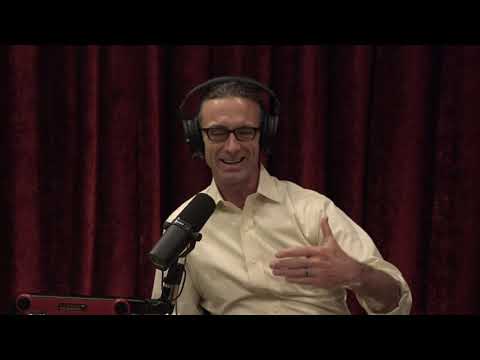
Joe Rogan Experience #1726 - Chuck Palahniuk
Chuck Palahniuk (guest), Narrator, Joe Rogan (host), Narrator, Narrator
In this episode of The Joe Rogan Experience, featuring Chuck Palahniuk and Narrator, Joe Rogan Experience #1726 - Chuck Palahniuk explores chuck Palahniuk, Censorship, Pain, and the Dark Joy of Stories Joe Rogan and Chuck Palahniuk discuss how the current climate of censorship, sensitivity, and purity tests collides with dark, transgressive fiction and comedy. Palahniuk frames his work within “absurdist existentialism,” arguing that when life feels unfixable, art must go straight into the crazy and uncomfortable. They explore why some disturbing books and creators survive cancellation, the unique intimacy of reading versus film, and how taboo, humiliation, and pain can be transformed into catharsis and connection through storytelling.
Chuck Palahniuk, Censorship, Pain, and the Dark Joy of Stories
Joe Rogan and Chuck Palahniuk discuss how the current climate of censorship, sensitivity, and purity tests collides with dark, transgressive fiction and comedy. Palahniuk frames his work within “absurdist existentialism,” arguing that when life feels unfixable, art must go straight into the crazy and uncomfortable. They explore why some disturbing books and creators survive cancellation, the unique intimacy of reading versus film, and how taboo, humiliation, and pain can be transformed into catharsis and connection through storytelling.
The conversation veers through extreme examples—Mr. Hands, zoophilia, Fight Club-style violence, self-abortion jokes, animal brutality, and bizarre porn trends—to probe what people find funny, horrifying, or off-limits, and why. Palahniuk repeatedly returns to the idea that revealing our most shameful stories lets others realize they’re not alone, turning private trauma into shared, even darkly comic, relief.
They also dig into brain trauma, risk-taking, steroids, and aging, connecting head injuries to creativity, impulsivity, and even cultural phenomena like Fight Club and legendary comics. Palahniuk shares deeply personal stories—about his father’s murder, a childhood near-amputation, psychic readings, and building a literal stone castle during lockdown—to show how fate, pattern, and pain fuel his writing.
Throughout, both men contrast performative modern discourse with older, more brutal honesty in art, arguing that real creative work often lives where society least wants to look, and that audiences still crave that dangerous honesty despite attempts to sanitize culture.
Key Takeaways
Reading’s intimacy makes truly transgressive material possible in a way film cannot.
Palahniuk argues that certain books (e. ...
Get the full analysis with uListen AI
Censorship is often selective and economic, not purely moral.
They note Mel Gibson staying uncanceled while Roseanne Barr is banished, and beloved books avoiding serious scrutiny, suggesting the real axis is: do people like you, and do you still make money for powerful interests? ...
Get the full analysis with uListen AI
Humiliation and taboo stories, when told honestly, free others from lifelong shame.
Palahniuk describes workshop stories of childhood sexual curiosity punished brutally (the heating pad girl, his friend Franz with the doll) and his own traumatic anecdotes. ...
Get the full analysis with uListen AI
There may be a real link between head trauma and radical creative or risk-taking behavior.
They discuss Roseanne Barr, Sam Kinison, Eadweard Muybridge, Rogan’s fighters, and Palahniuk himself getting badly beaten, noting that some people emerge from brain injuries more impulsive, less fearful, and more willing to take creative or physical risks—though Rogan stresses the much higher rate of lifelong damage and depression.
Get the full analysis with uListen AI
Audiences tolerate extreme human violence on screen but draw a hard line at visible animal suffering.
Palahniuk can watch hyperrealistic murder scenes but turned off a film over a duckling’s leg being cut—until he learns it was faked. ...
Get the full analysis with uListen AI
Palahniuk sees his writing as service to a “gift” that must be honored, not just a career.
Drawing on Lewis Hyde’s The Gift, he describes the idea of an inner ‘daemon’ or genius that becomes destructive if ignored. ...
Get the full analysis with uListen AI
Creative discipline thrives in constrained, communal contexts—airplanes, study halls, gyms.
Both men note they write unusually well while “trapped” on planes. ...
Get the full analysis with uListen AI
Notable Quotes
“Life is so messed up, so unfixable, that we might as well go right to the crazy.”
— Chuck Palahniuk (on absurdist existentialism)
“You have them laughing and laughing and laughing and then at the moment of the greatest laugh, you break their hearts really badly.”
— Chuck Palahniuk (on his preferred storytelling structure)
“They prove I’m not the only one… I’m not the only one that’s had these moments of complete humiliation or complete powerlessness.”
— Chuck Palahniuk (on why he loves deeply uncomfortable stories)
“Real creative work often lives where society least wants to look.”
— Paraphrased core idea from the conversation (Palahniuk’s stance)
“At some age, you realize you have to sacrifice your life for something. And I’ve decided to sacrifice my life for writing.”
— Chuck Palahniuk
Questions Answered in This Episode
How much cultural and artistic value are we losing by sanitizing uncomfortable or offensive stories to fit current norms?
Joe Rogan and Chuck Palahniuk discuss how the current climate of censorship, sensitivity, and purity tests collides with dark, transgressive fiction and comedy. ...
Get the full analysis with uListen AI
Is there an ethical line where transgressive art—especially involving real animals or real-world trauma—should not cross, even in the name of honesty?
The conversation veers through extreme examples—Mr. ...
Get the full analysis with uListen AI
To what extent do we have a moral duty to share our most shameful experiences if doing so might help others process their own?
They also dig into brain trauma, risk-taking, steroids, and aging, connecting head injuries to creativity, impulsivity, and even cultural phenomena like Fight Club and legendary comics. ...
Get the full analysis with uListen AI
Could there be responsible ways to harness the risk-taking aftermath of brain injuries or neurochemical quirks for creativity without glorifying head trauma?
Throughout, both men contrast performative modern discourse with older, more brutal honesty in art, arguing that real creative work often lives where society least wants to look, and that audiences still crave that dangerous honesty despite attempts to sanitize culture.
Get the full analysis with uListen AI
If writing and other gifts are, as Palahniuk suggests, a kind of daemon we must serve, how should that affect how we design our careers and daily lives?
Get the full analysis with uListen AI
Transcript Preview
(drumbeats) Joe Rogan podcast, check it out.
The Joe Rogan Experience.
Train by day, Joe Rogan podcast by night. All day. (instrumental music plays)
Good to see you, man.
Hey, welcome back.
Welcome back to you, too.
Yeah.
Um, I was very excited to talk to you because it's been about three years, and during those three years, it seems like censorship issues and issues of what you can and can't say and what is and isn't acceptable, they seem to be ramping up. And you are, in my mind, one of the more interesting and dangerous writers out there, because you, you tap into these super-uncomfortable stories, and you're willing to explore areas in, in writing that I think a lot of people would avoid. When we talked about this the last time you were here, some of the more dangerous stories that you, uh, had workshopped and people have gotten upset at you for. (laughs) But I really wanted to talk to you because like, I wanted to know how this is affecting you, how this, uh, weird climate of, uh, hypersensitivity and, uh, purity tests is sort of affecting your writing.
Uh, this is the dead air part.
(laughs) Scooch up to the mic.
Okay. You know, and I- I- I don't wanna kind of shoot my wad with a big term, but have you ever heard of absurdist existentialism?
No, I haven't.
Okay.
I can piece the two words together.
You know, I used to... When I look back at the books that I really loved growing up, I see that they are now under the big umbrella of the very small phenomenon called absurdist existentialism. Do you remember the book Geek Love?
Yes.
Geek Love. Could Katharine write Geek Love right now? And it's about a man and a woman who own a failing circus, and they decide the way to sa- save their circus is to have deformed babies. So, they take insecticides, they expose themselves to radiation, and they give birth to, ultimately, uh, a whole crew of severely deformed children, plus a whole crew of children that don't live, that are... In the circus culture, they're called "pickled punks," those kind of deformed babies in formaldehyde.
Yeah.
Uh, Katharine wrote that book. It was the first banner book under the new director at, at Knopf, Suni Mehta. It was one of the top-selling books of the 20th century. It was a huge success, and it really is absurdist existentialism. And the general idea is that life is so messed up, so unfixable, that we might as well go right to the crazy. And Vonnegut wrote it, Tom Robbins wrote it throughout the '70s, Still Life with A Woodpecker and Matches, Even Cowgirls Get the Blues. Uh, Nathanael West wrote it. Uh, uh, F. Scott Fitzgerald wrote it in the '20s. These people who had survived the Spanish flu and survived the First World War, and that there is a kind of a tipping point in the culture where things seem so messed up and so unfixable that you just sort of tip into this absurdist existentialism, and there's a fantastic joy and freedom in that. And so my goal is always to- to try to write the kind of book I want to read, and I want to write Geek Love because I want to read Geek Love, uh, regardless of whether or not Katharine could write it, because I don't... Even if she wasn't dead, she got, could not write that book anymore.
Install uListen to search the full transcript and get AI-powered insights
Get Full TranscriptGet more from every podcast
AI summaries, searchable transcripts, and fact-checking. Free forever.
Add to Chrome