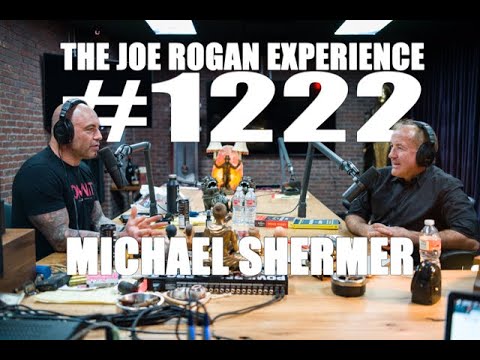
Joe Rogan Experience #1222 - Michael Shermer
Joe Rogan (host), Michael Shermer (guest), Guest (unidentified, likely in-studio friend/producer) (guest), Guest (unidentified, likely in-studio friend/producer) (guest), Narrator, Narrator
In this episode of The Joe Rogan Experience, featuring Joe Rogan and Michael Shermer, Joe Rogan Experience #1222 - Michael Shermer explores skepticism, Self-Help, and Conspiracies: Michael Shermer Dissects Belief Systems Joe Rogan and Michael Shermer range across skepticism, religion, self-help, and conspiracy theories, examining why people believe dubious claims and how those beliefs persist. They discuss psychics, astrology, self-help gurus, broken-windows policing, and the psychology behind cults like Scientology. A large portion explores how and why conspiracy theories (9/11, JFK, moon landing, chemtrails, flat earth) take hold, and what actual conspiracies (Khashoggi, Gulf of Tonkin, Saudis, Cold War plots) look like. They close by talking about moral progress, secular humanism, and whether society is becoming more rational and tolerant over time.
Skepticism, Self-Help, and Conspiracies: Michael Shermer Dissects Belief Systems
Joe Rogan and Michael Shermer range across skepticism, religion, self-help, and conspiracy theories, examining why people believe dubious claims and how those beliefs persist. They discuss psychics, astrology, self-help gurus, broken-windows policing, and the psychology behind cults like Scientology. A large portion explores how and why conspiracy theories (9/11, JFK, moon landing, chemtrails, flat earth) take hold, and what actual conspiracies (Khashoggi, Gulf of Tonkin, Saudis, Cold War plots) look like. They close by talking about moral progress, secular humanism, and whether society is becoming more rational and tolerant over time.
Key Takeaways
Vague, flattering statements fuel belief in astrology and psychics.
Shermer describes the Barnum effect and cold reading: if statements are general and positive (“you enjoy people but also value solitude”), most people see themselves in them and overlook misses, reinforcing belief in bogus readings.
Get the full analysis with uListen AI
Self-help works only when treated as ongoing practice, not a cure.
They argue motivation is like bathing or NFL two‑minute drills—you can’t sustain peak intensity; you need repeated, small habits (“small wins,” like making your bed) and realistic expectations rather than one transformative seminar.
Get the full analysis with uListen AI
Broken-windows style “small signals” can shift behavior at scale.
Cleaning graffiti, stopping turnstile jumping, and attracting “anchor” businesses helped transform places like New York’s Times Square and Old Town Pasadena by signaling that norms and order are enforced.
Get the full analysis with uListen AI
Most religious and spiritual claims about the afterlife are unfalsifiable.
Shermer emphasizes no one actually knows what happens after death; elaborate descriptions are sales pitches, not knowledge, and imagining “nothing” or “heaven” exposes how constrained our concepts are.
Get the full analysis with uListen AI
Conspiracy thinking thrives on anomalies and mismatched scale.
People feel big events must have big, orchestrated causes; they overvalue unexplained details (anomalies) and underestimate incompetence and randomness, ignoring that real conspiracies usually are smaller, leak, and involve few people.
Get the full analysis with uListen AI
Identity and tribalism distort how people process facts.
On climate change, the Google memo, or Trump, people map issues to teams (“liberal,” “patriot,” “social justice”) and then filter evidence accordingly, making persuasion via raw facts alone largely ineffective.
Get the full analysis with uListen AI
Secular, community-based ‘church alternatives’ are emerging.
Shermer notes humanist and Unitarian groups that keep ritual, community, and ethical focus while dropping supernatural claims, reflecting a broader rise in the “nones” who want meaning without dogma.
Get the full analysis with uListen AI
Notable Quotes
“Militant Agnostic: I don’t know and you don’t either.”
— Michael Shermer (quoting a bumper sticker and summarizing his book’s conclusion)
“The brain abhors a vacuum of belief.”
— Michael Shermer
“If you can’t tell the difference between a sane and insane person, what are you doing?”
— Michael Shermer (on classic psychiatric hoax experiments)
“It’s not that scientists are dogmatically closed‑minded; it’s that we can’t explain everything and you don’t have to.”
— Michael Shermer
“Everything’s crazy. Being alive is so titanically bizarre.”
— Joe Rogan
Questions Answered in This Episode
How can education systems practically teach bias-awareness in a way that changes people’s own reasoning, not just their criticism of others?
Joe Rogan and Michael Shermer range across skepticism, religion, self-help, and conspiracy theories, examining why people believe dubious claims and how those beliefs persist. ...
Get the full analysis with uListen AI
Where is the ethical line between ‘entertainer’ and ‘fraud’ for psychics, self‑help gurus, and motivational speakers?
Get the full analysis with uListen AI
What distinguishes a healthy, secular community structure from a proto‑cult as it becomes more organized and charismatic?
Get the full analysis with uListen AI
Given how sticky conspiratorial thinking is, what communication strategies actually work to de‑radicalize dedicated believers without humiliating them?
Get the full analysis with uListen AI
If moral progress is real but uneven, which current beliefs or practices are most likely to be seen as barbaric 50–100 years from now?
Get the full analysis with uListen AI
Transcript Preview
And we're live. Hello, Michael Shermer. How are you, sir?
Hello, Joe Rogan. I'm doing well, thank you. (laughs)
Good to see you. Good to see- with your pile of your writing. Look what you got there.
(laughs) Yeah, what-
You got Moral Arc, uh, Heavens on Earth. Look at you.
This is-
Skeptic magazine.
... that's the latest issue, "Why is there something rather than nothing?" We- we like to tackle the little questions.
Whoa. That's a deep one.
You've dealt with this on the show.
Yeah, too much. It's, uh, that's one that just p- uh, you know, when you're in traffic and going, "What is this?"
When you have someone like Neil or, or uh, Sean Carroll-
Yeah.
... or, or uh, Lawrence Krauss talking about this, it's like, whoa.
Yeah.
I mean, I'm not a physicist. I'm a social scientist, so for me, I, I come at it like, "What do you mean by this word nothing?" Because most of us have this idea of what it mean... Oh no, in physics, it means this other thing, like, okay. (laughs)
Yeah. Well, I think our limited understanding of what they're talking about, like, when I see those guys writing down on legal papers with all that scritchety scratchety crazy-looking-
Right.
... fake alien language-
(laughs) Right.
... mathematics, like, thank God you guys are out there. (laughs)
(laughs) Well, I opened Heavens on Earth with, "Imagine yourself dead." And, you know, most people go, "Well, uh, you know, I, I see myself in the casket and my friends and family are around," and hopefully they're mourning. Uh, no, you wouldn't see anything, of course. You- you're dead. Uh, I mean, to imagine anything, you have to be conscious and alive, so you can't even picture being dead, so you can't picture not existing. And it would be the same thing, imagine there's no universe.
Yeah.
Okay, I see blackness. No, there's no blackness. I mean, nothing would literally be, not just no light, but no-
No perception of darkness.
... n- nothing, not even nothing.
I was (sighs) going through Instagram the other day and there was this one, uh, person who was, uh, talking about the purpose of life, and when you die what's going to happen? And, uh-
Right.
... I immediately just started laughing. I'm like, "You don't know."
Right.
How are you saying this? Like, "When you die, what happens?" And he was, like, one of them spiritual-type characters who's just kind of a huckster. There's a lot of spiritual hucksters out there these days.
There are, yes. The, in the '90s, we debunked all those, the psychics talking to the dead. That was a, that, that hasn't been too popular in recent years, but that was a big thing.
Install uListen to search the full transcript and get AI-powered insights
Get Full TranscriptGet more from every podcast
AI summaries, searchable transcripts, and fact-checking. Free forever.
Add to Chrome