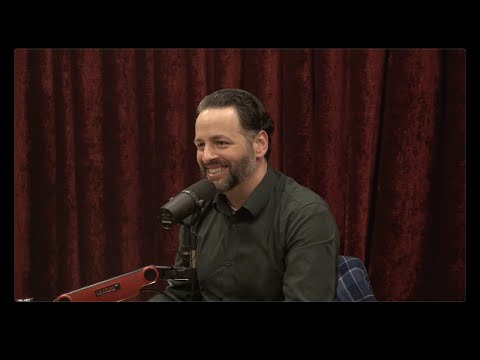
Joe Rogan Experience #2444 - Andrew Wilson
Joe Rogan (host), Andrew Wilson (guest), Joe Rogan (host), Joe Rogan (host), Joe Rogan (host)
In this episode of The Joe Rogan Experience, featuring Joe Rogan and Andrew Wilson, Joe Rogan Experience #2444 - Andrew Wilson explores rogan and Wilson discuss conspiracies, protests, immigration, and moral frameworks Rogan and Wilson open by contrasting “fun” conspiracy culture with what they see as conspiracism that escalates into credibility collapse, then pivot into nature and ecology as a reality-check against sensational explanations (Missing 411, Bigfoot, predators).
Rogan and Wilson discuss conspiracies, protests, immigration, and moral frameworks
Rogan and Wilson open by contrasting “fun” conspiracy culture with what they see as conspiracism that escalates into credibility collapse, then pivot into nature and ecology as a reality-check against sensational explanations (Missing 411, Bigfoot, predators).
The conversation shifts into political unrest and immigration enforcement, arguing recent protests are organized rather than organic, describing a “color revolution” dynamic and discussing a fatal shooting near an ICE/CBP-related incident through the lens of concealed-carry training and possible firearm malfunction.
They broaden into critiques of U.S. and U.K. institutions—legacy media incentives, NGO/charity overhead and misallocation, homelessness spending, Social Security as a political weapon, and the drift toward speech policing in the UK.
The episode closes with Wilson’s origin story (COVID-era layoffs to debating) and both men’s claim that religious/Christian frameworks foster community, forgiveness, and better mental health compared to secular/leftist ideologies they characterize as punitive and power-seeking.
Key Takeaways
Conspiracy content succeeds until it must constantly escalate.
Rogan and Wilson argue that influencers who gain attention via insider claims eventually “crash out” when they move from plausible insider topics to ever-wilder narratives (Mandela Effect, time travel), losing trust as escalation replaces evidence.
Get the full analysis with uListen AI
Many “mystery disappearances” have mundane wilderness explanations.
They contend Missing 411-style narratives ignore how quickly bodies are consumed in nature, making recoveries rare and encouraging pattern-seeking that can spiral into supernatural or conspiratorial conclusions.
Get the full analysis with uListen AI
Wildlife policy has cascading, often counterintuitive effects.
Wolf reintroduction is discussed as both potentially ecosystem-stabilizing and politically bungled when “problem wolves” are relocated into ranching areas, shifting costs onto locals and worsening conflict.
Get the full analysis with uListen AI
Sustained confrontation can be used to manufacture incidents.
Wilson describes a “mathematical formula”: prolonged nightly engagement with federal officers increases odds of an escalatory event, which then becomes propaganda fuel to validate the protest’s premise after the fact.
Get the full analysis with uListen AI
The shooting incident is framed as chaos plus bad decision-making, not simple “execution.”
They argue that physically engaging officers while armed violates concealed-carry training and that pepper spray, confusion, and a perceived gun threat can compress decision time into seconds—producing tragic outcomes regardless of intent.
Get the full analysis with uListen AI
Equipment reputation matters during crisis interpretation.
Rogan highlights the SIG P320’s history of alleged accidental/negligent discharges (especially older models), arguing that even a small possibility of malfunction complicates definitive claims about intent in a chaotic scramble.
Get the full analysis with uListen AI
Media narratives are shaped with aesthetic and emotional levers.
They cite MSNBC allegedly enhancing the deceased man’s image (while recalling CNN allegedly making Rogan look “green” during COVID) as an example of editorial choices designed to steer sympathy and outrage.
Get the full analysis with uListen AI
Immigration rhetoric has flipped, suggesting instrumental rather than principled politics.
They play older Obama and Hillary clips advocating tougher border enforcement to argue that today’s “fascism/Gestapo” framing is strategic messaging, not a consistent moral stance across time.
Get the full analysis with uListen AI
Institutions and NGOs can absorb aid money without solving problems.
They argue modern charity and public spending (homelessness, disaster relief) often routes funds through layers of nonprofits and overhead, creating incentives to maintain crises and resist audits.
Get the full analysis with uListen AI
Religious communities are portrayed as pro-social ‘software’ for society.
Both claim Christianity’s emphasis on humility, duty, and forgiveness fosters community cohesion and better mental health, contrasting it with what they describe as secular “purity” politics that punishes dissent and offers no path back.
Get the full analysis with uListen AI
Notable Quotes
“Everything has to be a wild conspiracy… it has to, like, one-up the last one.”
— Joe Rogan
“Nature has a whole plan for dead things, and it does a really good job of consuming them.”
— Joe Rogan
“The longer we’re here… the more chance of incident between federal officers and us.”
— Andrew Wilson
“You’re knocking steel against flint… waiting for sparks.”
— Joe Rogan
“When combat starts, we all roll initiative.”
— Clip played on the show (referenced as a D&D meme)
Questions Answered in This Episode
On the “color revolution” claim: what specific evidence beyond the referenced Signal chats would convince skeptics the protests are centrally coordinated?
Rogan and Wilson open by contrasting “fun” conspiracy culture with what they see as conspiracism that escalates into credibility collapse, then pivot into nature and ecology as a reality-check against sensational explanations (Missing 411, Bigfoot, predators).
Get the full analysis with uListen AI
Regarding the ICE/CBP shooting: what are the most important unknown facts (body-cam angles, weapon model/serial, holster type, trigger mods) that would settle whether it was negligence, malfunction, or justified force?
The conversation shifts into political unrest and immigration enforcement, arguing recent protests are organized rather than organic, describing a “color revolution” dynamic and discussing a fatal shooting near an ICE/CBP-related incident through the lens of concealed-carry training and possible firearm malfunction.
Get the full analysis with uListen AI
SIG P320 discussion: which documented cases are confirmed mechanical failures versus user error, and how common are they relative to other duty pistols?
They broaden into critiques of U. ...
Get the full analysis with uListen AI
You suggest local police ‘stand down’ to force federal engagement—what incentives or directives would produce that behavior, and who benefits politically?
The episode closes with Wilson’s origin story (COVID-era layoffs to debating) and both men’s claim that religious/Christian frameworks foster community, forgiveness, and better mental health compared to secular/leftist ideologies they characterize as punitive and power-seeking.
Get the full analysis with uListen AI
On immigration strategy: what concrete data supports the claim that migrants were targeted into swing states specifically to lock in Democratic power?
Get the full analysis with uListen AI
Transcript Preview
[upbeat music] Joe Rogan Podcast, check it out!
The Joe Rogan Experience.
Train by day, Joe Rogan Podcast by night, all day. [upbeat music] Prove me wrong type things, you know, way before Charlie Kirk was-
That changed my minds?
Changed my mind.
Yeah.
What does Charlie... What did Charlie say? Prove me wrong or something like that?
Yeah, it was something akin to that. My understanding was that es- essentially, uh, TPUSA ripped that idea off from Crowder.
Yeah, essentially.
Yeah. And then, uh, he w- I think he feels a lot of, like, responsibility for what happened with Kirk, because-
Is he the Mossad?
What's that?
Is he the Mossad? [laughing]
Is he the Mossad? Yeah, exactly. That's so funny. I don't know, let's k- have you got, you got Candace's number? We can ask her.
[laughing]
We can ask her.
Candace is getting, uh... She's getting dragged on Twitter today, because-
[coughs]
... uh, she's like: "I've, I've lived in Connecticut. I've never seen this much ice on trees, and, uh, it's 30 degrees out." And everybody's like, "Yeah, 30 is freezing." [laughing]
Yeah. Yeah, it's so funny. Ice on trees.
And then people are like, "This is the people- "
Do you see all the Miss Cleo memes?
Miss Cleo?
It's... Oh, it's so funny.
Who's Miss Cleo?
You remember... You don't remember the Miss Cleo-
Oh, the psychic?
Yeah, the psychic.
The psychic.
They keep on [chuckles] putting the Miss Cleo memes out for Candace, 'cause she's a psychic, you know? [laughing]
That's hilarious.
[laughing] It is funny.
I think this lighter just shit the bed. Can I borrow that other one? Thank you. Yeah.
It's really funny.
Well, Candace has painted herself into a weird corner, where everything has to be a wild conspiracy. Like, it has to be Bridget Macron's a man-
Oh, yeah, it's-
... Erika Kirk killed Charlie. It ha- it has to, like, one-up the last one, you know?
Yeah. I, uh, I was... It's really funny, you came to the same conclusion that I did. So it's like, I've seen those conspiracy channels come up before-
Mm-hmm
... and then they, they come up, and then they crash out.
[chuckles]
And the reason is, is because, like, with- for her, I think she, she had the whole, like, um, uh... She was involved with this, right? She was involved intricately with, with Kirk. She knew him.
Yeah.
And so that give- gave a lot of credibility to a lot of the things that she was saying. But then once you start moving back into, like, Mandela Effect stuff and, and-
Yeah
... you know, time travel and this and that.
Time travel.
Yeah, people are like, "Ah." [laughing]
[laughing]
"Ah."
I mean, you can do that if you're that guy, if you're Art Bell-
[laughing] Yeah
... you know, if you w- [laughing]
Well, you know, but Bell, I, I, I remember l- I used to listen to Bell all the time.
Install uListen to search the full transcript and get AI-powered insights
Get Full TranscriptGet more from every podcast
AI summaries, searchable transcripts, and fact-checking. Free forever.
Add to Chrome