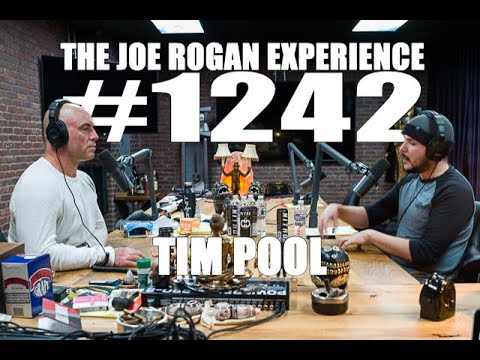
Joe Rogan Experience #1242 - Tim Pool
Joe Rogan (host), Tim Pool (guest), Guest (guest), Narrator, Narrator
In this episode of The Joe Rogan Experience, featuring Joe Rogan and Tim Pool, Joe Rogan Experience #1242 - Tim Pool explores tim Pool and Joe Rogan Dissect Big Tech Censorship, Media Bias, Polarization Joe Rogan and Tim Pool spend the episode examining how Twitter, YouTube, Patreon, and other platforms police speech, using high‑profile bans (Milo, Alex Jones, Meghan Murphy, Laura Loomer, Sargon, etc.) as case studies. They argue that enforcement is inconsistent, ideologically tilted toward a progressive/intersectional worldview, and dangerously opaque given these platforms now function as the public square. The conversation broadens into media malpractice and click‑driven incentives, Russian and domestic information warfare, culture‑war polarization, and how social and tech structures may be pushing the U.S. toward deeper civil conflict. They close by stressing the need for paths to redemption online, more viewpoint‑neutral rules, and serious scrutiny of the power held by a few unaccountable tech and media gatekeepers.
Tim Pool and Joe Rogan Dissect Big Tech Censorship, Media Bias, Polarization
Joe Rogan and Tim Pool spend the episode examining how Twitter, YouTube, Patreon, and other platforms police speech, using high‑profile bans (Milo, Alex Jones, Meghan Murphy, Laura Loomer, Sargon, etc.) as case studies. They argue that enforcement is inconsistent, ideologically tilted toward a progressive/intersectional worldview, and dangerously opaque given these platforms now function as the public square. The conversation broadens into media malpractice and click‑driven incentives, Russian and domestic information warfare, culture‑war polarization, and how social and tech structures may be pushing the U.S. toward deeper civil conflict. They close by stressing the need for paths to redemption online, more viewpoint‑neutral rules, and serious scrutiny of the power held by a few unaccountable tech and media gatekeepers.
Key Takeaways
Major platforms function as the modern public square yet operate like opaque, partisan gatekeepers.
Twitter, YouTube, and Patreon now host political discourse and livelihoods, but bans are often permanent, inconsistently justified, and shaped by internal cultural/ideological bubbles, creating effective “exile” from public debate.
Get the full analysis with uListen AI
Rule enforcement is visibly inconsistent and often tracks an intersectional/progressive bias rather than neutral principles.
Examples include permanent bans for mild or factual statements (“men aren’t women though,” “learn to code”) while open harassment or threats from ideologically favored figures sometimes go unpunished, eroding trust in the platforms’ fairness.
Get the full analysis with uListen AI
Media incentives and digital metrics are structurally pushing outlets toward rage, speed, and distortion.
Outlets rely on viral outrage and traffic games (clickbait, traffic assignment, social media piles‑on) to survive, contributing to episodes like the Covington Catholic misreporting and uncritical amplification of dubious “alternative influence network” maps.
Get the full analysis with uListen AI
Information warfare—foreign and domestic—exploits existing fractures to deepen polarization.
Russian campaigns and domestic operatives have used social platforms to amplify both sides of divisive issues (BLM vs Blue Lives, pro‑ and anti‑Trump, pro‑ and anti‑Islam), sometimes even organizing opposing rallies to physically confront each other.
Get the full analysis with uListen AI
Banning and deplatforming people hardens extremism and drives the creation of parallel ecosystems.
Removing controversial figures from mainstream platforms doesn’t erase them; it clusters them on alternative networks (Gab, alternative payment processors, Minds, etc. ...
Get the full analysis with uListen AI
Society needs clear standards and genuine paths to redemption for online offenders.
Rogan and Pool argue that, like the justice system, there should be proportional penalties and opportunities for reform; permanent bans for speech without recourse are both disproportionate and incompatible with any notion of free expression norms.
Get the full analysis with uListen AI
Identity‑based policy (intersectionality, “equity,” race‑based standards) risks deepening divisions and reshaping politics.
They highlight policies like the Green New Deal language on “economic security for the unwilling to work” and Harvard’s higher bar for Asian applicants as examples of race‑ and ideology‑driven approaches that alienate moderates and may fuel backlash populism.
Get the full analysis with uListen AI
Notable Quotes
“When you ban somebody, you exile them. They're no longer a part of that conversation.”
— Tim Pool
“You can't kill somebody and get 25 years, but you can lose Twitter for life for saying 'men aren’t women though.'”
— Tim Pool
“If Milo's banned for life... are we throwing people away?”
— Joe Rogan
“It's terrifying how easy it is to get people riled up with fake stories.”
— Tim Pool
“We’re too big. Communism works really, really well when you have like five people.”
— Tim Pool
Questions Answered in This Episode
Given their de facto monopoly over public discourse, should platforms like Twitter and YouTube be regulated more like public utilities or common carriers?
Joe Rogan and Tim Pool spend the episode examining how Twitter, YouTube, Patreon, and other platforms police speech, using high‑profile bans (Milo, Alex Jones, Meghan Murphy, Laura Loomer, Sargon, etc. ...
Get the full analysis with uListen AI
How could transparent, viewpoint‑neutral moderation standards be designed and enforced without empowering new forms of ideological capture?
Get the full analysis with uListen AI
At what point does deplatforming and financial blacklisting cross the line from private choice into a systemic civil rights or democratic legitimacy problem?
Get the full analysis with uListen AI
What practical mechanisms could be created to offer proportionate penalties and credible rehabilitation paths for users who violate platform rules?
Get the full analysis with uListen AI
How can individuals realistically protect themselves from being manipulated by outrage‑driven media, troll campaigns, and algorithmic amplification of extreme content?
Get the full analysis with uListen AI
Transcript Preview
Three, two, one. Hello, Tim.
How's it going?
Uh, thanks for finally being here.
(laughs) Yeah.
Uh, long story, right?
Oh, yeah.
Uh, I definitely drank too much coffee before we get here, so if I appear, appear like cracked out, I sw- I swear to God I'm not on pills. But, uh-
Glad to hear it.
But, um, so we had a nice conversation on the phone about deplatforming and social media. And, um, one, what was very obvious to me in talking to you was that you're way more schooled on this than I am. So that's why I wanted to have this conversation with you-
Right on.
... because-
Yeah.
... part of what was ... Like, I've re-listened to my podcast with Jack and, um, you had a good criticism of it. I agree with a lot of what you said. First of all, I agree that it was kinda boring.
Yeah.
And it was, I think, in many, for many reasons it was my fault. Uh, I don't think I prepared enough for it, and I also don't think I understood the magnitude of how other people felt about deplatforming on Twitter and, uh, in all social media, YouTube and all these different things, and what the ramifications are and how y- how much this means to people to have very clear and obviou- obvious free speech outside of very egregious examples of like threats and doxxing and things like that.
Right, right. I-
Which I think we can all agree, right?
I think this problem might be one of the, like, one of the worst problems we're facing right now politically.
Yes.
You know, the Twitter is where public discourse is happening. It's where journalists are, and this is a problem, sourcing a lot of their stories.
Yes.
So if you have somebody who's completely removed from public discourse, that, that, that's exile.
Yeah.
You know? I can, I can imagine why some people kinda lose their minds when that happens.
And, um, I think going into that conversation with him, well, that's what I wanted it to be. That's why I don't really interview people. You know, I kinda have conversations with them.
Yeah.
Occasionally we have disagreements and we, you know, we talk about things, and you know ... But it's not ... I don't have a, a, like a mandate. My only con- The, the only thing I wanted to get out of the conversation is I wanted to find out what it was like to start that organization and to have no idea when you were doing it that it was going to be essentially like one of the most important distribution at- uh, re- avenues for information.
An act- an activist buddy, an activist buddy of mine asked me if I knew why people smash windows, smash Starbucks. It's not because they think they're gonna cause damage. It's because they wanna strike a symbol down of something they view oppresses them.
Install uListen to search the full transcript and get AI-powered insights
Get Full TranscriptGet more from every podcast
AI summaries, searchable transcripts, and fact-checking. Free forever.
Add to Chrome