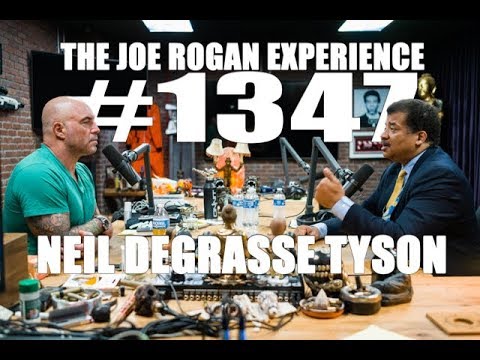
Joe Rogan Experience #1347 - Neil deGrasse Tyson
Joe Rogan (host), Neil deGrasse Tyson (guest), Joe Rogan (host), Narrator, Narrator, Narrator, Narrator, Narrator, Narrator, Narrator
In this episode of The Joe Rogan Experience, featuring Joe Rogan and Neil deGrasse Tyson, Joe Rogan Experience #1347 - Neil deGrasse Tyson explores neil deGrasse Tyson Explains Science, Art, Gravity, and Our Digital Future Neil deGrasse Tyson joins Joe Rogan for a wide-ranging conversation spanning art, physics, astronomy, climate science, technology, and privacy. They begin with Van Gogh’s ‘Starry Night’ as a gateway into how art interprets reality and elevates the mundane, then move into the role of science in society and the dangers of selective science denial. Tyson unpacks everyday physics (water, ice, skating, boiling, triple points), big-picture astrophysics (black holes, Mars, dark matter, telescopes), and how infrastructure and policy reflect hidden scientific and economic choices. They close by debating digital surveillance, targeted ads, the nature of gravity, religion’s clash and coexistence with science, and Tyson’s efforts to communicate science through letters and media.
Neil deGrasse Tyson Explains Science, Art, Gravity, and Our Digital Future
Neil deGrasse Tyson joins Joe Rogan for a wide-ranging conversation spanning art, physics, astronomy, climate science, technology, and privacy. They begin with Van Gogh’s ‘Starry Night’ as a gateway into how art interprets reality and elevates the mundane, then move into the role of science in society and the dangers of selective science denial. Tyson unpacks everyday physics (water, ice, skating, boiling, triple points), big-picture astrophysics (black holes, Mars, dark matter, telescopes), and how infrastructure and policy reflect hidden scientific and economic choices. They close by debating digital surveillance, targeted ads, the nature of gravity, religion’s clash and coexistence with science, and Tyson’s efforts to communicate science through letters and media.
Key Takeaways
Art’s power lies in expressing feeling, not just depicting reality.
Tyson uses ‘Starry Night’ to argue that great art filters reality through human emotion; Van Gogh titles the painting after the sky (the background), making the universe the subject and elevating the ordinary village into something profound.
Get the full analysis with uListen AI
Artists immortalize the mundane and can reshape history’s focus.
Examples like Paul Revere and Kilmer’s ‘Trees’ illustrate how poetry and art turn otherwise routine acts or unnoticed objects into cultural touchstones, effectively ‘beatifying’ them in the public imagination.
Get the full analysis with uListen AI
Selective science denial is widespread and cuts across ideologies.
Tyson notes conservatives often deny human-caused climate change while happily using technology, and some liberals reject vaccines or GMOs; when such denial shapes policy, it harms economic, physical, and national security.
Get the full analysis with uListen AI
Basic physics of water and ice underpins life on Earth.
Water uniquely expands when it freezes, making ice float, which insulates lakes so fish survive winter; phenomena like pipe bursts, ice skating, triple points, and boiling point changes with altitude all follow from this, demonstrating how subtle properties of water make life possible.
Get the full analysis with uListen AI
We understand how gravity behaves, even if ‘why’ remains open.
Newton described gravitational attraction mathematically; Einstein reframed gravity as the curvature of spacetime, where mass and energy tell space how to curve and space tells matter how to move—good enough to land spacecraft and run GPS, even if deeper ‘why’ questions (why mass curves spacetime) are still research frontiers.
Get the full analysis with uListen AI
Modern astronomy relies on big telescopes, but must respect local cultures.
Discussing Hawaii’s Thirty Meter Telescope, Tyson argues native Hawaiians should ultimately decide the mountain’s fate, but only after being fully informed about what astrophysics contributes to understanding our place in the universe and the practical benefits (jobs, education).
Get the full analysis with uListen AI
Our infrastructure and energy systems hide enormous scientific and economic assumptions.
From the interstate highway system (built under military/security rationale) to fossil fuel subsidies and underpriced environmental damage, Tyson emphasizes that ‘true cost’ accounting would make renewables like solar, wind, and desalination far more competitive than they appear today.
Get the full analysis with uListen AI
Digital convenience trades away privacy in subtle, escalating ways.
Voice assistants, location tracking, and targeted ads offer tailored services but build a pervasive surveillance environment; Tyson likens this to a ‘frog in slowly heated water’ and notes that what would once be seen as authoritarian monitoring is now normalized via private tech platforms.
Get the full analysis with uListen AI
Notable Quotes
“Anything that deviates from reality is reality filtered through your senses. And I think art at its highest is exactly that.”
— Neil deGrasse Tyson
“If you’re running around saying, ‘I don’t like science,’ you will die in poverty if you elect officials who believe that as well.”
— Neil deGrasse Tyson
“There is an atmospheric pressure for which water, ice, and steam coexist, and it’s called the triple point of water.”
— Neil deGrasse Tyson
“As the area of our knowledge grows, so too does the perimeter of our ignorance.”
— Neil deGrasse Tyson
“We understand gravity well enough to land a spacecraft on Mars inside a crater in a hole-in-one.”
— Neil deGrasse Tyson
Questions Answered in This Episode
How should societies balance scientific progress with indigenous rights when they conflict, as in the case of the Thirty Meter Telescope?
Neil deGrasse Tyson joins Joe Rogan for a wide-ranging conversation spanning art, physics, astronomy, climate science, technology, and privacy. ...
Get the full analysis with uListen AI
Where should we draw the line between beneficial personalization and unacceptable surveillance in our digital lives?
Get the full analysis with uListen AI
If we fully ‘true-cost’ priced fossil fuels, how quickly could solar, wind, and desalination realistically replace them?
Get the full analysis with uListen AI
Does understanding gravity as spacetime curvature change anything about how non-scientists should think about fate, free will, or meaning?
Get the full analysis with uListen AI
How can science communicators better address widespread science denial without alienating the very audiences they need to reach?
Get the full analysis with uListen AI
Transcript Preview
Hello.
Joe.
What's going on, man?
Man.
Good to see you.
Thanks, thanks. I feel a little overdressed, sorry about this.
You look good.
You know...
Oh, look at that.
A little bit of Starry Night there.
Yeah, you're really into that, huh?
Uh, yeah, I got, I got-
That's, is that-
Yeah.
That's what's on your phone as well.
So you remembered, yeah.
Yes.
Uh, yeah. Yeah, it's on the phone.
(laughs)
Starry Night, I, what, you know what I like about Starry Night? It's not what Van Gogh saw that night, it's what he felt.
How do you know what he felt?
Because this is not an a- a representation of reality.
Oh, okay.
And anything that deviates from reality is reality that has filtered through your senses. And I think art at its highest is exactly that. If this was an exact depiction of reality, it would be a photograph and I don't need the artist.
Hmm. Okay.
So, even photographs that take you to a slightly other kinda dimension as you gaze upon them, it's more than what was actually going on at the time, and that's, that's art taken to the craft of photography.
That's why you like it?
That's, uh, it's one of the reasons why. Plus I think it was the very first painting where its title is the background. Think about that. This coulda been called, uh, you know, in, in the full painting obviously, this is a, a, a snippet.
A town.
Yeah, yeah. So there's a town there, there's a cypress tree, there's a church steeple. It coulda been called Cypress Tree. It coulda been called Sleepy Village. It could've been called Rolling Hills. But no, it's called Starry Night, and everything in front of it-
Hmm.
... everything in front of it is just in the way. And how often do you paint something where the title is the background? That, that's my point. And in this particular case, the background is the universe. And so, so for me, this was a pivot point in art. And it's, uh, 1889, which is recent given the history of, of paintings and, you know, that go all the way back. So yeah, there, there it is.
Is that your favorite painting ever?
I have to say yes.
It has to be.
Yeah.
You have a vest and a phone cover.
(laughs)
If it's not, what are you doing?
Yeah, and I have-
It's-
... I have four or five ties that have this painting on them in different ways. Yeah, so-
Well, what's it, put that thing on the-
... I'm all in. I'm all in.
What's interesting is that the town is s-
Wait, wait, have you seen Starry Night in bacon? Somebody did. Look i- dig it up on the screen.
Install uListen to search the full transcript and get AI-powered insights
Get Full TranscriptGet more from every podcast
AI summaries, searchable transcripts, and fact-checking. Free forever.
Add to Chrome