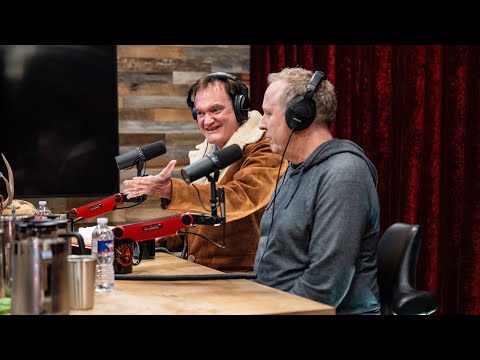
Joe Rogan Experience #2240 - Roger Avary & Quentin Tarantino
Narrator, Narrator, Joe Rogan (host), Roger Avary (guest), Quentin Tarantino (guest), Quentin Tarantino (guest), Narrator, Joe Rogan (host), Roger Avary (guest), Joe Rogan (host), Narrator, Quentin Tarantino (guest), Joe Rogan (host), Joe Rogan (host), Narrator
In this episode of The Joe Rogan Experience, featuring Narrator and Narrator, Joe Rogan Experience #2240 - Roger Avary & Quentin Tarantino explores tarantino, Avary, Rogan Dive Deep Into Film, Failure, And Redemption Joe Rogan hosts Quentin Tarantino and Roger Avary for an extended conversation that starts with wild assassin lore and California wildfires, then pivots into a rich oral history of their video-store days, early careers, and the evolution of independent film.
Tarantino, Avary, Rogan Dive Deep Into Film, Failure, And Redemption
Joe Rogan hosts Quentin Tarantino and Roger Avary for an extended conversation that starts with wild assassin lore and California wildfires, then pivots into a rich oral history of their video-store days, early careers, and the evolution of independent film.
They unpack how working at Video Archives shaped their movie education, how films like Blood Simple, Sex, Lies, and Videotape, and Kubrick’s genre work informed their own creative strategies, and how they built careers by doubling down on strong personal taste.
The trio compare the ecosystems of stand-up comedy and filmmaking, stressing the importance of proximity to scenes, mentorship, and enduring years of obscurity before “making it.”
In the final act, Avary recounts the DUI manslaughter that sent him to prison, how it obliterated his career and finances, and how incarceration, intense remorse, and writing by hand completely reshaped his outlook on life, art, and compassion.
Key Takeaways
Proximity to a real scene is more valuable than abstract ambition.
Tarantino left the South Bay for Hollywood and immediately met low-budget horror writers and directors; Rogan emphasizes how comics must be near clubs like The Comedy Store or the Mothership. ...
Get the full analysis with uListen AI
Use genre as the foundation for artistic, ‘elevated’ work.
Both Tarantino and Avary stress that centering a clear genre (bank heist, thriller, horror) lets you smuggle in art-film ambition; they cite Blood Simple, Kubrick’s filmography, and Killing Zoe as examples where a commercial hook gives you permission to experiment.
Get the full analysis with uListen AI
Curation and human taste are irreplaceable creative advantages.
At Video Archives, they became ‘the algorithm’—knowing each customer’s sensibility and steering them to under-seen gems instead of only new hits like Top Gun. ...
Get the full analysis with uListen AI
Success often follows a brutally honest audit of your own complacency.
Tarantino describes his “Quentin Detest Fest” nights, where he ruthlessly listed everything he was doing wrong, then plotted concrete changes (moving, quitting the ‘comfortable’ video-store life). ...
Get the full analysis with uListen AI
Creative identity can be chosen first, then grown into.
Avary recounts John Langley (creator of Cops) telling him, “If you want to direct, be a director,” leading him to quit a PA job, declare himself a director, and build the career around that identity. ...
Get the full analysis with uListen AI
Handwriting drafts can fundamentally change the creative process.
Both highlight that writing by hand forces overwriting and deeper connection to words, while typing becomes a later-stage rewriting and structuring pass. ...
Get the full analysis with uListen AI
Catastrophic failure can radically deepen empathy and artistic purpose.
Avary’s DUI manslaughter, incarceration, and loss of career/money shattered his previous arrogance. ...
Get the full analysis with uListen AI
Notable Quotes
““This isn’t my dream, but it’s dream-adjacent. I get to watch movies all day… That comfort put my ambitions to sleep for a few years.””
— Quentin Tarantino
““Start at the top. If you want to be a director, be a director… I quit. I’m a director.””
— Roger Avary (recounting advice from John Langley and his own response)
““He who has the strongest point of view in the room wins… Executives don’t have the strongest point of view. Film geeks do.””
— Quentin Tarantino
““You can’t write poetry on a computer… The pen is the antenna to God.””
— Quentin Tarantino
““People don’t appreciate what we have. You don’t appreciate it until it’s gone… Simple existence is the best thing there is.””
— Roger Avary
Questions Answered in This Episode
How different would Tarantino’s and Avary’s careers be if Video Archives hadn’t existed as a community hub and informal film school?
Joe Rogan hosts Quentin Tarantino and Roger Avary for an extended conversation that starts with wild assassin lore and California wildfires, then pivots into a rich oral history of their video-store days, early careers, and the evolution of independent film.
Get the full analysis with uListen AI
Is the ‘genre foundation’ strategy still the most effective way to smuggle art into today’s IP-dominated, franchise-driven film industry?
They unpack how working at Video Archives shaped their movie education, how films like Blood Simple, Sex, Lies, and Videotape, and Kubrick’s genre work informed their own creative strategies, and how they built careers by doubling down on strong personal taste.
Get the full analysis with uListen AI
What responsibilities do artists have when depicting real-world violence or moral gray zones, especially after personal experiences like Avary’s?
The trio compare the ecosystems of stand-up comedy and filmmaking, stressing the importance of proximity to scenes, mentorship, and enduring years of obscurity before “making it.”
Get the full analysis with uListen AI
How might AI-powered tools (like the Eyes Wide Shut recut Avary imagines) change authorship, restoration, and the ethics of altering a director’s work posthumously?
In the final act, Avary recounts the DUI manslaughter that sent him to prison, how it obliterated his career and finances, and how incarceration, intense remorse, and writing by hand completely reshaped his outlook on life, art, and compassion.
Get the full analysis with uListen AI
If comfort is as dangerous as they describe, how can young creatives recognize when they’re ‘dream-adjacent’ and intervene before years slip by?
Get the full analysis with uListen AI
Transcript Preview
(drumming) Joe Rogan podcast, check it out.
The Joe Rogan Experience.
Train by day, Joe Rogan podcast by night, all day. (rock music)
All right, here we go. We're rolling. So you were- you were saying that someone was telling you how to kill someone with coffee?
Okay, so I got to know all these, uh, you were talking about, uh, some-
His name's John McFee.
... yeah, some operators.
Yeah.
And, uh, I got to know through a friend, through a billionaire friend who, uh, loaned his plane to the, to Clinton to fly those people out of, uh, I think North Korea. And so from that point on, he was surrounded by these guys. And, uh, one of 'em, uh, this guy Mikey, uh, which isn't his real name. Um, I think he's actually named, they name 'em all after the archangels. So he was, like, Michael, another guy Gabriel.
Oh, Jesus.
And like-
(laughs)
... they take on these-
(laughs)
(laughs)
There's nothing creeper than an assassin with Biblical names.
Named after an archangel.
Yeah. And well, you know. And so, um, he, uh, um, you know, we got to know each other because of our mutual friend, and, uh, I think what happened was, uh, um, he and a couple of the other guys, you know, they were placed on me as, like, for surveillance purposes, like, you know, find out what this Avery guy is about maybe.
Right.
Or just keep an eye on him or whatever. And they told me right up front, like, "Be nice to your surveillance." You know, like, "Don't try to lose us or anything like that."
Right.
'Cause, uh, you know, I heard stories about how, you know, they're surveilling somebody in wherever, Bolivia, and suddenly some gang attacks their surveillance and they step in, kick the shit out of the gang. And so, um, so I got to know these guys, and naturally, you know, I'm a writer and a filmmaker, and so I of course want to talk to them about stuff, and they immediately started volunteering, "Oh yeah, we've learned all these different ways when I became an operator," blah, blah, blah. "I learned how to kill people without... And I was just making a list now of the 10 ways to kill someone without leaving a trace." And I was like, "Well," just like when I told Quentin about this, he's like, "Well, what are those?"
(laughs)
(laughs)
"I'd like to hear those." Everybody wants to hear those. And so one of the ones that I think is the best one is, uh, you inject someone with coffee, caffeine, like, uh, just inject coffee into their bloodstream, gives them a heart attack, and it's untraceable. Later on, they do an autopsy and they just discover caffeine in your system.
That's it?
Install uListen to search the full transcript and get AI-powered insights
Get Full TranscriptGet more from every podcast
AI summaries, searchable transcripts, and fact-checking. Free forever.
Add to Chrome