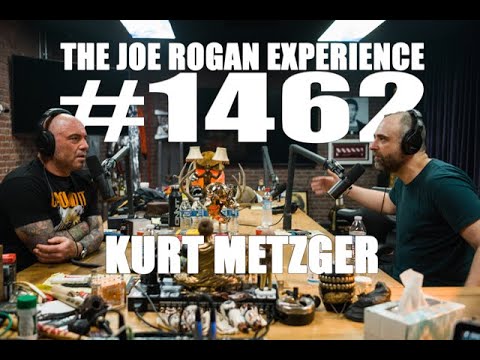
Joe Rogan Experience #1462 - Kurt Metzger
Joe Rogan (host), Kurt Metzger (guest), Narrator, Narrator, Narrator, Narrator, Narrator
In this episode of The Joe Rogan Experience, featuring Joe Rogan and Kurt Metzger, Joe Rogan Experience #1462 - Kurt Metzger explores joe Rogan, Kurt Metzger Tackle Cults, Outrage Culture, And Absurdity Joe Rogan and Kurt Metzger have a meandering, three-hour conversation that bounces from COVID testing, China, and media distrust to religion, cult psychology, and the evolution of online outrage culture. They dig into Metzger’s Jehovah’s Witness upbringing, comparing religious dogma to modern ideological movements like social justice activism and cancel culture. Along the way they riff on everything from space dick‑pics and Nazi scientists to tiger cults, pedophile teachers, and the absurdity of woke advertising and comics. The episode is mostly comedic and anecdotal but underpinned by a recurring theme: humans’ need for belonging and how that need is exploited by institutions, media, and self‑styled gurus.
Joe Rogan, Kurt Metzger Tackle Cults, Outrage Culture, And Absurdity
Joe Rogan and Kurt Metzger have a meandering, three-hour conversation that bounces from COVID testing, China, and media distrust to religion, cult psychology, and the evolution of online outrage culture. They dig into Metzger’s Jehovah’s Witness upbringing, comparing religious dogma to modern ideological movements like social justice activism and cancel culture. Along the way they riff on everything from space dick‑pics and Nazi scientists to tiger cults, pedophile teachers, and the absurdity of woke advertising and comics. The episode is mostly comedic and anecdotal but underpinned by a recurring theme: humans’ need for belonging and how that need is exploited by institutions, media, and self‑styled gurus.
Key Takeaways
Modern ideologies often replicate cult dynamics without admitting it.
Metzger argues that social justice movements and online outrage communities mimic the rigid conformity, purity tests, and excommunication patterns he saw in Jehovah’s Witnesses—only they’ve removed the explicit religious framework while keeping the behavior.
Get the full analysis with uListen AI
People have a deep need for belonging and moral structure.
Both guests emphasize that religion and ideology fill a human craving for community and clear rules; remove one system and people will often replace it with another—sometimes something much worse or less forgiving.
Get the full analysis with uListen AI
Outrage is being commodified by media and brands.
They criticize news outlets and corporations (e. ...
Get the full analysis with uListen AI
You can’t persuade people by attacking and humiliating them.
Rogan notes that online activists often mistake hostility for righteousness; in practice, shaming and dogpiling only harden opposition and create new enemies, rather than changing minds or building coalitions.
Get the full analysis with uListen AI
Media coverage of Trump is locked in a mutually reinforcing loop.
They suggest Trump exploits the press’s addiction to his every tweet and misstep, using constant minor scandals to distract from substantive actions while media personalities lean into performative outrage that actually strengthens his brand.
Get the full analysis with uListen AI
Double standards shape how we treat abuse and misconduct.
Teacher–student sex cases and #MeToo examples are used to show that society judges similar behavior very differently depending on gender, politics, or perceived team affiliation—especially when powerful figures are involved.
Get the full analysis with uListen AI
Crisis moments expose the limits of identity politics and trivial grievances.
The pandemic context makes performative wokeness and petty cancellation battles feel increasingly hollow, highlighting how fragile these status games are when confronted with real risk, economic collapse, or mortality.
Get the full analysis with uListen AI
Notable Quotes
“I’m hyper‑vigilant to culty shit—I grew up in one.”
— Kurt Metzger
“They got rid of Jesus and kept the bullshit.”
— Kurt Metzger
“If you’re making a ton of money off preaching, you’re not supposed to get rich. How come Jesus didn’t get rich?”
— Joe Rogan
“Outrage is like a fossil fuel they’re almost out of.”
— Kurt Metzger
“If you act that way and you’re attacking people, you don’t ever get those people to change their mind.”
— Joe Rogan
Questions Answered in This Episode
How fair is the comparison between organized religion and modern online social justice movements—where does the analogy break down?
Joe Rogan and Kurt Metzger have a meandering, three-hour conversation that bounces from COVID testing, China, and media distrust to religion, cult psychology, and the evolution of online outrage culture. ...
Get the full analysis with uListen AI
If outrage is being monetized by media and brands, what concrete alternatives could realistically compete in attention and revenue?
Get the full analysis with uListen AI
How should we draw ethical lines when judging relationships with large age gaps or power imbalances, especially when gender reversals change public reaction?
Get the full analysis with uListen AI
What structural changes to news media would be needed to reduce partisan framing and restore trust without sacrificing profitability?
Get the full analysis with uListen AI
In a post‑COVID world, will the experience of real collective risk actually diminish identity‑based culture wars, or will those conflicts simply adapt to the new environment?
Get the full analysis with uListen AI
Transcript Preview
(mimicking a drum roll) And we're live.
Hey.
Look at you-
Boy.
... smoking a blunt.
I know. I've-
This is your celebratory blunt.
Holy shit, dude. I- I'm still a little bit-
(laughs)
That felt like getting a AIDS test.
(laughs)
But you're clean. You're good.
I know. It's weird. (laughs)
But you knew you were healthy. You feel good.
Yeah. I haven't felt like I had something.
So you were aware you were one of the asymptomatic people.
Yeah.
They said as many as 60 to 70% could be asymptomatic.
Right. So, like, I don't wanna-
Yeah.
... I don't have it, but then I gotta drive all the way back. (laughs)
Well, that's why it's such a creepy disease. Like, there was a Anderson Cooper thing that, that was, we were talking about it earlier, where the mayor of Las Vegas was on with Anderson Cooper.
Oh, yeah.
And, uh, he was describing to her how one asymptomatic people, person can go to a restaurant, and it showed this chart of all the people that infected, got infected by this one. So, he's trying to say to her-
How are they getting infected? Just the air?
Just the air. Yeah. So he's trying to tell... This is completely theoretical. First of all, I don't know... The, the, the people that are saying this from Chi- I mean, I, I, I mean, maybe they touched the same things, maybe there was a bunch of different factors.
Yeah.
I don't know. I'm guessing it was just because of the air. But I don't trust a goddamn thing they're saying that's coming from China.
Yeah, no, no. I wouldn't. (laughs)
If anything they say, if they're saying something, it's been approved by the government.
Right.
You know what I mean? It's not like these doctors-
What's that paper, uh, The Epoch Times? There's, like, a paper that-
Epoch? I think it's Epoch Times.
Yeah, Epoch Times. Yeah.
What is that?
They, it's like, they'll be critical of China, but I think the guy that owns it is a Falun Gong guy.
Oh.
So I've seen criticism.
What is the difference?
Well, Falun Gong's that, that persecuted Tai Chi, uh, religion in, in China.
Oh, really?
China's fucking crazy, dude. You-
Epoch Times is a multi-language newspaper.
Yeah.
It was founded in 2000 by John Tang and a group of Chinese-Americans-
Yeah.
... associated with the Falun Gang spiritual movement. So, who is he, again?
Uh, I don't know who John Tang is, but-
No, no, no. F- Falun Gang?
F-... Falun Gong is, like-
Falun Gong.
... it's like Tai Chi, but I guess China considers it a cult. (laughs)
Install uListen to search the full transcript and get AI-powered insights
Get Full TranscriptGet more from every podcast
AI summaries, searchable transcripts, and fact-checking. Free forever.
Add to Chrome