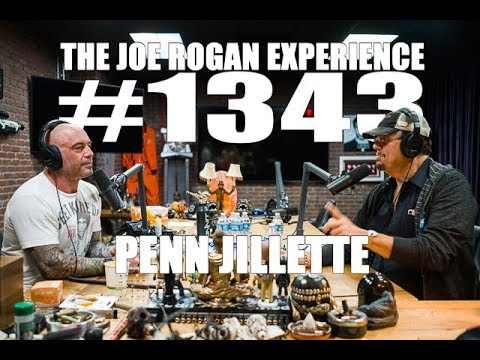
Joe Rogan Experience #1343 - Penn Jillette
Joe Rogan (host), Penn Jillette (guest), Narrator
In this episode of The Joe Rogan Experience, featuring Joe Rogan and Penn Jillette, Joe Rogan Experience #1343 - Penn Jillette explores penn Jillette, Psychedelics, Trump, and Why Teams Ruin Everything Joe Rogan and Penn Jillette have a long-form conversation that weaves through cultural pessimism, media diets, war, and Steven Pinker’s argument that human life is objectively getting better despite appearances.
Penn Jillette, Psychedelics, Trump, and Why Teams Ruin Everything
Joe Rogan and Penn Jillette have a long-form conversation that weaves through cultural pessimism, media diets, war, and Steven Pinker’s argument that human life is objectively getting better despite appearances.
They dig into Penn’s time on The Apprentice and his unsettling impressions of Donald Trump, then broaden that into a discussion of drugs, Adderall culture, and how altered states and physical health affect the mind.
Penn reflects on his drastic weight loss, becoming a vegan for health, meditation, and his ongoing struggle to dismantle his own “team” mindset in politics, art, and taste.
The episode closes with critiques of higher education, the value of self-directed learning, and how conspiracy thinking functions both as a cognitive trap and as a kind of modern intellectual “play.”
Key Takeaways
Treat information like a diet: limit junk and know your sources.
Penn and Joe stress that constant exposure to low-quality, negative, or dishonest media warps your worldview just like junk food harms your body; curate inputs deliberately and favor reliably edited sources even when you disagree with their slant.
Get the full analysis with uListen AI
Progress and catastrophe can coexist; recognize improvements without complacency.
Citing Steven Pinker, they argue violence and many social harms have declined over time, but acknowledging that progress doesn’t negate current injustices or environmental risks—it just grounds activism in reality instead of despair.
Get the full analysis with uListen AI
Beware “team” identities in politics, taste, and culture.
Penn describes how aligning with tribes (Velvet Underground vs. ...
Get the full analysis with uListen AI
Your body dramatically shapes your mind and ethics.
After losing over 100 pounds and going plant-based, Penn noticed not just physical changes but also emotional and even ethical shifts (e. ...
Get the full analysis with uListen AI
Sobriety doesn’t settle the drug question; different drugs do radically different things.
Penn has avoided recreational drugs his whole life, yet both he and Joe distinguish between destructive stimulants (e. ...
Get the full analysis with uListen AI
Conspiracy thinking is seductive but requires epistemic humility.
They use the moon-landing debate and Epstein’s death to show how anomalies and lies fuel conspiracies; Joe admits he overstated certainty in the past and now emphasizes ‘I don’t know’ over joining a definitive camp.
Get the full analysis with uListen AI
Formal college is just one path; learning can be lifelong, modular, and cheap.
They question the cost and structure of traditional college, arguing that online courses, books, podcasts, and ad hoc local study groups can deliver high-level education without crippling debt, especially if society stops treating ages 18–22 as the only “real” learning window.
Get the full analysis with uListen AI
Notable Quotes
“There’s such a fetish to suffer. It’s a fetish to say how bad things are.”
— Penn Jillette
“I’m trying so hard now to think, ‘I have two choices: one or seven billion, and there’s no teams between that.’”
— Penn Jillette
“Your body and your mind are all in the same house. If your house is filled with shit, it doesn’t help the way you think.”
— Joe Rogan
“The genius is the one who is most like himself.”
— Penn Jillette (quoting Thelonious Monk)
“I do not know whether or not people went to the moon. I was pretending that I knew that people didn’t go to the moon, and I was arguing it that way. I was on a team.”
— Joe Rogan
Questions Answered in This Episode
How can individuals realistically balance awareness of global problems with a Pinker-style recognition that many metrics of human well-being are improving?
Joe Rogan and Penn Jillette have a long-form conversation that weaves through cultural pessimism, media diets, war, and Steven Pinker’s argument that human life is objectively getting better despite appearances.
Get the full analysis with uListen AI
What practical steps can someone take to dismantle their own ‘team’ identities in politics and culture without losing a sense of belonging?
They dig into Penn’s time on The Apprentice and his unsettling impressions of Donald Trump, then broaden that into a discussion of drugs, Adderall culture, and how altered states and physical health affect the mind.
Get the full analysis with uListen AI
If the microbiome and diet can change our emotions and ethics, how much responsibility do we really have for the way we feel and what we value?
Penn reflects on his drastic weight loss, becoming a vegan for health, meditation, and his ongoing struggle to dismantle his own “team” mindset in politics, art, and taste.
Get the full analysis with uListen AI
Where should society draw the line between healthy skepticism and conspiracy thinking that corrodes trust in institutions?
The episode closes with critiques of higher education, the value of self-directed learning, and how conspiracy thinking functions both as a cognitive trap and as a kind of modern intellectual “play.”
Get the full analysis with uListen AI
Given modern technology and debt levels, what might an ideal, affordable model of higher education and lifelong learning actually look like?
Get the full analysis with uListen AI
Transcript Preview
Here we go. (singing) Oh, and we're live. Hello, Penn.
Okay. Tha- was that that quick and that easy?
That's it. It's that easy. Yeah.
Yeah.
Wonderful.
We didn't say very much interesting before it started.
No. We were-
You just starting, and then you just said, "S- shut the fuck up."
I said, "Hold that thought, please."
(laughs)
This, uh, this concept of things getting better. You know, we were talking about war. War being too... 'Cause there's a World War II helmet that, um... Shane Against the Machine is the gentleman's name. He's made me another, uh, sculpture, and he started making sculptures out of, uh, these World War II helmets with, uh, a lamp underneath it and an actual real World War II bayonet as well. And you were saying war is a terrible idea.
(laughs) Yeah. And it's going away.
You think? Really?
Real- yeah. Real- really fast. And you, you mentioned Pinker.
Yeah.
And that's... You know, everything I will say is redundant to Pinker. I mean, that, um, uh, The Better Angels of Our Nature is one of, I think, the most subversive books of our time. You know? People are... Th- there's such a, um... It's a fetish to suffer. It's a fetish to say how bad things are. People are getting really off on it. And when you start saying, you know... After you say, "One death by violence is too many." And, "We gotta clean up the environment." And da-da-da-da-da. Y- you say all that stuff and it's all true, but you can also take a breath and say things are getting better.
Yeah. I think we need to recognize that. And the, the problem is, there is, there is violence. There is horrible things. There are horrible things in the world. They, they still exist.
Mm-hmm.
And now they're magnified because of the fact that we have this ability to look at it on your phone anytime you want to.
Yeah.
Look at it on your computer anytime you want to.
You know, it's the same thing, it's the same thing... I think calories and information are identical. You know? For millions, billion-
Yeah.
... years, um, the biggest problem every living thing had was too few calories. And then for, uh, what? Maybe 75 years, a very small percentage of the animals in the world had this problem of too many calories. And there's nothing that prepares anybody for that.
Mm-hmm.
But we now have more information in one issue of the New York Times than, um, a 17th century peasant would have had in their entire life. So we have this glut of information that we're dealing with about as well as we dealt with calories. (laughs)
I talk about this quite often, but the way I describe it is diet, in that most people have a poor diet and that most people's diet is not nutritious.
Install uListen to search the full transcript and get AI-powered insights
Get Full TranscriptGet more from every podcast
AI summaries, searchable transcripts, and fact-checking. Free forever.
Add to Chrome