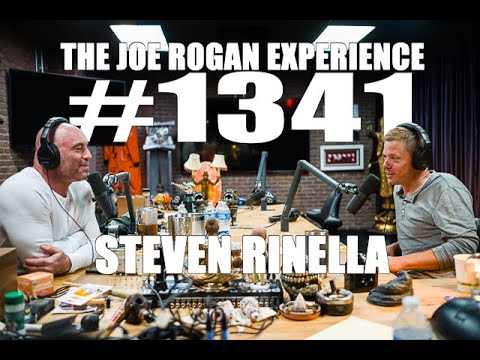
Joe Rogan Experience #1341 - Steven Rinella
Steven Rinella (guest), Joe Rogan (host)
In this episode of The Joe Rogan Experience, featuring Steven Rinella and Joe Rogan, Joe Rogan Experience #1341 - Steven Rinella explores joe Rogan and Steven Rinella Explore Hunting, Wildlife, Parenting, Purpose Joe Rogan and Steven Rinella spend a long, free‑flowing conversation moving from wild‑game cooking and hunting ethics to wildlife behavior, conservation politics, parenting, work, and mental health.
Joe Rogan and Steven Rinella Explore Hunting, Wildlife, Parenting, Purpose
Joe Rogan and Steven Rinella spend a long, free‑flowing conversation moving from wild‑game cooking and hunting ethics to wildlife behavior, conservation politics, parenting, work, and mental health.
They dig into how real contact with wildlife differs from urban and media‑driven perceptions of animals, and how hunting can be both spiritual and practical when done respectfully.
The two contrast rural and urban attitudes toward nature, discuss domestication (dogs vs. actual wild animals), and explore complex issues like invasive species management, shark finning, and public land policy.
Throughout, they come back to the importance of community, good parenting, personal responsibility, and building a meaningful life rather than just chasing success or ideology.
Key Takeaways
Think in terms of cuts, not species, when cooking wild game.
Rinella emphasizes that with most ungulates, the cut (e. ...
Get the full analysis with uListen AI
Real wildlife experience fundamentally changes how you think about animals.
Rogan notes that most people only know pets and zoo animals; sneaking up on truly wild animals, seeing their senses and reactions, shatters naive ‘I love animals’ notions and replaces them with respect rooted in reality.
Get the full analysis with uListen AI
Habituation to humans can quickly reverse when predation pressure returns.
Rinella explains that Yellowstone elk lose fear in the park but instantly behave differently once they migrate into hunted areas, suggesting how fast animals can relearn caution if hunting or predation resumes.
Get the full analysis with uListen AI
Invasive species management creates deep cultural and ethical tensions.
Hawaii’s axis deer and pigs, or goats on islands, are both cherished hunting resources and ecological problems; indigenous and local hunters often resent eradication plans that treat animals central to their culture as expendable ‘non‑natives.’
Get the full analysis with uListen AI
Resource use is judged not just by impact, but by respect and waste.
They distinguish between eating sharks or deer and practices like finning sharks alive or machine‑gunning island ungulates, arguing that visible waste and cruelty signal a lack of reverence that people instinctively recoil from.
Get the full analysis with uListen AI
Sleep and downtime are essential inputs to creativity and performance.
Rogan cites sleep science and personal experience: most Americans are under‑rested, undermining cognition, hormones, and long‑term brain health, while intentional rest and travel act like a ‘mental diet’ that replenishes creative fuel.
Get the full analysis with uListen AI
Good parenting and strong boundaries matter more than public image.
Both men stress that damaging your kids creates generational fallout; Rogan openly distances himself from narcissistic or destructive friends and evaluates people—especially in show business—by how they treat their children, not by their success.
Get the full analysis with uListen AI
Notable Quotes
“Most people who say they love animals don’t even know any. They know pets and zoo animals.”
— Joe Rogan
“When you damage your kid, you’re creating a string of decades—and maybe they’ll do the same to their kids.”
— Steven Rinella
“I can only really relax when there’s nothing I could possibly be doing—and my kids aren’t fighting.”
— Steven Rinella
“It’s possible to get there without being a piece of shit. Some people think you have to be a piece of shit to be successful. You don’t.”
— Joe Rogan
“Your comedy comes from a position of strength. So much comedy comes from self‑loathing.”
— Steven Rinella
Questions Answered in This Episode
How would urban attitudes toward hunting and wildlife change if more people had direct, non‑zoo encounters with truly wild animals?
Joe Rogan and Steven Rinella spend a long, free‑flowing conversation moving from wild‑game cooking and hunting ethics to wildlife behavior, conservation politics, parenting, work, and mental health.
Get the full analysis with uListen AI
Where should societies draw the line between protecting native ecosystems and respecting the cultural traditions built around ‘non‑native’ species?
They dig into how real contact with wildlife differs from urban and media‑driven perceptions of animals, and how hunting can be both spiritual and practical when done respectfully.
Get the full analysis with uListen AI
Is it possible to design conservation policies that honor both scientific goals and local hunting cultures without defaulting to total eradication or total protection?
The two contrast rural and urban attitudes toward nature, discuss domestication (dogs vs. ...
Get the full analysis with uListen AI
How can individuals in high‑pressure, creative careers realistically build enough sleep and leisure into their lives to avoid burnout without sacrificing ambition?
Throughout, they come back to the importance of community, good parenting, personal responsibility, and building a meaningful life rather than just chasing success or ideology.
Get the full analysis with uListen AI
What practical steps can parents take to avoid passing their own childhood damage onto their children while still pursuing demanding careers or passions?
Get the full analysis with uListen AI
Transcript Preview
What's going on with all the cigars?
Uh, which cigars? Those are not cigars. Those are marijuana.
Oh, okay. I figured it might be something like that.
(laughs) It's marijuana on the outside.
(laughs)
It's called a blunt. That's what the youngins call it. It's tobacco, you know.
Oh, no, I know the term blunt, but that looks like a leg- I thought it was, like, some kind of-
Well, you're younger than me. Of course, you, you know what you're talking about.
Yeah. I'm not as schooled as you.
(laughs)
I'm not as schooled as you in the illicit. Even though that's not a... It, it's not an illicit now.
Speaking of illicit, we got some Meateater Bourbon, some Elk Shank Bourbon.
Yeah, it pairs with-
It's a good name for it, because-
... it pairs with beaver tail.
... it pairs with beaver tail.
(laughs) Elk shank, elk shank.
I've, I've had both of those things thanks to you.
(laughs)
Elk shank's a great name for it, because that is, like, one of the rare foods. Like, if you talk to most hunters, like I said, "Have you ever had elk shank, ossobuco?"
Yeah.
They'd be like, "What?" Most, most hunters have never eaten that.
No, but it... And it was revelatory to find out about it, and then, it's the thing that, uh, I became... I started to proselytize, you know. I found out about eating it 'cause my brother found out about eating it, because he has this old cookbook called the L.L.Bean. It's like the L.L.Bean Wild Game Cookbook, um, by a guy named Angus, first name Angus, if I remember right. And he's got a shank, like, he's got a shank recipe in his book for antelope shank, and so we started making it. That, that's the funny thing about wild game cooking that you've probably picked up on, is that you could, um, you could have a thing where you could say like, "Hey, here's a recipe for a white-tailed deer heart," right? And someone would be like, "But do you have one for a mule deer heart?" Have I explained this to you before?
No. Well, they're interchangeable, aren't they?
Well, that's... Yeah, that's the thing, so.
Obviously.
Like, when we did our cookbook, I tried really hard to steer away from things that would be elk recipes, deer recipes, and just take it from a cut basis.
Your cookbook is excellent, by the way.
Have you messed around with it?
Many times, many times.
Oh, that's good. That's great.
I've cooked quite a few things from it. It's really great.
Um, we got away from saying that, like, "Here's an antelope recipe," or, or whatever, because it's just, like, the cut is more important, especially with all these ungulates, like horned and antlered game. What it is, is more important than what it came from. So, by putting elk shank on that bottle, I'm kinda, like, going against my own advice. But if I just put shank, people might not know what you're talking about.
Install uListen to search the full transcript and get AI-powered insights
Get Full TranscriptGet more from every podcast
AI summaries, searchable transcripts, and fact-checking. Free forever.
Add to Chrome