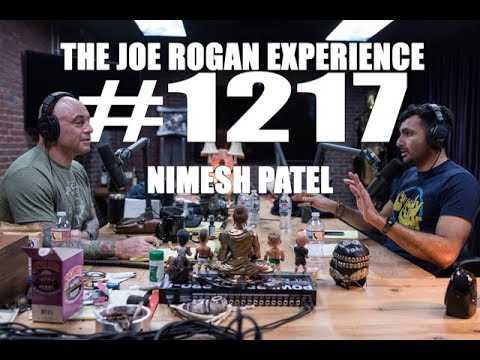
Joe Rogan Experience #1217 - Nimesh Patel
Joe Rogan (host), Nimesh Patel (guest), Jamie Vernon (guest), Narrator, Narrator, Narrator, Narrator, Jamie Vernon (guest), Narrator, Narrator
In this episode of The Joe Rogan Experience, featuring Joe Rogan and Nimesh Patel, Joe Rogan Experience #1217 - Nimesh Patel explores comic Nimesh Patel Breaks Down Columbia Censorship And Comedy’s Future Joe Rogan and comedian Nimesh Patel dissect Patel’s controversial removal mid-set from a Columbia University event after a joke about gay Black people and Mike Pence drew complaints from organizers. Patel walks through the night in detail, emphasizing that most of the crowd was enjoying the show and that a small, empowered group decided his material was “disrespectful” and “entitled.” The conversation expands into a broader critique of campus culture, political correctness, social media outrage, and how vocal minorities shape public narratives. They also dive deep into the craft and grind of stand-up, free speech boundaries, deplatforming, and how comics navigate an increasingly sensitive cultural landscape.
Comic Nimesh Patel Breaks Down Columbia Censorship And Comedy’s Future
Joe Rogan and comedian Nimesh Patel dissect Patel’s controversial removal mid-set from a Columbia University event after a joke about gay Black people and Mike Pence drew complaints from organizers. Patel walks through the night in detail, emphasizing that most of the crowd was enjoying the show and that a small, empowered group decided his material was “disrespectful” and “entitled.” The conversation expands into a broader critique of campus culture, political correctness, social media outrage, and how vocal minorities shape public narratives. They also dive deep into the craft and grind of stand-up, free speech boundaries, deplatforming, and how comics navigate an increasingly sensitive cultural landscape.
Key Takeaways
A small vocal minority can override a satisfied majority in live events.
Patel describes how three student organizers ended his set despite clear audience support, illustrating how those with procedural power or the “bullhorn” can dictate outcomes even when most attendees are engaged and unoffended.
Get the full analysis with uListen AI
Context and intent matter, but outrage culture often ignores both.
The joke that triggered Patel’s removal was meant to affirm that being gay isn’t a choice and to mock Mike Pence’s homophobia, yet critics labeled it anti-gay/anti-Black—showing how keywords (“gay,” “Black”) can trump nuance and comedic intent.
Get the full analysis with uListen AI
Political correctness on campuses can create brittle, unrealistic expectations of the real world.
Rogan and Patel argue that shielding students from uncomfortable jokes rather than engaging or debating them leaves them ill-prepared for genuine offense, conflict, and complexity outside academic “safe spaces.”
Get the full analysis with uListen AI
Stand-up comedy is an entrepreneurial craft requiring rigorous process, not casual talent.
Rogan outlines a disciplined loop of writing (sober and high), performing, recording, reviewing, and rewriting, while Patel describes upgrading his own habits after observing top comics’ maniacal work ethic.
Get the full analysis with uListen AI
Deplatforming based on off-platform speech is a dangerous precedent.
Their discussion of Patreon banning Sargon of Akkad for remarks made on another channel highlights the risk of payment and distribution platforms becoming ideological gatekeepers rather than neutral infrastructure.
Get the full analysis with uListen AI
Social media amplifies confirmation bias and shallow thinking.
Patel’s experience reading every article and DM, plus Rogan’s examples of hyper-partisan Twitter accounts, show how people can instantly find validation for any view and weaponize partial narratives against individuals.
Get the full analysis with uListen AI
Generational identity and ideology can become brittle personal brands.
They suggest many young people treat political and moral stances as identity badges, rushing to perform outrage for validation instead of engaging in slower, more self-critical thought about ideas and context.
Get the full analysis with uListen AI
Notable Quotes
““They said, ‘We think there’s a distinction between being uncomfortable and being disrespectful.’ And I’m like, ‘What? Don’t use your big words on me.’””
— Nimesh Patel
““You hired a guy to tell jokes. He tells jokes, and you say, ‘Not that joke.’””
— Joe Rogan
““If you silence someone, that’s not progress. You can’t isolate yourself from the real world like this.””
— Nimesh Patel
““There’s no solution because you’re dealing with immature people… Their frontal lobe is not fully formed yet.””
— Joe Rogan
““Comedy is the most entrepreneurial endeavor there is… There’s no boss whipping you. It’s just you telling yourself, ‘Get the work done.’””
— Nimesh Patel
Questions Answered in This Episode
Where should student organizers realistically draw the line between ‘uncomfortable’ and ‘disrespectful’ when booking comedians or speakers?
Joe Rogan and comedian Nimesh Patel dissect Patel’s controversial removal mid-set from a Columbia University event after a joke about gay Black people and Mike Pence drew complaints from organizers. ...
Get the full analysis with uListen AI
How can platforms like Patreon or Twitter fairly balance free expression with policies against hate speech without becoming political arbiters?
Get the full analysis with uListen AI
What responsibilities, if any, do comedians have to adapt their material to highly sensitive environments like elite campuses?
Get the full analysis with uListen AI
Does protecting students from offensive material ultimately help or harm their ability to handle real-world conflict and power dynamics?
Get the full analysis with uListen AI
How might comedians and audiences work together to preserve risky, honest comedy in an era of social media pile-ons and deplatforming?
Get the full analysis with uListen AI
Transcript Preview
Two, one. Fucking kids today.
Fucking kids today.
Fucking kids today.
(laughs)
Hasn't everybody said that from the beginning of time? I bet cave people were saying that shit.
Uh-huh.
You know?
Arr.
Arr, fucking kids.
(laughs)
It's just, it is what it is, right?
Yeah.
Every new group comes up, they try to reestablish themselves as smarter, you know?
Yeah.
There's the new group coming up, they're gonna change the rules.
I don't know what's so wrong with how we turned out. You know what I mean? Like-
Oh, we're a mess. (laughs)
(laughs) I mean, uh, I'm saying, not from a, like, I mean, every, I think every generation is better than the next in terms of how, like, things are just... This is the best times have ever been for most people.
Right.
But I'm saying from, like, uh, uh, how we handled things perspective, things seem... I'm, like, a fine human being. You seem like a fine hum- like, most human beings are fine, and we were raised quite, I don't wanna say differently, but a little better in my perspective than, like, uh, what's happening now. Like, what, what is being corrected is, is strange to me.
To people that don't know the story, let's fill them in on your story-
Yeah, sure.
... and how we got together.
Uh-huh.
So you're doing a gig, you're at Columbia.
Mm-hmm. So, a few months ago, uh, I got this group called the Asian American Alliance at Columbia University hit me up saying, "Hey, you know, we're big fans of your work." Um, I was the first Indian to ever write for SNL. Um, and so they were, like, that was a story in the Asian American/Indian community. And so they hit me up in, like, May or June, like, "Hey, come. We have this show in November. It's called Culture Shock." Um, it's a big, like, fashion culture kinda event. And I've done, like, tons of these before, you know? Like, 'cause my sister and I, we both went to NYU, but my sister, um, like, helped put on these kinds of shows. So I would attend them, and like I've seen them ever since high school, 'cause I went to high school in Parsippany, New Jersey, which is like a hyper-diverse kinda place. Um, at least with, like, Asians and Indian people. And, like, I went to a few in high school, and I got laid after one of them when I was in high school. So they have like a-
Congratulations.
(laughs) I lost my virginity after one of them, so like-
Oh.
It was like, they held a special place in my heart. And so, like, I went thinking, "Okay, this is gonna be fun." And, and they know who they're getting in that, you know, the email said, "We're fans of your work," like, "We want you to come do this show. It's about, like, representing Asian identities and all that." I'm like, "Dope." And that's... I get there at, like, 7:30, and I walk in, and I'm like, "Okay, I know all these kids." I mean, they're like 20 or something, but, like, I know them. I grew up with these kids, you know, like Abigails and Pratik's or whatever. Like, I know all these guys.
Install uListen to search the full transcript and get AI-powered insights
Get Full TranscriptGet more from every podcast
AI summaries, searchable transcripts, and fact-checking. Free forever.
Add to Chrome