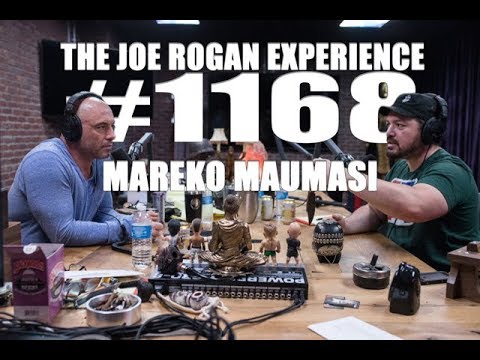
Joe Rogan Experience #1168 - Mareko Maumasi
Mareko Maumasi (guest), Joe Rogan (host), Guest (secondary clip/reading) (guest), Guest (secondary clip/reading) (guest)
In this episode of The Joe Rogan Experience, featuring Mareko Maumasi and Joe Rogan, Joe Rogan Experience #1168 - Mareko Maumasi explores joe Rogan Explores Lost Craft of Knifemaking With Mareko Maumasi Joe Rogan talks with master bladesmith Mareko Maumasi about the art, history, and culture of handmade knives, including blades forged with meteorite steel and ancient materials like bog oak and antler.
Joe Rogan Explores Lost Craft of Knifemaking With Mareko Maumasi
Joe Rogan talks with master bladesmith Mareko Maumasi about the art, history, and culture of handmade knives, including blades forged with meteorite steel and ancient materials like bog oak and antler.
They dig into why craftsmanship is resurging in a hyper-digital world, and how making tangible objects provides meaning, pride, and connection that many modern jobs lack.
Maumasi explains in detail how Damascus and high‑carbon steels are made, forged, heat‑treated, and sharpened, contrasting handmade performance with mass‑produced knives and even hunting broadheads.
The conversation branches into topics like morphic resonance, meditation, wild game, parenting, and regional life, but always circles back to the value of hands‑on work and the ‘soul’ in crafted objects.
Key Takeaways
Handmade tools carry emotional and experiential value beyond function.
Rogan and Maumasi argue that when someone invests time, skill, and even blood into making a knife, table, or cue, the owner feels a deeper connection and treats it with more care than any mass‑produced equivalent.
Get the full analysis with uListen AI
Forging and pattern‑welding are complex skills that dramatically affect performance.
True Damascus (pattern‑welded) steel involves stacking, heating, and forging different high‑carbon steels into intricate patterns; done correctly, it produces blades that combine aesthetics with excellent edge retention and toughness.
Get the full analysis with uListen AI
Heat treatment and geometry matter more than most people realize.
Maumasi explains that hardness vs. ...
Get the full analysis with uListen AI
Cheap sharpening gadgets often destroy knives over time.
Pull‑through sharpeners and electric machines remove metal unevenly and can dish out the edge near the heel, effectively shortening blade life; learning proper stone or professional sharpening preserves performance and value.
Get the full analysis with uListen AI
Using natural, storied materials adds depth and uniqueness to a blade.
Handles made from moose and elk antler, ancient bog oak, or meteorite infuse knives with history, texture, and grip properties that synthetics can’t fully replicate, turning tools into heirloom objects.
Get the full analysis with uListen AI
Working with your hands can answer a psychological need for achievement.
They contrast “data entry” style work with the satisfaction of finishing a physical object—students walk away from Maumasi’s knife classes proud of imperfect blades because they can literally hold their achievement.
Get the full analysis with uListen AI
High‑quality wild and pasture‑raised meat feels and performs differently in the body.
Rogan notes that wild game like elk, moose, and axis deer has higher protein density and a distinct ‘energy’ compared to feedlot meat, reinforcing his belief in sourcing and cooking as an extension of craftsmanship.
Get the full analysis with uListen AI
Notable Quotes
“There’s a piece of space in there.”
— Joe Rogan (on his meteorite‑steel knife)
“People are driven by a sense of achievement, and when you’re doing data entry that literally millions of people can be trained to do… it’s very, very different from making something with your hands.”
— Mareko Maumasi
“Even if I taught a class and the knife looks like a turd, they’re gonna think it’s the most beautiful knife they’ve ever seen because their sweat and probably some of their blood went into it.”
— Mareko Maumasi
“You can buy a knife from the store and it’ll work, but it doesn’t feel the same. It’s not the same thing.”
— Joe Rogan
“Doing this craft is the first time I’ve ever had anything that I felt like I could give back with.”
— Mareko Maumasi
Questions Answered in This Episode
How does the resurgence of handmade knives fit into broader shifts toward analog, “farm‑to‑table” and artisanal culture in a digital age?
Joe Rogan talks with master bladesmith Mareko Maumasi about the art, history, and culture of handmade knives, including blades forged with meteorite steel and ancient materials like bog oak and antler.
Get the full analysis with uListen AI
What specific failures or mistakes taught Maumasi the most about forging and heat‑treating high‑performance blades?
They dig into why craftsmanship is resurging in a hyper-digital world, and how making tangible objects provides meaning, pride, and connection that many modern jobs lack.
Get the full analysis with uListen AI
How might widespread access to high‑quality tools change people’s relationship to cooking, hunting, or everyday tasks?
Maumasi explains in detail how Damascus and high‑carbon steels are made, forged, heat‑treated, and sharpened, contrasting handmade performance with mass‑produced knives and even hunting broadheads.
Get the full analysis with uListen AI
To what extent do you believe objects can carry “memory” or energetic residue from their makers, beyond sentimental perception?
The conversation branches into topics like morphic resonance, meditation, wild game, parenting, and regional life, but always circles back to the value of hands‑on work and the ‘soul’ in crafted objects.
Get the full analysis with uListen AI
If you wanted to start learning a physical craft today, what beginner‑friendly path or discipline would provide the same sense of meaning Maumasi finds in knifemaking?
Get the full analysis with uListen AI
Transcript Preview
... (humming)
Four, three, two, one. Boom! The lost art of- of knife making-
(laughs)
... it's still alive. How are you, man?
I'm doing good, man. I really-
Thanks for coming down here. I appreciate it.
... I, I'm fucking huge. I really appreciate you having me down.
Hey, listen, man. You've made two awesome, well, four awesome knives for me, but this one, um, is one I use all the time that, uh, I've posted on Instagram that people freak out, as we were talking about before the podcast. It actually has meteor in it.
Yeah.
Meteorite. What's ... Meteor's a big one? Meteorite's a little one? Is that the idea? Do you know?
I guess. (laughs) Yeah. I don't-
You should know.
(laughs) I- j-
You're the knife maker.
So, I didn't actually make ... So I made the knife, I forged the knife, but the steel is, is a very special kind of steel that very few people can actually manufacture on a small scale in the world. And that was made by my shop mate, Peter Swarsberg. And so he, um ... The meteorite is kind of a, a small element in the whole matrix because most meteorite is, uh, all nickel or all iron or something like that and this one particularly is a lot of nickel and some cobalt and if you're gonna make a- an actual usable steel out of it, you can't really use a whole lot of it in the overall mixture.
Mm. So is there any meteorites that are made out of all iron?
Yeah, definitely.
You just have to find 'em?
You just gotta find the ones. Yeah, and there, there are impact sites all over the world. Like they're hitting the world all the time. Uh-
How ... So wh- ... Is it w- ... Can you just take 'em? Like when they land, is it yours if you find it?
Yep. They-
Like you don't have to report it to NASA or anything, right?
No. No. Um-
"Hey, bro."
(laughs)
"Found some space junk."
Most of them are, are, are so small that they ... By the time they-
Get here.
... wh- hit the actual Earth's surface-
Mm-hmm.
... they've completely disintegrated or burned up. So it's the really massive ones and this was part of, uh, an impact, I think, in South America.
Oh, wow.
I can't remember where exactly. (laughs)
This is crazy to think-
On, on top of a ball-
... that there's a piece of space in there.
Fuck yeah, dude.
There's a dope pattern. Um, I'm really into craftsmanship, man. I've, I always have been. I love handmade pool cues and this desk, which is a handmade desk.
Yeah.
And I feel like it's one of the things that I really appreciate in this modern digital world, and I also feel like, unfortunately, it may be one of the things that's slipping away.
Install uListen to search the full transcript and get AI-powered insights
Get Full TranscriptGet more from every podcast
AI summaries, searchable transcripts, and fact-checking. Free forever.
Add to Chrome