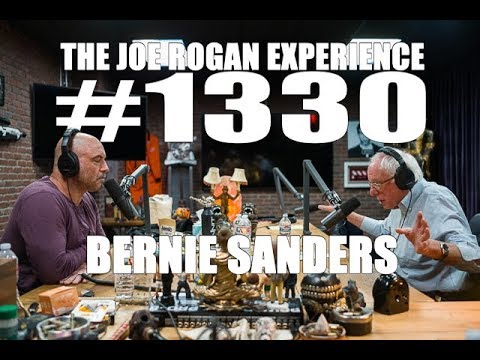
Joe Rogan Experience #1330 - Bernie Sanders
Joe Rogan (host), Bernie Sanders (guest)
In this episode of The Joe Rogan Experience, featuring Joe Rogan and Bernie Sanders, Joe Rogan Experience #1330 - Bernie Sanders explores bernie Sanders details political revolution, healthcare overhaul, and climate urgency Bernie Sanders joins Joe Rogan to critique modern political debates and the media’s preference for sound bites over substantive discussion, arguing for longer-form, policy-focused communication with voters.
Bernie Sanders details political revolution, healthcare overhaul, and climate urgency
Bernie Sanders joins Joe Rogan to critique modern political debates and the media’s preference for sound bites over substantive discussion, arguing for longer-form, policy-focused communication with voters.
He lays out his core agenda: Medicare for All, free public college and student debt cancellation via a Wall Street transaction tax, a $15 federal minimum wage, aggressive climate action, and major criminal justice reforms.
Sanders repeatedly identifies concentrated corporate wealth and lobbying power—especially from pharmaceutical, fossil fuel, and financial industries—as the central obstacle to these reforms.
They also examine guns and mass shootings, mental health, drugs and addiction, and distressed communities, with Sanders framing broad social investment and mass civic mobilization as the only path to lasting structural change.
Key Takeaways
Televised debates encourage sound bites, not serious policy discussion.
Sanders argues that 45–second answers reduce complex issues like healthcare to entertainment, and calls for legally mandated blocks of uninterrupted airtime (similar to the UK) so candidates can explain policies in depth.
Get the full analysis with uListen AI
Medicare for All is framed as a cost-efficient, non-radical extension of existing programs.
He proposes expanding Medicare to all ages over four years and adding dental, vision, and hearing, claiming it would match systems like Canada’s that cover everyone at roughly half the U. ...
Get the full analysis with uListen AI
Corporate money and lobbying structurally block popular reforms.
Sanders cites billions spent by drug companies and the ability of corporations like Amazon to pay no federal income tax as evidence that wealthy interests write the rules, leading to policies that favor billionaires over working people.
Get the full analysis with uListen AI
Free public college and canceling student debt would be funded by a tiny tax on financial trades.
He proposes a financial transaction tax of under 0. ...
Get the full analysis with uListen AI
Gun reform must combine tighter regulation with respect for responsible ownership.
Sanders supports universal background checks, closing gun show loopholes, banning new assault weapon sales, and stricter licensing—while acknowledging the cultural place of guns and the legitimacy of law‑abiding owners.
Get the full analysis with uListen AI
Addiction and the opioid crisis are tied to “diseases of despair.”
He links drug abuse, alcoholism, and suicide to economic collapse, lack of healthcare, and hopelessness in both rural and urban areas, arguing that prevention requires jobs, education, community rebuilding, and universal mental health care.
Get the full analysis with uListen AI
Climate change requires a WWII‑scale mobilization and global cooperation.
Calling it the top national security threat, Sanders wants to phase out fossil fuels, massively expand efficiency and renewables, protect workers through a “just transition,” and push countries like China and Russia to redirect military spending into saving the planet.
Get the full analysis with uListen AI
Notable Quotes
“You can't explain the complexity of healthcare in America in 45 seconds. Nobody can.”
— Bernie Sanders
“The function of the current healthcare system is not to provide quality care to all; it is to make tens of billions of dollars in profit for the drug companies and the insurance companies.”
— Bernie Sanders
“Three people own more wealth than the bottom half of American society.”
— Bernie Sanders
“The only way that change takes place is when ordinary people come together and stand up and fight and say that the status quo is not working.”
— Bernie Sanders
“Mental health is healthcare.”
— Bernie Sanders
Questions Answered in This Episode
How realistic is Sanders’ claim that Medicare for All can be implemented nationwide within four years without major system disruption?
Bernie Sanders joins Joe Rogan to critique modern political debates and the media’s preference for sound bites over substantive discussion, arguing for longer-form, policy-focused communication with voters.
Get the full analysis with uListen AI
What unintended consequences might arise from a financial transaction tax used to fund free college and student debt cancellation?
He lays out his core agenda: Medicare for All, free public college and student debt cancellation via a Wall Street transaction tax, a $15 federal minimum wage, aggressive climate action, and major criminal justice reforms.
Get the full analysis with uListen AI
Can strong gun control measures like an assault weapons ban coexist with a robust interpretation of the Second Amendment that gun owners will accept?
Sanders repeatedly identifies concentrated corporate wealth and lobbying power—especially from pharmaceutical, fossil fuel, and financial industries—as the central obstacle to these reforms.
Get the full analysis with uListen AI
How would a rapid transition away from fossil fuels practically protect workers and communities that currently depend on those industries?
They also examine guns and mass shootings, mental health, drugs and addiction, and distressed communities, with Sanders framing broad social investment and mass civic mobilization as the only path to lasting structural change.
Get the full analysis with uListen AI
To what extent can large-scale social despair—and the resulting addiction and violence—actually be alleviated by federal economic and healthcare policy changes?
Get the full analysis with uListen AI
Transcript Preview
And we're live. Hello, Bernie.
How are you, Joe?
Wonderful. Pleasure to meet you.
Nice to meet you.
It's exciting to have you here, man. And it's, uh, obviously an, an exciting time for you. Um, you know, presidential campaign is up in full swing. Do you, uh, do you get frustrated by the, the time constraints of the debates?
Uh, absolutely. It's... You shouldn't even call them a debate. Uh, what they are is a, um, you know, reality TV show in which you have to come up with a sound bite and all that stuff. And it's the meaning, it's the meaning to the candidates and it's the meaning to the American people. You can't explain the complexity of healthcare in America in 45 seconds. Nobody can.
But, uh, why is still done that way? Have you tried to... Let's pull this thing. Like, bring it right there. There you go.
Um, you know, I think the DNC is in a difficult position. They have 20-plus candidates and they want to give everybody a fair shot, which is, is the right thing to do. Uh, and then if you're gonna have 10 candidates up on the stage, what do you do? But there are other ways that we've got to do it, because the issues facing this country are so enormous and in some cases, so complicated, nobody in the world can honestly explain them in 45 seconds. And then that, what encourages people to do is to come up with sound bites or do absurd things. So if I yelled and scream on the show, I took my clothes off, uh, we get a lot of publicity, right?
Yeah.
But if you give a thoughtful answer to a complicated question, it's not so sexy for the media.
But you don't even have a chance to give a thoughtful answer. Like, uh, Tulsi Gabbard went after Kamala Harris, and then Kamala Harris had about 12 seconds to reply to it.
Yeah.
It was so ridiculous. To, to, to have something that's such an important issue, like, did you or did you not put all those people in jail for marijuana? Did you laugh about it? Did this happen? Did that happen? All these different things. Was, was evidence withheld?
Right.
That's a... They, these are long conversations.
Well, but it takes us to another issue, and that as a nation, we do a pretty bad job in analyzing and discussing the serious issues facing our country. And I, I hold the media to some degree responsible for that. You know, other countries, what they do is say, "Joe, you want to run for president? I'll tell you what, whether your party in the general election, we're going to give you a certain amount of time, hours, on television. And you use those hours any way you want. You want a 15-minute discourse?" You remember Ross Perot?
Install uListen to search the full transcript and get AI-powered insights
Get Full TranscriptGet more from every podcast
AI summaries, searchable transcripts, and fact-checking. Free forever.
Add to Chrome