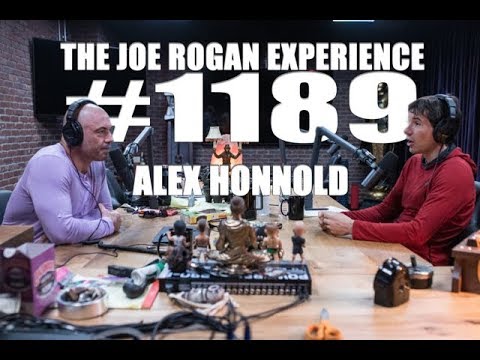
Joe Rogan Experience #1189 - Alex Honnold
Alex Honnold (guest), Joe Rogan (host), Narrator, Narrator
In this episode of The Joe Rogan Experience, featuring Alex Honnold and Joe Rogan, Joe Rogan Experience #1189 - Alex Honnold explores alex Honnold Dissects Risk, Mastery, And Meaning Beyond Free Soloing Alex Honnold joins Joe Rogan to discuss the mental, physical, and logistical preparation behind his historic free solo of El Capitan and how the film "Free Solo" portrays that achievement. They explore risk management, complacency, and why cutting‑edge free soloists rarely die on their hardest climbs but more often on "easy" terrain. Honnold contrasts his quiet, intentional climbing life with the chaos of media attention, film tours, and corporate speaking, and explains how he uses his growing platform to advance solar energy through the Honnold Foundation. The conversation ranges from training, nutrition, and injuries to environmental concerns, solar power, and how he thinks about his future after achieving a lifelong climbing goal.
Alex Honnold Dissects Risk, Mastery, And Meaning Beyond Free Soloing
Alex Honnold joins Joe Rogan to discuss the mental, physical, and logistical preparation behind his historic free solo of El Capitan and how the film "Free Solo" portrays that achievement. They explore risk management, complacency, and why cutting‑edge free soloists rarely die on their hardest climbs but more often on "easy" terrain. Honnold contrasts his quiet, intentional climbing life with the chaos of media attention, film tours, and corporate speaking, and explains how he uses his growing platform to advance solar energy through the Honnold Foundation. The conversation ranges from training, nutrition, and injuries to environmental concerns, solar power, and how he thinks about his future after achieving a lifelong climbing goal.
Key Takeaways
Elite performance in free soloing is more mental than physical.
Honnold emphasizes that on climbs like El Cap, his physical output doesn’t have to be at 100%, but his mental state does—confidence, rehearsal, and psychological readiness matter more than raw strength on the day.
Get the full analysis with uListen AI
Complacency on easy terrain is more dangerous than pushing the limits.
He notes that no free soloist has died doing truly cutting‑edge solos; deaths and serious accidents often occur on easier, familiar ground where people relax, stop focusing, and make small mistakes with huge consequences.
Get the full analysis with uListen AI
Thorough, methodical preparation is his alternative to “risk-taking.”
Before free soloing El Cap, Honnold spent months rehearsing every move with a rope, visualizing the sensations (exposure, footholds, hand placements), and stripping distractions from his life so that nothing would surprise him on the wall.
Get the full analysis with uListen AI
Managing life distractions is a form of mental training.
He deliberately erased social media, stopped answering email, and spent time alone in his van before the El Cap solo to create mental space to process fear and commitment on his own terms.
Get the full analysis with uListen AI
Nutrition and lifestyle matter more as he ages and travels.
At 33, Honnold has shifted from “tray of Oreos and climb” to focusing on sleep, diet, and mostly vegetarian eating for environmental reasons, recognizing that recovery and cognitive sharpness are crucial as his schedule and body change.
Get the full analysis with uListen AI
Climbing can be objectively dangerous yet structurally safer than many impact sports.
He contrasts climbing with sports like football and fighting: in climbing you can operate safely for decades and accidents are usually rare, sudden events, whereas contact sports guarantee accumulative physical and brain trauma just by participation.
Get the full analysis with uListen AI
Solar energy is both an environmental and human‑development solution.
Through his foundation, he backs projects that provide solar access to low‑income households in the U. ...
Get the full analysis with uListen AI
Notable Quotes
“No free soloist has ever died doing anything cutting edge.”
— Alex Honnold
“The real challenge of free soloing is the psychological side, the mental side of it.”
— Alex Honnold
“Free soloing El Cap was the end of a very long path that you have to choose and really cultivate.”
— Alex Honnold
“Even if you don’t believe in climate change, is there really a downside to adopting the future sooner?”
— Alex Honnold
“I would love to inspire people to live an intentional life that they care about. I don’t necessarily feel like people all need to go free soloing.”
— Alex Honnold
Questions Answered in This Episode
How does Honnold decide when a free solo objective is acceptably safe versus unacceptably risky, and has that threshold changed since El Cap?
Alex Honnold joins Joe Rogan to discuss the mental, physical, and logistical preparation behind his historic free solo of El Capitan and how the film "Free Solo" portrays that achievement. ...
Get the full analysis with uListen AI
What specific moments on El Cap or other climbs truly scared him, and how did he manage that fear in real time?
Get the full analysis with uListen AI
Given his critique of the film’s portrayal of deaths in free soloing, what responsibilities do filmmakers have when dramatizing risk?
Get the full analysis with uListen AI
If he largely feels he’s reached the pinnacle of free soloing with El Cap, what kinds of challenges—climbing or otherwise—could be meaningful enough to pursue next?
Get the full analysis with uListen AI
How might his solar and environmental work evolve if he devoted as much structure and obsession to it as he did to climbing El Cap?
Get the full analysis with uListen AI
Transcript Preview
Should I, should I do headphones, or does it matter?
Yeah, I like headphones.
I kinda hate hearing myself that loud though.
Why? You sound good.
All right.
Why do you hate hearing yourself?
Dude.
Try to pull this sucker up, like about a fist from your face. Good to see you again, man.
Yeah, it's been a long time.
It has been.
Yeah.
With a guy like you, it's always nice to see you're still alive. (laughs)
Oh, you know, I do my best.
Do you get tired of hearing shit like that?
Oh, I don't care. I mean-
Do you get tired of like-
... I get it a lot.
... the weirdness of like interviewing with people and they're like, you know, "You know you could die? Is this scary?"
(laughs) Yeah. Yeah, that's all right though. I mean, the thing is... Yeah, it's funny, uh, touring with the film, we've been doing Q and A's every night and you get the same questions from the audience all the time.
Yeah.
And part of that is tiring. But then part of it, like people ask the same questions because they're obvious, because everybody wants to know the same things.
Right.
And I'm like, "I understand that," you know?
One of the weirdest parts of the film is when they're showing all the guys who have died from free soloing and they're-
Yeah, though actually, they didn't all die free soloing.
Oh.
That, that's actually one of the... That's probably the only thing that I take slight issue with, with the film.
Ah.
Is it's slightly hyperbolic, is the... Two of them died BASE jumping and one of them died rope jumping. They, they all were free soloists, which is kind of what the film is saying-
Uh-huh.
... that they're all free soloists who have died, but they all died in the mountains doing mountain related extreme activities, you know, not-
Yeah, that's not... That doesn't make the stories good. You got... That's like poetic license.
Yeah.
They got sneaky. (laughs)
Well, you know.
A little bit.
I mean, they, they all were free soloists, but yeah.
That's not the same though.
Yeah. No, exactly.
Yeah.
I mean, I, I prefer... The other way to look at it is that no free soloist has ever died doing anything cutting edge. That's my favorite statistic. That, uh...
What does that mean?
Like no free soloist has ever died doing hard soloing. Like basically a free, a few free soloists have died falling off a easy terrain or just falling off sort of routine or, you know, I don't know, just falling off a mountain. But none of them have ever died while doing something cutting edge, something that had never been done before or something that was, you know, hardcore.
Install uListen to search the full transcript and get AI-powered insights
Get Full TranscriptGet more from every podcast
AI summaries, searchable transcripts, and fact-checking. Free forever.
Add to Chrome