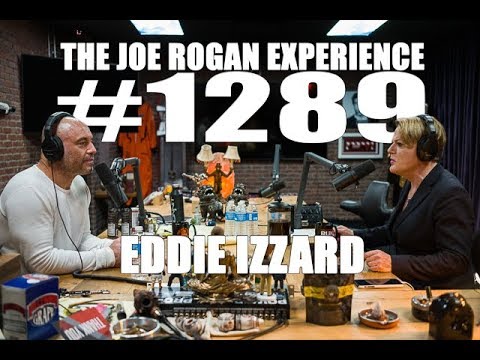
Joe Rogan Experience #1289 - Eddie Izzard
Joe Rogan (host), Eddie Izzard (guest), Joe Rogan (host), Joe Rogan (host), Joe Rogan (host), Joe Rogan (host)
In this episode of The Joe Rogan Experience, featuring Joe Rogan and Eddie Izzard, Joe Rogan Experience #1289 - Eddie Izzard explores eddie Izzard on gender, grit, global politics, and relentless comedy Joe Rogan and Eddie Izzard range widely across language quirks, travel, war, politics, gender identity, comedy, and physical endurance.
Eddie Izzard on gender, grit, global politics, and relentless comedy
Joe Rogan and Eddie Izzard range widely across language quirks, travel, war, politics, gender identity, comedy, and physical endurance.
Izzard explains coming out as transgender in the 1980s, the hostility he faced, and how he built a career while alternating between “boy mode” and “girl mode.”
He details running dozens of marathons with minimal training, including a dangerous bout of rhabdomyolysis, framing it as his own “civilian special forces” test of will.
They close by discussing optimism about humanity, global cooperation, Brexit, and Izzard’s ambitions in politics and multilingual stand-up.
Key Takeaways
Coming out early can be freeing but brutally costly in the short term.
Izzard describes coming out as transgender in 1985—well before it was accepted—as both humiliating and liberating, involving street fights, court cases, and daily abuse, but ultimately giving him internal peace and authenticity.
Get the full analysis with uListen AI
Deliberately subjecting yourself to extreme challenges can redefine how others see you.
Running 43 marathons in 51 days and later 27 in 27 days transformed public perception of Izzard from “eccentric transvestite comedian” to someone with extraordinary discipline and resilience, which he says gave him a kind of ‘civilian special forces’ credibility.
Get the full analysis with uListen AI
Endurance is more mental adaptation than physical talent.
He notes that the first 10 marathons are the hardest; afterward the body and brain adapt, healing faster and normalizing the effort, turning ‘What are you doing? ...
Get the full analysis with uListen AI
Language and culture are powerful but overrated dividers.
After performing in 45 countries and multiple languages, Izzard believes people are fundamentally similar beneath branding, politics, and sports—arguing that curiosity and travel reveal shared humanity more than media narratives suggest.
Get the full analysis with uListen AI
Improvisation can be a sustainable way to build material—if you accept constant failure.
Because of dyslexia and a background in street performance, Izzard never writes his stand-up; he talks onstage, chases odd tangents (e. ...
Get the full analysis with uListen AI
Global problems require long-term, optimistic strategy, not just outrage.
Izzard plans his life 50 years ahead and sees the next 80 years as decisive: we’ll either destroy ourselves or create a fairer world amid population growth, automation, and AI, which he wants to influence through politics and advocacy.
Get the full analysis with uListen AI
Visibility and positive role models gradually normalize previously taboo identities.
He argues that seeing transgender and LGBT people succeeding in ordinary roles—comics, politicians, athletes—shifts public attitudes over time, especially for younger generations who grow up with such figures as part of their normal world.
Get the full analysis with uListen AI
Notable Quotes
“Instead of going to do a military fighting thing, I've done Special Forces civilian division.”
— Eddie Izzard
“I plan 50 years ahead.”
— Eddie Izzard
“I'm a glass is two-thirds full person.”
— Eddie Izzard
“We have to be brave and curious rather than fearful and suspicious.”
— Eddie Izzard
“He died for us—to give us freedom of speech.”
— Eddie Izzard, on Lenny Bruce
Questions Answered in This Episode
How should sports organizations fairly balance inclusion of transgender athletes with competitive safety and fairness, especially in combat sports?
Joe Rogan and Eddie Izzard range widely across language quirks, travel, war, politics, gender identity, comedy, and physical endurance.
Get the full analysis with uListen AI
What specific policies would Eddie Izzard pursue as a ‘radical moderate’ politician to tackle automation, inequality, and population pressure?
Izzard explains coming out as transgender in the 1980s, the hostility he faced, and how he built a career while alternating between “boy mode” and “girl mode.”
Get the full analysis with uListen AI
Can the kind of extreme endurance challenges Izzard undertakes be made safer, or is serious health risk an unavoidable part of pushing human limits?
He details running dozens of marathons with minimal training, including a dangerous bout of rhabdomyolysis, framing it as his own “civilian special forces” test of will.
Get the full analysis with uListen AI
How might widespread real-time translation and future mind-reading tech change politics, propaganda, and our tolerance for lying leaders?
They close by discussing optimism about humanity, global cooperation, Brexit, and Izzard’s ambitions in politics and multilingual stand-up.
Get the full analysis with uListen AI
Is there a point where relentless optimism becomes denial—and how can we distinguish between constructive optimism and naïve hope when facing global crises?
Get the full analysis with uListen AI
Transcript Preview
Three, two, one. Boom, and we're live. How are you? What's going on?
I'm good. I'm pouring coffee in the first seconds...
Perfect.
... of our chat.
That's the good way to do it.
With a cafetiere-
Good way to-
... cafetiere, I think it is. I think that's f- f- named in a French way.
A French press? That's what they're called?
Is it called... Well, it's called a, I think it's called a cafetiere, but it's probably called a pot of coffee. But, um-
That makes sense.
But you know-
That there's a French word for it that we just ignore here in America. (laughs)
I know, 'cause they, they did invent a lot of the food. You know, 'cause you have, um, herbs. You know herbs?
Mm-hmm.
And I used to do this bit of material, which I really enjoyed saying, you know, the difference between British and American, you say this, you say that. And, uh, you say herbs and we say herbs because there's a fucking H in it.
Right.
And I used to... (laughs)
(laughs)
I used to say because there's a fucking H. But, and I thought, "Well, why has the H dropped off for America?" And I think it's because put, a lot of French guys would have come over, immigration, and they would have done a lot of cooking, you know, so now these French guys know about cooking.
Ah.
And they do the herbs, and they, they cut the H off totally. So I think that was an influence from that.
Probably Julia Child.
Julia Child? Is she French?
Yeah, I think. Wasn't she?
She is now. I think she's-
I mean, she's into French cooking.
Oh, right. Okay, but that, that-
That was her thing, right?
... Lafayette, maybe Lafayette is sitting next to Washington saying, "We will use herbs with the stuff here."
Mm-hmm.
"And then we can do the Revolutionary War and then, uh, and then you guys will win. And then, then we'll hate each other forever."
Well, you als- you guys also do a lot of weird stuff where you put, like, a U in color and you have a Y-
We have lots of-
... in tires.
What do you put in tires? You put an I?
T-I-
Yeah.
... R-E-S.
Yeah, I think we had, we had first dibs on the language. (laughs)
Yeah, I don't understand what we did it there.
No, well, you got on the, uh, your guys got on the Mayflower and they said, "Okay, we're gonna talk like this."
(laughs)
"From now on we're gonna say 'woo' a lot. And, uh, we're gonna get, put, get rid of the Y in, uh, tires. We're going to invent tires."
Install uListen to search the full transcript and get AI-powered insights
Get Full TranscriptGet more from every podcast
AI summaries, searchable transcripts, and fact-checking. Free forever.
Add to Chrome