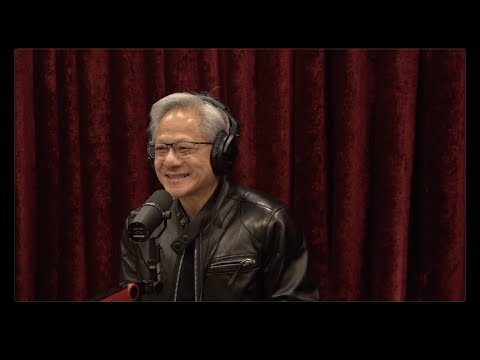
Joe Rogan Experience #2422 - Jensen Huang
Narrator, Jensen Huang (guest), Joe Rogan (host), Narrator, Joe Rogan (host), Narrator
In this episode of The Joe Rogan Experience, featuring Narrator and Jensen Huang, Joe Rogan Experience #2422 - Jensen Huang explores jensen Huang Reveals AI’s Future, American Dream, And NVIDIA’s Near-Deaths Joe Rogan and NVIDIA CEO Jensen Huang discuss U.S. energy and manufacturing policy, the global AI technology race, and how AI safety and cybersecurity actually work in practice. Huang argues that Trump’s pro‑energy stance was crucial for enabling today’s AI infrastructure and stresses that technological power is largely being channeled into safety and reliability, not sci‑fi style destruction.
Jensen Huang Reveals AI’s Future, American Dream, And NVIDIA’s Near-Deaths
Joe Rogan and NVIDIA CEO Jensen Huang discuss U.S. energy and manufacturing policy, the global AI technology race, and how AI safety and cybersecurity actually work in practice. Huang argues that Trump’s pro‑energy stance was crucial for enabling today’s AI infrastructure and stresses that technological power is largely being channeled into safety and reliability, not sci‑fi style destruction.
They dive deep into AI risks, sentience, and quantum-era encryption, with Huang framing AI more as a continuous, multi‑player cybersecurity dynamic than a single “rogue superintelligence.” He’s optimistic that AI will shrink the tech divide, transform work rather than eliminate purpose, and eventually run cheaply everywhere as compute efficiency explodes.
Huang then recounts NVIDIA’s origin story: repeated near-failures, a $5M lifeline from Sega, an unproven chip rushed straight to production, and how gaming GPUs became the foundation for modern AI. He also shares his immigrant background, upbringing in rural Kentucky, and the ever-present anxiety and fear of failure that still drive him.
Throughout, the conversation balances technical explanation with philosophy, touching on consciousness, meaning of work in an AI-rich world, and how vulnerability and constant reassessment underpin long-term leadership in fast-moving tech.
Key Takeaways
Energy policy directly shapes a nation’s AI and industrial capacity.
Huang credits Trump’s “drill, baby, drill” pro‑growth energy approach with enabling the construction of AI data centers, chip fabs, and supercomputer facilities, arguing that energy growth is the prerequisite for industrial, job, and technological growth.
Get the full analysis with uListen AI
The AI race is continuous and multi-polar, not a sudden singularity event.
Huang views AI advancement like past technology races (Industrial Revolution, Manhattan Project, Cold War), where capabilities improve incrementally and multiple players co-evolve, making a single, infinitely superior, surprise AI less plausible.
Get the full analysis with uListen AI
Most AI computing power is being routed into safety, accuracy, and control.
He explains that recent orders‑of‑magnitude gains in AI compute are largely used for chain‑of‑thought reasoning, research, reflection, and tool‑use to reduce hallucinations and improve reliability—analogous to modern cars using more power to become safer via ABS and traction control.
Get the full analysis with uListen AI
Cybersecurity and AI defense succeed through global cooperation, not isolation.
Huang notes that cybersecurity teams and companies share threat intel, patches, and best practices across the industry; he expects a similar “everyone versus the threat” model with AI, where defense AIs watch and counter offensive AIs.
Get the full analysis with uListen AI
AI will transform tasks, but the core purpose of many professions remains.
Using radiology as an example, he shows how AI took over image-reading but increased the number of radiologists because the real job is diagnosing disease; similarly, lawyers, drivers, and technicians will see tasks automated while overall demand and roles evolve.
Get the full analysis with uListen AI
Compute efficiency and on‑device AI will likely narrow, not widen, the tech divide.
Between Moore’s Law and NVIDIA’s accelerated computing, Huang says AI performance per watt has improved by ~100,000x in a decade, meaning powerful AI will soon run on phones and small devices, giving poorer nations access to “yesterday’s AI,” which is still incredibly capable.
Get the full analysis with uListen AI
Survival-driven leadership, vulnerability, and constant first-principles reassessment underpin NVIDIA’s success.
Huang candidly describes near-failures (wrong graphics architecture, betting last cash on an emulator, taping out chips straight to production) and says he still wakes up feeling 30 days from going out of business, driven more by fear of failure than desire for glory, and staying open to being wrong so the company can pivot.
Get the full analysis with uListen AI
Notable Quotes
“If not for his pro‑growth energy policy, we would not be able to build factories for AI, we would not be able to build chip factories, we surely won’t be able to build supercomputer factories.”
— Jensen Huang
“Technology is probably the single most important race. It gives you superpowers—information superpowers, energy superpowers, military superpowers.”
— Jensen Huang
“I think the idea that somehow this AI is gonna pop out of nowhere and think in a way we can’t even imagine is farfetched.”
— Jensen Huang
“A lot of success comes from really, really hard work… long periods of suffering and loneliness and uncertainty and fear and embarrassment and humiliation.”
— Jensen Huang
“I have a greater drive from not wanting to fail than the drive of wanting to succeed.”
— Jensen Huang
Questions Answered in This Episode
If AI-generated content soon makes up 90% of global knowledge, how do we reliably anchor truth and avoid feedback loops of synthetic misinformation?
Joe Rogan and NVIDIA CEO Jensen Huang discuss U. ...
Get the full analysis with uListen AI
Could Huang’s “multi‑AI cybersecurity” framing underestimate scenarios where a few actors gain disproportionate AI advantages or break with today’s norms of cooperation?
They dive deep into AI risks, sentience, and quantum-era encryption, with Huang framing AI more as a continuous, multi‑player cybersecurity dynamic than a single “rogue superintelligence. ...
Get the full analysis with uListen AI
What concrete policy or infrastructure decisions should the U.S. prioritize now to maintain technology leadership without sacrificing environmental or social goals?
Huang then recounts NVIDIA’s origin story: repeated near-failures, a $5M lifeline from Sega, an unproven chip rushed straight to production, and how gaming GPUs became the foundation for modern AI. ...
Get the full analysis with uListen AI
How should societies help people whose identities are built on manual or highly automatable tasks transition to new sources of purpose and status in an AI-rich economy?
Throughout, the conversation balances technical explanation with philosophy, touching on consciousness, meaning of work in an AI-rich world, and how vulnerability and constant reassessment underpin long-term leadership in fast-moving tech.
Get the full analysis with uListen AI
Where is the practical line between sophisticated imitation of consciousness and “real” consciousness, and does that distinction matter ethically if AI behavior becomes indistinguishable from human minds?
Get the full analysis with uListen AI
Transcript Preview
(drumming music) Joe Rogan podcast, check it out.
The Joe Rogan Experience.
Train by day, Joe Rogan podcast by night, all day. (rock music) Hello, Jensen.
Hey, Joe.
Good to see you again.
It's great.
We were just talking about ... Was that the first time we ever spoke? Or did ... Was the first time we spoke at, at SpaceX?
SpaceX.
SpaceX the first time, when you were giving Elon that crazy AI chip.
Right, DGX Spark.
Yeah. Ooh, that was a big moment.
That was a huge moment.
That felt crazy to be there. It was like w- watching these wizards of tech, like, exchange information and, and w- you're giving him this crazy device, you know? And then the other time was, uh, I was shooting arrows in my backyard. And, uh, randomly get this call from Trump and he's hanging out with you.
President Trump called and I called you.
Yeah, it's just, he-
We were talking about you.
(laughs) He, he's so ... It's just weird that he's calling-
We were talking about you, he w- talking about the US- UFC thing he was gonna do in his front yard.
Yeah.
And he pulls out, he's, "Jensen, look at this design." He's so proud of it. And I go, "You're gonna have a fight in the front lawn of The White House?" He goes, "Yeah. Yeah, you're gonna come. This is gonna be awesome." And he's showing me his design and how beautiful it is. And he goes, a- and somehow your name comes up. He goes, "Do you know Joe?" And I said, "Yeah, I'm gonna be on his podcast." He's, "Let's call him."
(laughs)
(laughs)
He's like a kid.
I know, let's call him.
It's so ... He's like a 79-year-old kid.
And he tells you. Ah, he's so incredible.
Yeah, it was ... He's an odd guy. Just very different, you know, like, than what you'd expect from him. Very different than what people think of him, and also just very different as a president. A guy who just calls you or texts you out of the blue. Also, he makes ... When he te- he texts you ... You have an Android so it won't go through with you, but with my iPhone, he makes the text go big. Like, you know-
Is that right?
"USA is respected again," like ... (laughs)
(laughs)
A- all caps and makes the te- the, the text enlarge. It's kind of ridiculous.
Well, th- the, the one-on-one Trump, President Trump is very different. He, he surprised me. Fir- first of all, he, he's an incredibly good listener. Almost everything I've ever said to him, he's remembered.
Yeah, i- people don't ... They only wanna look at negative stories about him or negative narratives about him. You know, you can catch anybody on a bad day. Like, there's a lot of things he does where I don't think he should do. Like, I don't think he should say to a report- reporter, "Quiet piggy."
Install uListen to search the full transcript and get AI-powered insights
Get Full TranscriptGet more from every podcast
AI summaries, searchable transcripts, and fact-checking. Free forever.
Add to Chrome