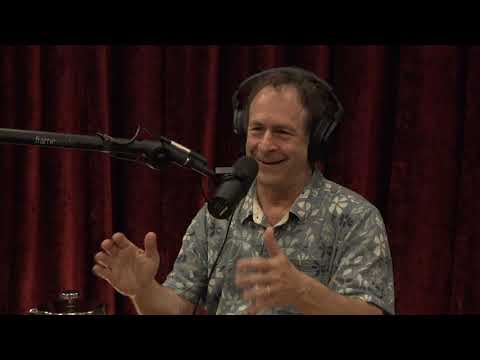
Joe Rogan Experience #1661 - Rick Doblin
Joe Rogan (host), Narrator, Rick Doblin (guest), Guest (guest), Guest (guest)
In this episode of The Joe Rogan Experience, featuring Joe Rogan and Narrator, Joe Rogan Experience #1661 - Rick Doblin explores rick Doblin Explains How Psychedelics Could Transform Trauma, War, Prisons, Politics Joe Rogan and MAPS founder Rick Doblin discuss the clinical, political, and cultural transformation underway around psychedelics, especially MDMA-assisted therapy for PTSD. Doblin explains decades of MAPS’ work to move MDMA from a stigmatized party drug to an FDA‑approved medicine, including phase III trial results, training therapists, and navigating FDA and DEA bureaucracy.
Rick Doblin Explains How Psychedelics Could Transform Trauma, War, Prisons, Politics
Joe Rogan and MAPS founder Rick Doblin discuss the clinical, political, and cultural transformation underway around psychedelics, especially MDMA-assisted therapy for PTSD. Doblin explains decades of MAPS’ work to move MDMA from a stigmatized party drug to an FDA‑approved medicine, including phase III trial results, training therapists, and navigating FDA and DEA bureaucracy.
They dive into using psychedelics with veterans, police, prisoners, refugees, and torture survivors, emphasizing that drugs are tools whose power depends on context, preparation, and integration—not one‑dose miracle cures. The conversation also explores historical psychedelic research, spiritual experiences, education reform, and how mass psychedelic access could shift society toward greater empathy and reduced violence.
Doblin outlines a near‑term future of thousands of psychedelic clinics and a longer‑term vision of regulated legalization, while candidly describing funding strategies, commercialization plans, and the need to balance public benefit with financial sustainability.
Key Takeaways
MDMA‑assisted therapy can dramatically reduce or even resolve chronic PTSD.
In MAPS’ phase III trial, 68% of participants receiving MDMA plus therapy no longer met criteria for PTSD at two months, versus 32% with therapy alone, with many continuing to improve by 12 months without further drug sessions.
Get the full analysis with uListen AI
The drug is not the cure; the therapeutic container and integration are crucial.
Both speakers stress that psychedelics open a window of neuroplasticity and emotional access, but without preparation, support, and post‑session integration, people often slide back into old patterns—or can even feel worse.
Get the full analysis with uListen AI
Trauma‑exposed populations—veterans, police, prisoners, torture survivors—may benefit most.
Doblin describes promising work and plans with veterans, police officers, active‑duty soldiers, Israeli and Palestinian trauma survivors, and envisions future work with prisoners and guards to address deep trauma and reduce recidivism and violence.
Get the full analysis with uListen AI
Psychedelics reliably enhance empathy and social connection, even across species.
Citing human data and octopus and mouse studies, Doblin notes that MDMA increases oxytocin, reduces fear (amygdala activity), and opens a “critical period” for social learning, suggesting mechanisms for lasting changes in how people relate to others.
Get the full analysis with uListen AI
A massive network of psychedelic clinics is likely within the next decade.
Doblin predicts 5,000–6,000 psychedelic centers in the U. ...
Get the full analysis with uListen AI
MAPS is pursuing a public‑benefit pharma model to avoid profit‑only distortions.
Instead of a standard for‑profit drug company, MAPS created a public benefit corporation that uses time‑limited data exclusivity (not patents) and aims to reinvest MDMA revenues into further research and global access rather than maximizing shareholder profit.
Get the full analysis with uListen AI
Changing public narratives and policy requires compelling stories as much as data.
While regulators demand rigorous evidence, Doblin notes that lawmakers, donors, and the public are often moved most by personal accounts of healing—from Navy SEALs, Holocaust survivors, trauma patients—which shift perceptions around “illegal drugs.”
Get the full analysis with uListen AI
Notable Quotes
“It’s not about the drug. It’s about the therapy that the drug helps make more effective.”
— Rick Doblin
“A real profound breakthrough psychedelic experience is like pressing control‑alt‑delete for your brain… but there’s still a folder on the desktop that says ‘My Old Bullshit.’”
— Joe Rogan
“If we want to claim we’re connected with everything, it’s not just the good out there. Hitler is part of you too.”
— Rick Doblin
“Our technology has exceeded our humanity… What shall be required if mankind is to survive is a whole new mode of thinking.”
— Rick Doblin (paraphrasing Einstein and expanding)
“Drugs are just tools. You can give somebody a hammer and they can smash their finger or they can build a house.”
— Rick Doblin
Questions Answered in This Episode
How can psychedelic‑assisted therapies be made accessible to traumatized populations (prisoners, refugees, poor communities) without replicating existing health inequities?
Joe Rogan and MAPS founder Rick Doblin discuss the clinical, political, and cultural transformation underway around psychedelics, especially MDMA-assisted therapy for PTSD. ...
Get the full analysis with uListen AI
What safeguards and training standards are truly necessary for psychedelic therapists, and how do we prevent commercialization from diluting quality of care?
They dive into using psychedelics with veterans, police, prisoners, refugees, and torture survivors, emphasizing that drugs are tools whose power depends on context, preparation, and integration—not one‑dose miracle cures. ...
Get the full analysis with uListen AI
Where is the ethical line between using psychedelics for healing versus using them for political or social engineering (e.g., reconciliation, “mass mental health”)?
Doblin outlines a near‑term future of thousands of psychedelic clinics and a longer‑term vision of regulated legalization, while candidly describing funding strategies, commercialization plans, and the need to balance public benefit with financial sustainability.
Get the full analysis with uListen AI
How should we study and regulate non‑clinical, spiritual, or personal‑growth use of psychedelics once medical access is established?
Get the full analysis with uListen AI
Given the history of scientific fraud and over‑optimism in the 1960s, what checks should exist today to ensure psychedelic research remains rigorous and transparent?
Get the full analysis with uListen AI
Transcript Preview
(drumbeats) Joe Rogan podcast, check it out.
The Joe Rogan Experience.
Train by day, Joe Rogan podcast by night. All day. (instrumental music plays) Very good to see you, my friend.
So, so great to be here again.
Your tireless work-
(laughs)
... has not gone unnoticed. I mean, I'm, I'm, I'm beyond thankful that you and MAPS are out there, and that you've done this incredible job. And we were just describing the genius of, first, doing it with, uh, people that e- no one can deny need help, and n- like, with, with soldiers with PTSD, using psychedelics to help them get over their, their, their horrible, y- you know, issues. That it's one of the best ways to sort of ingratiate or-
Mm-hmm.
... let people know the, the powerful benefits of psychedelics. And do it to people that you wouldn't expect to be connected with psychedelics ordinarily, right?
Well, the, the most, uh, unusual people are police officers.
Mm-hmm.
And so we've actually had police officers in our studies. And we even have a police officer, full time, who's also a psychotherapist, and he's going through our program to learn how to give MDMA therapy to other police officers.
Wow.
And I met, um, his police chief several times, and persuaded the, um, and, and told him about our full training program. And one of the steps is where we have a protocol from the FDA where therapists can volunteer to receive MDMA themselves as part of the training. And so the police chief gave his police officer permission to volunteer to take MDMA.
Wow.
So we're actually helping give MDMA to police officers to give it to other police officers with, with trauma.
That would be amazing. You know what we really need to do? Get it to prisoners.
Exactly, and prison guards.
Yeah.
I mean, they're also very traumatized. And so-
Oh, yeah, I can imagine.
Yeah. There was a 35-year followup study I did to, uh, Timothy Leary when he was at Harvard. He did the Concord Prison Experiment.
Mm-hmm.
And that was to give psilocybin to prisoners who were getting ready to be released, and the goal was to see if they could produce prosocial, um, experiences that would then help reduce recidivism.
Mm-hmm.
And the study was unfortunately, um, it was promoted as very, very successful. I thought I was gonna do a followup to, um, bring light to one of the most important e- psychedelic studies ever. But as I got more into it, it turned out that, um, Timothy Leary had fudged the data.
Oh, no.
(laughs) Yeah, it was really disappointing.
What did he do?
Well, for example, um, the longer you're out of prison, the more likely you are to go back. So his group, on average, had been out of prison 10 months, and he compared it with a group of people that had been out of prison 24 months.
Install uListen to search the full transcript and get AI-powered insights
Get Full TranscriptGet more from every podcast
AI summaries, searchable transcripts, and fact-checking. Free forever.
Add to Chrome