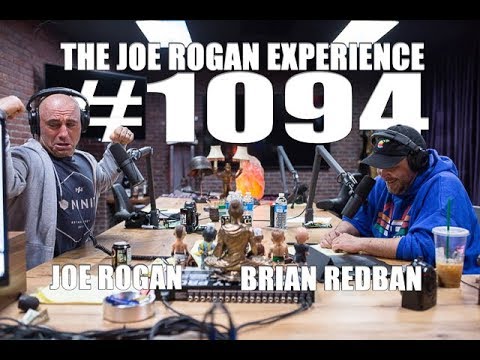
Joe Rogan Experience #1094 - Brian Redban
Joe Rogan (host), Brian Redban (guest), Jamie Vernon (guest), Guest (guest), Guest (guest), Guest (guest), Guest (guest), Guest (guest), Guest (guest), Guest (guest), Guest (guest), Guest (guest), Guest (guest)
In this episode of The Joe Rogan Experience, featuring Joe Rogan and Brian Redban, Joe Rogan Experience #1094 - Brian Redban explores rogan, Redban Roast Tech, Culture, and the Future of Humanity Joe Rogan and Brian Redban riff for hours on social media scandals, surveillance, and how platforms like Facebook, Snapchat, YouTube, and Instagram manipulate users and culture. They wander through topics like data-mining (Cambridge Analytica), clickbait, Snapchat’s missteps, and the erosion of privacy via iPhones, Apple Pay, and smart assistants.
Rogan, Redban Roast Tech, Culture, and the Future of Humanity
Joe Rogan and Brian Redban riff for hours on social media scandals, surveillance, and how platforms like Facebook, Snapchat, YouTube, and Instagram manipulate users and culture. They wander through topics like data-mining (Cambridge Analytica), clickbait, Snapchat’s missteps, and the erosion of privacy via iPhones, Apple Pay, and smart assistants.
The conversation then pivots into future tech and its implications: AI voices, deepfakes, VR, brain–computer interfaces, and how emerging tools will reshape identity, sex, politics, entertainment, and even what it means to be human.
They also explore physical life in a digital age—health, barefoot running, stem cells, diet, anxiety, and drugs—contrasting modern comforts and tech addictions with extreme outliers like minimalist ultra-runners and Amish communities.
Underlying the humor is a recurring question: how our systems—tech platforms, corporate power, academia, and law—are shaping our behavior and speech, and what future we’re sleepwalking into as we trade autonomy for convenience and entertainment.
Key Takeaways
Data-driven platforms quietly harvest and weaponize your information.
The Cambridge Analytica scandal highlights how seemingly harmless quizzes and apps can scrape massive amounts of personal data, which can then be used for political micro‑targeting and manipulation without users realizing it.
Get the full analysis with uListen AI
Clickbait and “sponsored content” blur the line between news and ads.
News sites increasingly slot low‑quality, misleading ad stories below real articles, normalizing fake headlines and training users to chase outrage or curiosity instead of information, eroding trust in media.
Get the full analysis with uListen AI
Design choices in social media directly affect mental state and conflict.
Features like algorithmic timelines, trending outrage, and frictionless political posting make platforms like Facebook and Snapchat fertile ground for fights, polarization, and performative takes, pushing many users to consider quitting altogether.
Get the full analysis with uListen AI
Convenience tech trades privacy and autonomy for frictionless living.
iPhone unlock boxes for police, Apple Pay, smart speakers, and always‑listening assistants show how quickly we accept deep surveillance and biometric access as long as it makes payments, shopping, and media easier.
Get the full analysis with uListen AI
Reality will get harder to trust as deepfakes and synthetic media mature.
Tools that stitch convincing audio and faces, combined with AR/VR worlds and future systems that generate scenes from text or speech, will make it trivial to forge “evidence” and live in personalized fantasy spaces.
Get the full analysis with uListen AI
Modern lifestyle and tech use are reshaping our bodies and health.
Rogan argues that cushioned shoes, constant screen time, junk food, and anxiety meds weaken natural systems—feet, joints, microbiome, stress response—while barefoot running, probiotics, and simpler habits can restore resilience.
Get the full analysis with uListen AI
Platform moderation and demonetization subtly steer public speech.
When YouTube or Twitter label content as “hate speech,” ban users, or demonetize certain topics, creators are financially nudged to self‑censor, effectively shifting platforms from neutral utilities toward ideological filters.
Get the full analysis with uListen AI
Notable Quotes
“If you don’t have some anxiety, it must be because you’re just choosing to not pay attention.”
— Joe Rogan
“They’re putting it on your wrist, in your pocket, in your ears… technology is trying to get into your body somehow.”
— Joe Rogan
“We just lie to ourselves for clicks.”
— Joe Rogan
“You’re cutting baby dicks. One day they’re gonna look back and go, ‘What in the fuck, people?’”
— Joe Rogan
“When you start deciding what people can and can’t say, you don’t have a free‑speech platform—now you’ve got a left‑wing platform.”
— Joe Rogan
Questions Answered in This Episode
How much personal responsibility do users bear for data breaches and manipulation compared to the responsibility of platforms like Facebook?
Joe Rogan and Brian Redban riff for hours on social media scandals, surveillance, and how platforms like Facebook, Snapchat, YouTube, and Instagram manipulate users and culture. ...
Get the full analysis with uListen AI
At what point does content moderation and demonetization by platforms become de facto censorship rather than just business policy?
The conversation then pivots into future tech and its implications: AI voices, deepfakes, VR, brain–computer interfaces, and how emerging tools will reshape identity, sex, politics, entertainment, and even what it means to be human.
Get the full analysis with uListen AI
How should society prepare for a world where deepfakes and synthetic media make it impossible to trust what we see and hear?
They also explore physical life in a digital age—health, barefoot running, stem cells, diet, anxiety, and drugs—contrasting modern comforts and tech addictions with extreme outliers like minimalist ultra-runners and Amish communities.
Get the full analysis with uListen AI
Is the trade-off between technological convenience (Apple Pay, smart speakers, location maps) and loss of privacy ultimately worth it?
Underlying the humor is a recurring question: how our systems—tech platforms, corporate power, academia, and law—are shaping our behavior and speech, and what future we’re sleepwalking into as we trade autonomy for convenience and entertainment.
Get the full analysis with uListen AI
What would a healthier cultural approach to anxiety and stress look like if we prioritized lifestyle changes over pills and constant digital stimulation?
Get the full analysis with uListen AI
Transcript Preview
So Jamie Vernon has some Facebook stock for sale.
(laughs)
(laughs)
He's got a... (laughs) . He's uploaded it to Craigslist.
Sold.
(laughs) Take it. Take it off my hands. I think it'll bounce back. If you guys don't know what we're talking about, Facebook, uh, apparently... Jamie, you were the one who first told me about it.
Yeah.
Why don't you fill people in?
I saw it yesterday. Well, from what I saw, there's something going on, I think the company is called Cambridge Analytica, which, uh, what I've also then learned is that Steve Bannon used to be the VP of this company, but that was before he was in the Trump campaign. And-
Yeah.
... they are responsible for scraping millions of users' personal information, I think through a couple apps, maybe, like the, like a personality app. If someone took one of those quizzes.
Like a personality quiz, right?
Yeah, yeah.
Like those online quizzes.
Clickbait polls and stuff. Right.
Yeah.
Yeah.
So th- but let's be... Those are morons that answer those things, right?
Right. Yeah.
For the most part, or people that are super bored.
And that's how you get... Most of the time, how you get your, your Facebook, like, passwords stolen is from those things.
Oh, yeah.
Yeah.
Or from sneaky emails-
Mm-hmm.
... that tell you, "Your account's been compromised. Please reenter your password."
Yeah.
And you're like, "Is that okay? Ho ho. Well, it doesn't say Facebook on the URL." They, they can be sneaky with their URLs too, like, put something in front of it and then Facebook, and you're like, "Oh, it looks like Facebook." You know?
Mm-hmm.
So the, uh, FTC is looking into this case right now, apparently, as of yesterday.
Wow.
And what I read is they face up to a potentially $40,000 fine for every infraction, which would total over two million, $2 trillion. I'm sorry with a T, trillion.
(inhales through teeth) What?
So it's, uh, their, their stock has tanked. I think it was like 8% yesterday. It's at eight and a half so far today. It's down to $165 a share. It was like 185 two days ago. So... And then a lot of people then are also now talking about just getting rid of their Facebook account altogether.
I talked about this last night. I'm on the, uh, actual fence of doing that just because I can't take it anymore. That's the only place I go to where it's just, I get annoyed, I get in fights. I have to see my sister talk about Trump every day, you know? Like, it's just... I, I get... It's just upsetting now.
It's a very good, uh, forum for people that are into political arguments, like political arguments, gay rights arguments. There's a lot of like... That's like one of the last places where it's okay to say that you don't think gay people should be married. (laughs)
Install uListen to search the full transcript and get AI-powered insights
Get Full TranscriptGet more from every podcast
AI summaries, searchable transcripts, and fact-checking. Free forever.
Add to Chrome