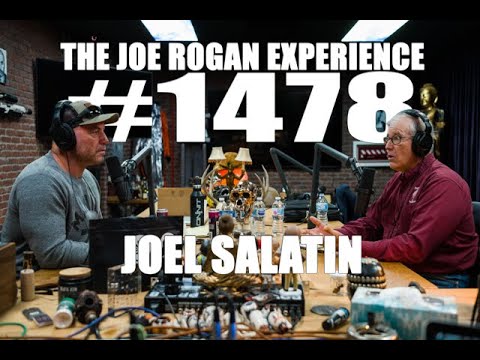
Joe Rogan Experience #1478 - Joel Salatin
Joe Rogan (host), Joel Salatin (guest), Narrator
In this episode of The Joe Rogan Experience, featuring Joe Rogan and Joel Salatin, Joe Rogan Experience #1478 - Joel Salatin explores pandemic Exposes Fragile Food System, Elevates Regenerative Local Farming Solutions Joe Rogan and farmer Joel Salatin discuss how COVID-19 has revealed the fragility of industrial, centralized meat processing while simultaneously creating unprecedented demand for small, local, direct-to-consumer farms.
Pandemic Exposes Fragile Food System, Elevates Regenerative Local Farming Solutions
Joe Rogan and farmer Joel Salatin discuss how COVID-19 has revealed the fragility of industrial, centralized meat processing while simultaneously creating unprecedented demand for small, local, direct-to-consumer farms.
Salatin contrasts mega‑plants and factory farms—highly efficient but disease‑prone, polluting, and inhumane—with decentralized, regenerative systems that integrate animals, plants, and community-scale processing.
They argue that true food cost must include health, environmental, and social damage, and that shifting to resilient local systems would require more farms, more farm jobs, and higher—but more honest—food prices.
The conversation broadens into immunity, personal health, urban–rural divides, and practical steps individuals and communities can take to rebuild food security and ecological health from the ground up.
Key Takeaways
Decentralize meat processing to reduce systemic vulnerability.
COVID outbreaks in huge packing plants exposed the risk of having 150–200 mega‑facilities handle most U. ...
Get the full analysis with uListen AI
Regenerative, pasture-based farms can feasibly feed large populations.
Salatin argues you don’t need more land to pasture chickens or cattle than to grow their grain and handle manure for confinement systems; the constraint is not land but processing, labor, and redesigning for integrated, distributed production.
Get the full analysis with uListen AI
Cheap industrial food hides massive health and environmental costs.
Ultra-cheap meat and processed foods externalize costs to public health (obesity, diabetes, foodborne illness), ecosystems (dead zones, soil loss, methane from landfills), and rural communities (farm bankruptcies, opioid addiction); paying more for real food can lower overall societal costs.
Get the full analysis with uListen AI
Building personal immunity is as critical as avoiding exposure.
They stress sleep, movement, sunlight, stress reduction, hydration, and nutrient-dense foods (especially minimally processed, pasture-based animal products) as core to immune resilience—something largely absent from official COVID messaging.
Get the full analysis with uListen AI
Policy reform could unlock more small-scale local meat.
The PRIME Act would let farmers sell meat processed at state-regulated custom facilities directly within their state, easing a major regulatory bottleneck that currently favors large plants and makes small abattoirs economically difficult.
Get the full analysis with uListen AI
Urban and suburban spaces hold huge untapped food potential.
From backyard chickens and gardens to repurposed vacant lots and micro‑farms, cities could grow a surprising share of their own produce and eggs, cutting waste streams and strengthening local food access, especially in food deserts.
Get the full analysis with uListen AI
Consumers have real leverage through daily food choices.
Shifting spending toward bulk, minimally processed, locally raised foods, learning to cook, and supporting nearby farms and markets directly changes demand signals, which in turn can drive structural change in how land and animals are managed.
Get the full analysis with uListen AI
Notable Quotes
“The pandemic is the best marketing strategy we've ever seen.”
— Joel Salatin
“We didn't get this coronavirus because of a lack of vaccine. We got this coronavirus because something in this beautiful life bath was out of whack.”
— Joel Salatin
“A cheeseburger really shouldn't be 99 cents.”
— Joe Rogan
“Our food is the cheapest aggregate food there is—we just put all the costs in.”
— Joel Salatin
“If we don't figure out a way to produce food abundantly and grow soil while we're doing it, the pandemic is going to be the least of our concerns.”
— Joel Salatin
Questions Answered in This Episode
If we doubled food prices to reflect true costs, how could society ensure low-income households still access healthy, regenerative food?
Joe Rogan and farmer Joel Salatin discuss how COVID-19 has revealed the fragility of industrial, centralized meat processing while simultaneously creating unprecedented demand for small, local, direct-to-consumer farms.
Get the full analysis with uListen AI
What specific policy changes beyond the PRIME Act would most quickly accelerate a shift from centralized industrial meat to decentralized regional systems?
Salatin contrasts mega‑plants and factory farms—highly efficient but disease‑prone, polluting, and inhumane—with decentralized, regenerative systems that integrate animals, plants, and community-scale processing.
Get the full analysis with uListen AI
How realistic is it to scale urban and suburban agriculture to meaningfully reduce dependence on industrial supply chains in major U.S. cities?
They argue that true food cost must include health, environmental, and social damage, and that shifting to resilient local systems would require more farms, more farm jobs, and higher—but more honest—food prices.
Get the full analysis with uListen AI
Where is the line between encouraging microbial exposure to strengthen immunity and exposing people, especially children, to unnecessary infection risk?
The conversation broadens into immunity, personal health, urban–rural divides, and practical steps individuals and communities can take to rebuild food security and ecological health from the ground up.
Get the full analysis with uListen AI
What incentives or transition programs would farmers in monocrop or factory-farm systems need to adopt regenerative, integrated models like Salatin’s?
Get the full analysis with uListen AI
Transcript Preview
Good to see you again, sir.
Good to be here-
Thanks.
... thanks for coming back, man. I really appreciate it. This is a perfect time to talk to someone like you about, uh, our food. Um, we're in a very strange crisis now, and you just keep hearing time and time again in the news, uh, how much ranchers and farmers and people are really suffering right now. And how much folks who don't have anything to do with that are now forcing... They're, they're being forced to understand the, the importance of the food supply chain and ranchers and farmers, and all the stuff that we've taken for granted for quite a long time now. Well, they sure have, and what's interesting about it is the juxtaposition between the... I'll just call it the industrial, the, the more, you know, uh, commercial industrial food sector, versus the sector that I'm in, which is a, um, a, a local-centric, you know, uh, uh, direct, direct sale branded product, you know, directly from the farm. Uh, the pandemic is the best marketing strategy we've ever seen.
(laughs)
We're having, we're having the best season we've ever had, and, um, a- a- a- and, and, and the same thing was with farmers around the country as I talked to them. Uh, everyone that's like us, that, that, that did not go into the supermarket system basically-
Mm-hmm.
... that, that's selling in their community, in their, in their region, regionally, uh, directly off the farm, having the best, best year we've ever had. It is the, it is the, um, it's the industrial, uh, mega-system that's cracking. And so for the first time, we're hearing talk of, "Well, maybe, maybe we need to add, uh, resiliency to efficiency." (laughs)
Hmm.
And so, um, so yeah. The, the, the system that's cracking, there's plenty of food. I mean, there's plenty of food on farms being r- produced. Uh, but of course as you know, milk is being dumped. Pigs are being euthanized. The problem is not at the farm level. The problem is in the chain of custody between the farmer and the consumer, and primarily in the, in the, uh, the large-scale processing, uh, situation.
Yeah, these large meat processing places, uh, they, they've, they've been hit hard by the coronavirus.
Th- they have been. I mean, if you think about it right now, Joe, probably, uh, in, in the, um, in the United States, the only places right now where every day thousands of people, um, come together in crowded conditions are these big meat processing plants. I mean, the offices are closed. The theaters are closed. (laughs)
Mm-hmm.
The convention centers are closed. Uh, a- and so the only place where people are coming shoulder to shoulder, thousands every day, are in these mega processing facilities. Uh, Therese and I, my wife, actually co-own a very small, um, abattoir, a slaughterhouse, uh, community slaughterhouse. We have 20 employees. And, um, and the, the differences, th- the difference in the vulnerability, in, in the exposure and risk factor between our little 20-person facility where we do, you know, maybe, um, 50 to 70 beeves a week, 100 hogs, versus these mega-plants that have, you know-
Install uListen to search the full transcript and get AI-powered insights
Get Full TranscriptGet more from every podcast
AI summaries, searchable transcripts, and fact-checking. Free forever.
Add to Chrome