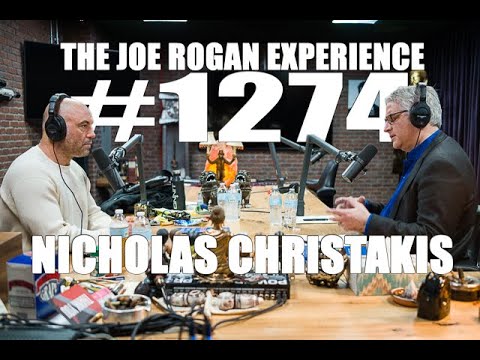
Joe Rogan Experience #1274 - Nicholas Christakis
Joe Rogan (host), Nicholas Christakis (guest), Jamie Vernon (host)
In this episode of The Joe Rogan Experience, featuring Joe Rogan and Nicholas Christakis, Joe Rogan Experience #1274 - Nicholas Christakis explores nicholas Christakis on Free Speech, Human Goodness, and Our Future Joe Rogan and physician-sociologist Nicholas Christakis use the Yale Halloween controversy as a springboard to discuss free speech, campus culture, and why deplatforming backfires. Christakis argues that liberal principles—open expression, reasoned debate, and granting good intent—are essential to social progress and to exposing bad ideas rather than driving them underground.
Nicholas Christakis on Free Speech, Human Goodness, and Our Future
Joe Rogan and physician-sociologist Nicholas Christakis use the Yale Halloween controversy as a springboard to discuss free speech, campus culture, and why deplatforming backfires. Christakis argues that liberal principles—open expression, reasoned debate, and granting good intent—are essential to social progress and to exposing bad ideas rather than driving them underground.
They dive into Christakis’s book *Blueprint*, which claims humans are genetically predisposed not only to violence and tribalism but also to friendship, love, cooperation, teaching, and building “good societies.” Using shipwreck communities, communes, hunter-gatherers, and lab experiments, he argues there is an evolved, universal social “blueprint” beneath cultural differences.
The conversation extends to vaccines, echo chambers, cults, prisons, self-domestication, AI, sex robots, CRISPR, and whether humanity is just a transitional stage toward artificial life. Throughout, Christakis maintains that we’re a “flawed but beautiful” species, and that cultivating reasoned disagreement is crucial both to individual growth and a healthy civilization.
Key Takeaways
Defend speech by prioritizing listeners’ rights, not just speakers’ rights.
Christakis argues deplatforming is wrong primarily because it deprives willing audiences of hearing ideas and evaluating them, undermining the marketplace of ideas that liberal societies depend on.
Get the full analysis with uListen AI
Treat bad ideas with more speech and better arguments, not suppression.
Whether it’s anti-vaxxers or flat-Earthers, they contend the only durable way to defeat misinformation is through transparent evidence, reasoned debate, and public critique—not censorship or social mobs.
Get the full analysis with uListen AI
Recognize that human nature includes strong, evolved tendencies toward goodness.
In *Blueprint*, Christakis shows that friendship, love, cooperation, teaching, and fairness are as deeply rooted in our biology as violence and tribalism; social living would not have evolved if harms outweighed benefits.
Get the full analysis with uListen AI
Look past surface cultural differences to see universal social patterns.
From shipwreck survivors to communes and Antarctic stations, diverse groups repeatedly reinvent similar social structures—families, friendships, cooperation, teaching—supporting the idea of an underlying human social ‘blueprint.’
Get the full analysis with uListen AI
Use disagreement as a training ground rather than a threat.
Both emphasize that arguing with people you profoundly disagree with is a powerful way to refine your own thinking, learn where you’re wrong, and strengthen the norms of civil, reasoned dispute.
Get the full analysis with uListen AI
Be wary of how technology reshapes how we treat each other, not just how we treat machines.
Christakis suggests we should regulate AI and robots (from Alexa to autonomous cars and sex robots) based on how they change human-to-human behavior—e. ...
Get the full analysis with uListen AI
Question punitive reflexes: long prison terms and lifetime labels often harm more than they help.
They criticize mass incarceration, extreme sentences, and broad sex-offender registries for nonviolent or adolescent behavior, arguing for shorter, smarter punishment and genuine reintegration instead of lifelong penalties.
Get the full analysis with uListen AI
Notable Quotes
“The answer to speech we do not like is more speech, not silencing.”
— Nicholas Christakis
“We are really a fucking unbelievable species who do amazing things when you compare us to other species.”
— Nicholas Christakis
“I completely reject the idea that words are violent. We have different words for it—they’re two different things.”
— Nicholas Christakis
“What’s wrong with America is volume. You’re going to have certain ridiculous ideas and awful ideas that are amplified in this incredible mass of humans.”
— Joe Rogan
“If we allow ourselves to just think that people are awful, it kind of relieves us of any duty to be good and to work to make the world better.”
— Nicholas Christakis
Questions Answered in This Episode
How should universities balance creating inclusive environments with preserving uncompromising free speech and inquiry?
Joe Rogan and physician-sociologist Nicholas Christakis use the Yale Halloween controversy as a springboard to discuss free speech, campus culture, and why deplatforming backfires. ...
Get the full analysis with uListen AI
If human nature includes a strong innate ‘blueprint’ for goodness, why do violent and tribal behaviors still surface so easily?
They dive into Christakis’s book *Blueprint*, which claims humans are genetically predisposed not only to violence and tribalism but also to friendship, love, cooperation, teaching, and building “good societies. ...
Get the full analysis with uListen AI
Where should we draw ethical lines in AI and robotics when the main risk is how they change us, not how we treat them?
The conversation extends to vaccines, echo chambers, cults, prisons, self-domestication, AI, sex robots, CRISPR, and whether humanity is just a transitional stage toward artificial life. ...
Get the full analysis with uListen AI
At what point does regulating harmful misinformation (like anti-vax content) become counterproductive censorship rather than responsible governance?
Get the full analysis with uListen AI
How far should we go with genetic editing and life extension before we fundamentally alter what it means to be human?
Get the full analysis with uListen AI
Transcript Preview
The gay folks took over the rainbow. Four, three, two. Will it work today, Jamie? Yes. Hello, Nicholas.
Hey, Joe. How are you, man?
Great to meet you.
It's really good to meet you, too.
Uh, I became aware of you, like many people did, with the infamous Halloween costume incident at Yale, uh, where, uh... Explain that for people who don't know what happened 'cause it was-
Um.
... kind of, kind of a crazy scene. It went national.
Yes. It was, um, a moment when, um, around the country, many students were struggling with how to balance a conflicting, um, sort of needs and-
Try to keep that a little bit closer-
Con-
... to your face. There you go.
... conflicting needs, uh, w- uh, wha- how on the one hand, to create an environment in schools where peop- everyone sort of felt welcome.
Mm-hmm.
As we've democratized, uh, admissions to our American universities, as I think we should have, people from all walks of life have started moving into these institutions, claiming them for their own, which I think is appropriate. But at the same time, these institutions had wonderful heritages of commitment to free expression and open debate and, um, and reason as a principle for resolving our differences. And, uh, s- and some of those values came into tension. And so around the country, there was a lot of, um, heat about this, and I happened to walk into a propeller, uh, myself.
Hmm.
And, um, and wound up, um, in some challenging, uh, circumstances and, um, y- you know, I, I, uh, it was not, uh, it was not the, um, worst thing that's ever happened to me, but, you know, it was in the top 10, uh, challenging moments I've had in my life, let's say.
Yeah, that's a very lawyer-like way of describing exactly what happened. (laughs)
(laughs) Well, I, well, I, yes. I mean, the thing is, I, you know, I, I, I, uh, you know, I struggle... I mean, you can tell the story if you want-
Yeah.
... and then I can correct things, but here's the thing is, uh, it's my job to be a teacher.
Mm-hmm.
And I have taken responsibility for teaching young people, and it is the case that many people, uh, lost their s- their minds. I mean, lost-
Yeah.
... their senses. And, and, and the faculty too, incidentally. I mean, you know, ther- it's one thing to talk about people in their, and college-aged people, but then d- you know, the faculty also didn't d- necessarily do what they should've done. But, um, but, uh, the, the, the thing is is that y- you know, m- my commitment, it, my commitment is to, is to teaching more generally, and I don't wanna be defined by that event. I don't want that to become a, the most important thing about me. You know, I have this book-
Install uListen to search the full transcript and get AI-powered insights
Get Full TranscriptGet more from every podcast
AI summaries, searchable transcripts, and fact-checking. Free forever.
Add to Chrome