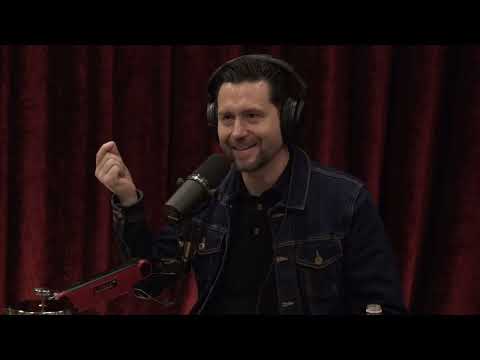
Joe Rogan Experience #1829 - Bobby Azarian
Narrator, Joe Rogan (host), Bobby Azarian (guest), Guest (unidentified third voice) (guest)
In this episode of The Joe Rogan Experience, featuring Narrator and Joe Rogan, Joe Rogan Experience #1829 - Bobby Azarian explores is the Universe Waking Up? Complexity, Consciousness, and Cosmic Destiny Joe Rogan and cognitive neuroscientist Bobby Azarian explore a new, complexity-science view of the universe in which life, intelligence, and consciousness are not freak accidents but natural, even inevitable outcomes of physical laws.
Is the Universe Waking Up? Complexity, Consciousness, and Cosmic Destiny
Joe Rogan and cognitive neuroscientist Bobby Azarian explore a new, complexity-science view of the universe in which life, intelligence, and consciousness are not freak accidents but natural, even inevitable outcomes of physical laws.
Azarian explains how thermodynamics, information processing, and evolutionary transitions drive increasing complexity—from atoms to societies—and argues that life actively resists entropy by extracting and using energy.
They debate what consciousness is, whether it exists in simple organisms or plants, and contrast views like panpsychism, materialist illusionism, and Azarian’s model that consciousness arises with self-modeling brains.
The conversation extends to technological evolution, social media chaos, potential alien intelligence, simulation and multiverse ideas, and whether humanity is an engine for a cosmic-scale mind or “global brain.”
Key Takeaways
Life does not violate entropy; it cleverly uses it.
The second law of thermodynamics applies to closed systems, but life exists in open systems (like Earth with input from the Sun), extracting useful energy and exporting entropy, which allows local increases in order and complexity.
Get the full analysis with uListen AI
The universe appears biased toward increasing complexity and intelligence.
From Santa Fe–style complexity science and origin-of-life work, Azarian argues the laws and constants of physics make life and intelligence statistically likely, not miraculous flukes, driving a directional trend toward more complex, capable systems.
Get the full analysis with uListen AI
Consciousness likely emerges with sophisticated self-modeling brains, not from all matter.
Azarian rejects panpsychism and says simple life and plants are information-processing “agents” with goals but probably lack subjective experience; consciousness arises when a system builds models that include itself as an observer.
Get the full analysis with uListen AI
Competition and cooperation are both necessary engines of progress.
Darwinian competition weeds out bad designs, while cooperation (division of labor, social organisms, global networks) increases efficiency and robustness; healthy societies balance bottom-up diversity with some top-down coordination.
Get the full analysis with uListen AI
Civilizations undergo predictable ‘phase transitions’ marked by chaos.
Drawing on complexity theory and historians like Peter Turchin, Azarian suggests today’s social unrest and information chaos resemble a phase transition—temporary instability that can enable a reorganization to a higher, more integrated order.
Get the full analysis with uListen AI
Technological integration may be steering us toward a ‘global brain.’
The internet, social media, and emerging AI connect billions of humans like neurons, forming a planetary-scale information-processing system; the danger is misuse and chaos, but the potential is a more coordinated, intelligent civilization.
Get the full analysis with uListen AI
Cosmic evolution may be teleological without being supernatural.
Ideas like cosmological natural selection suggest universes that produce black holes—and hence stable, life-permitting conditions—are “selected,” making life and intelligence central to cosmic history without invoking a traditional deity.
Get the full analysis with uListen AI
Notable Quotes
“You could look at this process of increasing complexity as the universe itself coming to life—or even waking up.”
— Bobby Azarian
“We are a way for the cosmos to know itself... and this book takes that statement very seriously.”
— Bobby Azarian
“I say that we are like some caterpillar that is becoming an electronic butterfly, and we don't even know why we're making the cocoon.”
— Joe Rogan
“Problems create progress. Our challenges are what force us to find solutions.”
— Bobby Azarian
“The universe doesn’t just support life; it seems to necessitate life.”
— Bobby Azarian
Questions Answered in This Episode
If consciousness requires self-modeling, could advanced AI systems eventually become genuinely conscious under Azarian’s criteria?
Joe Rogan and cognitive neuroscientist Bobby Azarian explore a new, complexity-science view of the universe in which life, intelligence, and consciousness are not freak accidents but natural, even inevitable outcomes of physical laws.
Get the full analysis with uListen AI
How can societies practically apply complexity-science principles to redesign economic and political systems for healthier, ‘global-brain’–like behavior?
Azarian explains how thermodynamics, information processing, and evolutionary transitions drive increasing complexity—from atoms to societies—and argues that life actively resists entropy by extracting and using energy.
Get the full analysis with uListen AI
Does framing the universe as teleological (goal-directed) risk re-importing religious thinking, or does it offer a new, secular kind of meaning?
They debate what consciousness is, whether it exists in simple organisms or plants, and contrast views like panpsychism, materialist illusionism, and Azarian’s model that consciousness arises with self-modeling brains.
Get the full analysis with uListen AI
What concrete evidence would most strongly discriminate between UAPs as advanced human tech versus genuinely non-human intelligence?
The conversation extends to technological evolution, social media chaos, potential alien intelligence, simulation and multiverse ideas, and whether humanity is an engine for a cosmic-scale mind or “global brain.”
Get the full analysis with uListen AI
If life and intelligence are inevitable, how should that reshape our assumptions about alien civilizations and humanity’s long-term responsibilities in the cosmos?
Get the full analysis with uListen AI
Transcript Preview
(drumbeats) Joe Rogan podcast, check it out. The Joe Rogan Experience. Train by day, Joe Rogan podcast by night. All day. (instrumental music)
Uh, first of all, thanks for coming, man.
Thank you for having me. This is amazing.
Well, when I g- got the request and I read the, the title and the subject of your book, I was immediately hooked. I was like, "Dude, I gotta get this guy in quickly." The Romance of Reality: How the Universe Organizes Itself to Create Life, Consciousness, and Cosmic Complexity.
Yep.
Tsk, yep. How does the... how do we know this? How do we know how the universe organizes?
(laughs)
Is this... Are you guessing? (laughs)
(laughs)
First of all, tell people what you do.
I mean, I think, I think it was an intuition that I had, um-
Can you tell people, like, what you do? Like, what your field of study is?
But yeah. So, you know, this is, this is all backed by complexity science, and when I say complexity science, uh, that's really not one field. It's an integration of all the sciences. So, physics, biology, cognitive science, uh, computer science, and, uh, yeah. From those sciences, we're getting a new picture of the universe and, uh, cosmic evolution and the role that life may play in the process. So, my background, uh, I'm a cognitive neuroscientist, uh, I got my PhD from George Mason University. Uh, I was really interested in the problem of consciousness. So, how does the brain create consciousness? What is the connection between consciousness and complexity and cosmos? Um, so, yeah. It, it was sort of an i- intuition that I had when, uh, I guess I was an undergraduate and I started taking, like, all of the basic science courses, like a physics course, and you learn about the second law of thermodynamics and, uh, the kind of popular interpretation of that law, uh, is that the universe tends towards disorder. And that didn't completely match up with, you know, my observations and, you know, what we understood about how, after the Big Bang, you had the formation of planets and stars, and then, on this planet, we see organization all around us. Um, so most of the popular books at that time, like, that was, like, you know, I graduated high school in, like, 1999 and so, popular books were like Stephen Hawking's A Brief History in Time, um, and those books, uh, kind of painted life as this improbable, kind of, statistical fluke, not a regularity. And, um, so, you know, some of those ideas didn't seem quite right to me, and I was really interested in this increase in complexity, and so I started, like, looking up these sorts of topics and I found out about the, uh, research being done at the Santa Fe Institute, which is kind of like the, uh, mecha for complexity science, and then, uh, there was this emerging world view that the universe is becoming more and more complex and it doesn't violate the law of second, uh, the second law of thermodynamics at all.
Install uListen to search the full transcript and get AI-powered insights
Get Full TranscriptGet more from every podcast
AI summaries, searchable transcripts, and fact-checking. Free forever.
Add to Chrome