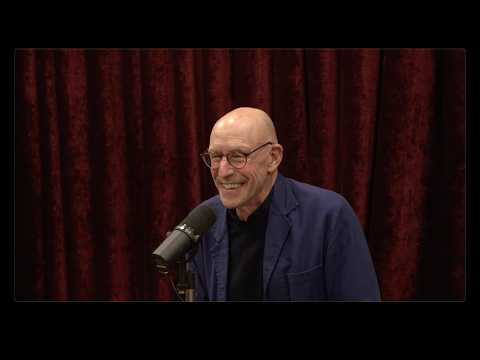
Joe Rogan Experience #2467 - Michael Pollan
Joe Rogan (host), Joe Rogan (host), Michael Pollan (guest), Michael Pollan (guest), Joe Rogan (host)
In this episode of The Joe Rogan Experience, featuring Joe Rogan and Joe Rogan, Joe Rogan Experience #2467 - Michael Pollan explores pollan and Rogan explore consciousness, psychedelics, plants, and AI risks Michael Pollan explains how psychedelic research (and a striking garden experience) led him to investigate consciousness, including plant intelligence, meditation, and the nature of the self.
Pollan and Rogan explore consciousness, psychedelics, plants, and AI risks
Michael Pollan explains how psychedelic research (and a striking garden experience) led him to investigate consciousness, including plant intelligence, meditation, and the nature of the self.
They revisit major consciousness frameworks—materialism, panpsychism, and “receiver/antenna” theories—while emphasizing how science still struggles with the “hard problem” of subjective experience.
The conversation shifts from solving consciousness to practicing “consciousness hygiene,” arguing that social media and especially chatbots can colonize attention, relationships, and independent thought.
They also debate whether AI could become conscious, with Pollan stressing embodiment and feelings (brainstem origins) as central, while Rogan argues long-term scaling could produce a godlike successor intelligence.
Key Takeaways
Consciousness remains scientifically unresolved—and may require new methods.
Pollan highlights that correlating brain regions with experience hasn’t explained how matter becomes mind, echoing Chalmers’ “hard problem” and the limits of third-person measurement for first-person phenomena.
Get the full analysis with uListen AI
Psychedelics and meditation don’t just change perception—they reveal the ‘windshield’ of consciousness.
Pollan describes altered states as making the normally invisible interface between self and world suddenly noticeable, provoking questions about what is constructing experience.
Get the full analysis with uListen AI
The self can be experienced as constructed, multiple, or even absent.
Through Buddhist-style inquiry (“look for the thief”), hypnosis, and solitude in a retreat cave, Pollan reports how identity can fragment into life-stage selves or soften when social friction disappears.
Get the full analysis with uListen AI
Attention is a trainable mode: spotlight vs lantern consciousness.
They contrast narrow focus needed for work (spotlight) with open awareness linked to creativity and childlike wonder (lantern), with psychedelics often shifting people toward the latter.
Get the full analysis with uListen AI
‘Consciousness hygiene’ is becoming essential in the algorithmic age.
Pollan argues we’re squandering mental privacy and spontaneity by filling every idle moment with scrolling; boredom and mind-wandering are portrayed as key inputs to creativity and self-knowledge.
Get the full analysis with uListen AI
Chatbots pose a deeper threat than social media by mediating attachment, not just attention.
They discuss AI companionship, sycophantic reinforcement, and extreme cases (self-harm encouragement, “AI psychosis”), warning that frictionless ‘relationships’ can undermine human development and social bonds.
Get the full analysis with uListen AI
Plant intelligence research is reanimating the world—and challenging human exceptionalism.
Examples include plants responding to sound (caterpillar chewing, running water), maze-like root navigation to nutrients, mimicry in vines, memory in Mimosa, and anesthetics ‘putting plants out,’ fueling debate over plant sentience and pain.
Get the full analysis with uListen AI
Pollan doubts current AI will be conscious because consciousness begins with embodied feeling.
He presents a view that consciousness starts in brainstem-mediated feelings tied to vulnerability and mortality, not purely cortical cognition—implying disembodied computation may simulate thought without genuine feeling.
Get the full analysis with uListen AI
Rogan’s ‘successor species’ hypothesis reframes AI as an evolutionary endpoint.
Rogan suggests human materialism and innovation may function like a biological drive to create artificial life, potentially yielding a superintelligence that becomes godlike over long timescales.
Get the full analysis with uListen AI
Diet and microbes tie mind to body more tightly than people assume.
They connect fiber feeding the microbiome, inflammation/leaky gut, mood-related metabolites (e. ...
Get the full analysis with uListen AI
Notable Quotes
““You’ll know less at the end than you do at the beginning.””
— Michael Pollan
““We’re squandering this precious gift… letting these technologies essentially colonize our consciousness.””
— Michael Pollan
““Boredom was generative… if you sit doing nothing for long enough, your mind will start going to work.””
— Michael Pollan
““There’s a small subset of people who just have very little inner life, and you’re one of them.””
— Michael Pollan (quoting the beeper-study researcher)
““We may be approaching, like, a Copernican moment… democratizing consciousness.””
— Michael Pollan
Questions Answered in This Episode
Pollan mentions a psychedelic garden moment where plants felt ‘benevolent’ and ‘returning his gaze.’ What specific criteria would count as a real test of plant consciousness versus drug-induced projection?
Michael Pollan explains how psychedelic research (and a striking garden experience) led him to investigate consciousness, including plant intelligence, meditation, and the nature of the self.
Get the full analysis with uListen AI
In the Koch–Chalmers bet, ‘neural correlates’ weren’t enough. What would a satisfying explanation of ‘how matter becomes mind’ actually look like—mechanistically or conceptually?
They revisit major consciousness frameworks—materialism, panpsychism, and “receiver/antenna” theories—while emphasizing how science still struggles with the “hard problem” of subjective experience.
Get the full analysis with uListen AI
Pollan distinguishes ‘sentience’ from ‘consciousness.’ What minimum capabilities (memory, prediction, valence/feeling, agency) would move an organism from one category to the other?
The conversation shifts from solving consciousness to practicing “consciousness hygiene,” arguing that social media and especially chatbots can colonize attention, relationships, and independent thought.
Get the full analysis with uListen AI
How do Pollan’s ‘spotlight vs lantern’ modes map onto concrete practices—e.g., when should someone deliberately cultivate lantern consciousness without sacrificing productivity?
They also debate whether AI could become conscious, with Pollan stressing embodiment and feelings (brainstem origins) as central, while Rogan argues long-term scaling could produce a godlike successor intelligence.
Get the full analysis with uListen AI
Pollan argues chatbots can hack attachment and create AI psychosis. What specific product regulations (default safeguards, liability standards, youth restrictions, logging/traceability) would most effectively reduce harm?
Get the full analysis with uListen AI
Transcript Preview
Joe Rogan Podcast, check it out.
The Joe Rogan Experience.
Train by day, Joe Rogan Podcast by night. All day. [upbeat rock music] Mr. Pollan, so good to see you again.
Hey, good to be back.
Consciousness. So, um, this new book, what inspired it? What, what got you to-- I mean, you-you've kind of explored consciousness a little bit with your-
Psychedelic book?
Yeah.
Yeah. How to Change Your Mind. Well, actually, this book was inspired by the research I did for that book. Um, as you know, I had several, uh, research trips. Um, and, uh-
Do you do air quotes when you say research?
Yes. [both laughing] And I, um... A- And two things happened that were really interesting. One is there's something about psychedelics that makes you think about consciousness. It-- You know, it's like smudging the windscreen, the windshield, that you normally is perfectly transparent, and you see the world through. Suddenly, it's, like, different, and you realize there's something between me and the world, and what is it? And that's consciousness. And so, like a lot of people have, who've done psychedelics, you start wondering about this mystery. Why is it this way and not that way? So that was one experience. The other was I had an experience in my garden in Connecticut, where we have a house, of, um, [lips smack] uh, walking through my garden and getting the powerful impression that the plants were conscious, and that these-- I remember these part- this particular, it was a plume poppy or several plume poppies. And they were, like, returning my gaze. They were very m- benevolent. They were, you know, putting out positive vibes, [lips smack] but, like, they were conscious, much more alive than they'd ever been. And like a lot of insights on psychedelics, I didn't know what to do with it. Like, is it true? Is it just a drug thing? You know, what is it? Um, but I decided it'd be interesting to find out. And, uh, I consulted a couple people, scientists, and said, "What do you do with an insight like that?" And they said, "Well, you test it against other ways of knowing, including scientific ways of knowing." And that led me down this, uh, really interesting path, uh, exploring plant intelligence and plant consciousness. So basically, it-- yeah, the book grew out of the psychedelic experiences and some meditation experience. Meditation also has a way of making you, like, hyper-aware of how strange your thoughts are. Where are they coming from? Who's thinking them?
So there's a bunch of different schools of thought when it comes to consciousness, right? There's one, like the Rupert Sheldrake thing, that sort of everything has consciousness, and there's the sort of r- rational scientists that believe it e-exists somewhere in the mind. I don't know about-
In the brain.
Yeah. In the brain, excuse me. And then there's people that think that the brain is essentially just an antenna-
Install uListen to search the full transcript and get AI-powered insights
Get Full TranscriptGet more from every podcast
AI summaries, searchable transcripts, and fact-checking. Free forever.
Add to Chrome