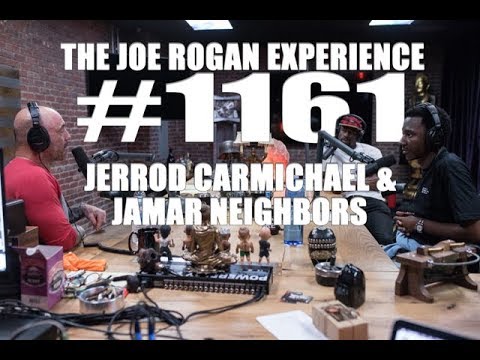
Joe Rogan Experience #1161 - Jerrod Carmichael & Jamar Neighbors
Joe Rogan (host), Jerrod Carmichael (guest), Jamar Neighbors (guest), Jerrod Carmichael (guest), Joe Rogan (host), Jamar Neighbors (guest), Narrator, Narrator
In this episode of The Joe Rogan Experience, featuring Joe Rogan and Jerrod Carmichael, Joe Rogan Experience #1161 - Jerrod Carmichael & Jamar Neighbors explores jerrod Carmichael Dissects Comedy, Authenticity, Outrage Culture, And Moon Landings Joe Rogan talks with Jerrod Carmichael and Jamar Neighbors about the Comedy Store, late‑night spots, and how that crucible shapes a comedian’s voice and identity.
Jerrod Carmichael Dissects Comedy, Authenticity, Outrage Culture, And Moon Landings
Joe Rogan talks with Jerrod Carmichael and Jamar Neighbors about the Comedy Store, late‑night spots, and how that crucible shapes a comedian’s voice and identity.
They dive into what makes standup authentic versus contrived—critiquing late‑night TV sets, industry expectations, and the pressure to perform a ‘1993 comedian’ version of yourself.
The conversation widens into mental health, meditation, exercise, and how real struggle and physical challenge create perspective and resilience.
They also explore conspiracy-leaning topics like whether the moon landing was faked and the JFK assassination, using them to illustrate how institutions lie and how people chase creative outrage today.
Key Takeaways
Late-night, sparsely attended sets forge a comic’s identity.
Rogan, Carmichael, and Neighbors describe 1 a. ...
Get the full analysis with uListen AI
Standup is strongest when it’s uniquely and unapologetically you.
Carmichael argues that in a comparison-heavy culture, your only real leverage is specificity—either being fully yourself or fully committing to a distinct character, instead of conforming to an outdated late‑night mold.
Get the full analysis with uListen AI
Traditional late‑night standup spots often distort a comic’s real voice.
They criticize shows that pre‑tape multiple comics, re‑order material, and demand ‘traditional’ setups, comparing it to telling a musician to rearrange their song; Carmichael has refused such spots rather than misrepresent himself.
Get the full analysis with uListen AI
Meditation and hard physical exertion reset mental momentum.
Jamar’s daily TM-style meditation and Rogan’s emphasis on cardio and yoga are framed as ways to stop the buildup of anxious thoughts, gain perspective on what actually counts as a ‘real problem,’ and make other stressors feel smaller.
Get the full analysis with uListen AI
We reward public complaining and manufactured outrage online.
Carmichael distinguishes genuine outrage (e. ...
Get the full analysis with uListen AI
Conspiracy narratives thrive where institutions have lied before.
Rogan walks through moon‑landing doubts (press conference behavior, lost telemetry data, radiation belts) and JFK anomalies, noting that proven schemes like Tuskegee and Operation Northwoods make people understandably suspicious.
Get the full analysis with uListen AI
Most comics never reach a career where they do what they truly want.
Carmichael notes that from hundreds of comics, only a few end up both working and creatively free; many hit a ‘glass ceiling’ of comfort, repeating the same 30 minutes for years instead of risking growth or authenticity.
Get the full analysis with uListen AI
Notable Quotes
“If standup is art, the medium is supposed to come to the artist, not the other way around.”
— Jerrod Carmichael
“It’s never worth it capturing yourself not as yourself.”
— Jerrod Carmichael
“Doing things that are difficult to do makes other things easier.”
— Joe Rogan
“We’re rewarded for publicly having a complaint.”
— Jerrod Carmichael
“People don’t talk about how comfy glass ceilings are.”
— Jerrod Carmichael
Questions Answered in This Episode
How should standup evolve its formats and venues so comics don’t feel pressured to dilute their voice for late‑night TV or conventional specials?
Joe Rogan talks with Jerrod Carmichael and Jamar Neighbors about the Comedy Store, late‑night spots, and how that crucible shapes a comedian’s voice and identity.
Get the full analysis with uListen AI
Where is the line between productive social criticism and ‘creative outrage’ that actually trivializes real issues?
They dive into what makes standup authentic versus contrived—critiquing late‑night TV sets, industry expectations, and the pressure to perform a ‘1993 comedian’ version of yourself.
Get the full analysis with uListen AI
What practical steps can an ordinary person take—outside meditation or intense exercise—to break the ‘momentum’ of negative thoughts Rogan describes?
The conversation widens into mental health, meditation, exercise, and how real struggle and physical challenge create perspective and resilience.
Get the full analysis with uListen AI
Does knowing about historical government lies (Tuskegee, Operation Northwoods) make skepticism about events like the moon landing rational, or does it risk sliding into reflexive distrust of everything?
They also explore conspiracy-leaning topics like whether the moon landing was faked and the JFK assassination, using them to illustrate how institutions lie and how people chase creative outrage today.
Get the full analysis with uListen AI
With so many specials and comedians competing for attention, what does it realistically mean today to ‘be uniquely yourself’ in comedy, and how can a new comic do that without getting lost in the noise?
Get the full analysis with uListen AI
Transcript Preview
Five, four, three, two, one. Live? And we're live. Mr. Carmichael.
Hello, my friend.
Mr. Neighbors.
Hello, Joe Rogan.
Uh, my friend, Jamar.
I know. Uh, Jamar, welcome.
Thank you, man. Thank you.
Didn't know you were coming, but glad to see you.
Man, me neither, man. He made, he made me come. (laughs)
Well-
He came by the house. He just came by.
(laughs)
I was like, "I'm gonna, I'm going to Joe Rogan." And he was like, "Oh, I'm gonna come."
(laughs)
I was like-
(laughs)
"That's perfect."
(laughs) Perfect, perfect. What the fuck is going on, man? What are you up to?
Not much. I just got in from New York, like, two hours ago, and now I'm here. I feel real... I don't know. I feel like a... You know, you ever see, like, a homeless man smoking a cigarette?
Yeah.
And he just feels, like, real zen and this is his... That's how, that's how I feel emotionally right now.
Really?
Yeah, really, like-
Like a homeless dude smoking a cigarette?
Yeah.
What a weird analogy.
I feel it's great.
Hmm.
It's really great.
Trying to figure that out, that feeling.
It's like I have everything that I need right now.
In your life.
I have everything that I need.
Yeah, yeah. But you've been killing it for a long time, man. You know, I- you were killing it when I wasn't at The Store. I'd heard about you, um, when I wa- I was gone, I'd heard about you. I think Ari is the one who told me about you.
Oh, yeah. (laughs)
You know? And then I found out that Spike Lee directed your special, I was like, "What? Like, what the fuck is happening over at The Comedy Store?" (laughs)
(laughs)
Yeah, that was-
You know? Spike Lee's directing comedy specials?
That was a fun one 'cause it was like, just such a immediate... Like I was like, "It has to be in the OR, nobody filmed in the OR." And so, like, you know, getting everybody to agree to that.
Yeah.
And then, like, 'cause even Spike was like, "But the main room's right here."
Hmm.
"It's so big." And it's like, I was like, "But I don't do the main room, I do the OR."
Yeah. The main room's pretty good too.
That's a good room.
I used to, I used to be prejudiced against the main room. I'd be like, "Ah, it's too big, it's too showy."
It depends on-
"The OR's dirty and grimy."
(laughs)
It, it depends on, like, you know, if the sides are full or open and what the... The, the room can change depending on, like, so many factors of like-
Install uListen to search the full transcript and get AI-powered insights
Get Full TranscriptGet more from every podcast
AI summaries, searchable transcripts, and fact-checking. Free forever.
Add to Chrome