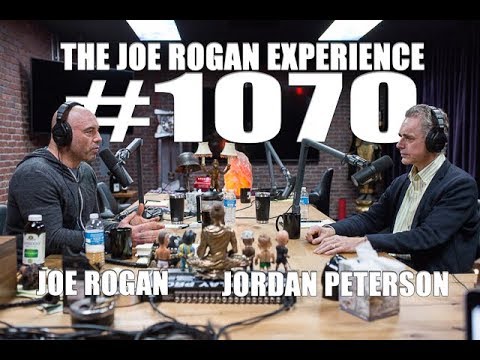
Joe Rogan Experience #1070 - Jordan Peterson
Joe Rogan (host), Jordan Peterson (guest), Narrator
In this episode of The Joe Rogan Experience, featuring Joe Rogan and Jordan Peterson, Joe Rogan Experience #1070 - Jordan Peterson explores jordan Peterson Dissects Identity Politics, Responsibility, And Meaningful Life Joe Rogan and Jordan Peterson unpack Peterson’s rise to prominence, starting with the Canadian Bill C-16 controversy and the viral Cathy Newman Channel 4 interview, using them as entry points into a broader critique of legacy media and ideological capture in institutions.
Jordan Peterson Dissects Identity Politics, Responsibility, And Meaningful Life
Joe Rogan and Jordan Peterson unpack Peterson’s rise to prominence, starting with the Canadian Bill C-16 controversy and the viral Cathy Newman Channel 4 interview, using them as entry points into a broader critique of legacy media and ideological capture in institutions.
They explore the dangers of equality-of-outcome thinking, Marxist-derived identity politics, and tribalism on both the left and right, arguing these dynamics erode individualism and risk real-world authoritarian outcomes.
Peterson lays out his core themes: intrinsic sex differences and their implications for careers; the psychological importance of responsibility, discipline, and voluntary confrontation of hardship; and the idea that meaning comes from bearing a worthwhile burden rather than pursuing comfort.
The conversation also covers the role of diet and health in Peterson’s life, the disruptive potential of YouTube and long-form discussion, and how his “12 Rules for Life” and self-authoring tools aim to help young people structure their lives amid cultural confusion.
Key Takeaways
Equality of outcome is both unrealistic and socially dangerous.
Peterson argues that natural distributions (Pareto principle) and individual differences in interests and effort inevitably create unequal outcomes; attempts to forcibly equalize them historically require heavy-handed state power and tend toward tyranny.
Get the full analysis with uListen AI
Biological and psychological sex differences help explain career patterns.
He emphasizes robust findings that, on average, men are more interested in things and women in people, especially at the extremes, which strongly shapes gender distributions in fields like engineering and nursing even in highly egalitarian countries.
Get the full analysis with uListen AI
Identity politics and tribalism on both left and right are corrosive.
Framing society primarily as oppressor vs. ...
Get the full analysis with uListen AI
Responsibility and voluntary confrontation of difficulty are primary sources of meaning.
Peterson contends that a worthwhile life comes from shouldering a ‘worthwhile burden’—caring for self, family, and community—rather than chasing comfort or self-esteem, and that this orientation counters bitterness, nihilism, and even malevolence.
Get the full analysis with uListen AI
Small, concrete improvements compound into major life changes.
Using examples like “clean your room” or studying 30 focused minutes instead of pretending to work for hours, he shows how targeting daily, controllable habits creates large, measurable gains over time and reduces the internal sense of rot and wasted potential.
Get the full analysis with uListen AI
Telling the truth and refining your speech can reshape your reality.
Drawing on Biblical symbolism and clinical experience, Peterson claims that honest, careful speech—especially in confronting fear and chaos—literally transforms the ‘potential’ of life into a more habitable, ordered reality for yourself and others.
Get the full analysis with uListen AI
Digital platforms are displacing traditional media and academia for serious discourse.
Rogan and Peterson argue that YouTube and long-form podcasts allow nuanced, hours-long conversations and global reach, making TV’s soundbite-driven format and even some university teaching models look obsolete for people who genuinely want to learn.
Get the full analysis with uListen AI
Notable Quotes
““Equality of outcome… I can’t imagine anything we could possibly strive for in our society that would make it into hell faster than equality of outcome.””
— Jordan Peterson
““You should be a monster, an absolute monster, and then you should learn how to control it.””
— Jordan Peterson
““Life isn’t a game. It’s a series of games, and the right ethic is to be the winner of the series of games.””
— Jordan Peterson
““The world is a battleground of groups… The ones that win are oppressors, the ones that lose are oppressed. That’s the way you look at the world, and I think that’s wrong.””
— Jordan Peterson
““Don’t waste your damn life… Aim high. Adopt some responsibility and then see what the hell happens.””
— Jordan Peterson
Questions Answered in This Episode
How can societies practically address harmful levels of inequality without sliding toward the kind of coercive equality-of-outcome schemes Peterson warns about?
Joe Rogan and Jordan Peterson unpack Peterson’s rise to prominence, starting with the Canadian Bill C-16 controversy and the viral Cathy Newman Channel 4 interview, using them as entry points into a broader critique of legacy media and ideological capture in institutions.
Get the full analysis with uListen AI
To what extent should public institutions (schools, tech companies, media) explicitly acknowledge sex-based differences in interests and temperament when designing policies or diversity initiatives?
They explore the dangers of equality-of-outcome thinking, Marxist-derived identity politics, and tribalism on both the left and right, arguing these dynamics erode individualism and risk real-world authoritarian outcomes.
Get the full analysis with uListen AI
Where is the line between legitimately critiquing identity-based oppression and falling into the kind of destructive tribalism Peterson describes on both the left and the right?
Peterson lays out his core themes: intrinsic sex differences and their implications for careers; the psychological importance of responsibility, discipline, and voluntary confrontation of hardship; and the idea that meaning comes from bearing a worthwhile burden rather than pursuing comfort.
Get the full analysis with uListen AI
How might individuals who strongly disagree with Peterson’s conclusions productively challenge his ideas in a long-form debate, rather than through media soundbites or labels?
The conversation also covers the role of diet and health in Peterson’s life, the disruptive potential of YouTube and long-form discussion, and how his “12 Rules for Life” and self-authoring tools aim to help young people structure their lives amid cultural confusion.
Get the full analysis with uListen AI
If responsibility and meaningful difficulty are central to a good life, what are some concrete first steps for someone who feels trapped in resentment, procrastination, or nihilism?
Get the full analysis with uListen AI
Transcript Preview
Four, three, two, one. Boom, and we're live. 12 Rules for Life. So without reading this, so what you're saying is?
(laughs)
That's what it's like. (laughs)
There's only 12 things you need to know in life, right? That's it?
(laughs) Yeah. Well-
Yeah, yeah.
This, um, this interview that you just did with this woman, uh, Cathy Newman, she... Was that in the UK?
It was. Channel 4, UK.
Um, I just went... I, I, I felt bad, but I was also laughing. I went to her Twitter page to read, like... And in... With each one of her tweets, no matter what she says, someone writes underneath it, "So what you're saying is..." And then some ridic... But by the way, the... Your fans were mocking her, but politely, non-aggressively. They were... I di-... I didn't read any rude things. Like there was no th-... There was no insults or there w-... Well, maybe a few insults, but there's no swears. It was just playful mocking of the interview that she did with you, because the interview was ridiculous. It was a ridiculous interview. I mean, I, I listened to it se-... Or watched it several times. I was like, "This is so strange." Like her determination to turn it into a conflict, to... It's one of the issues that I have with television shows.
Yep.
Because they have a very limited amount of time and they're trying to make things as salacious as possible.
Yep.
They wanna have these sound bites, these clickbait sound bites, and she just went into it incredibly confrontational, not trying to find your actual perspective, but trying to force you to defend a non-, non-realistic perspective.
Yes. Well, I was the, I was the hypothetical villain of her imagination, essentially.
Yeah.
Well, what happened, what was interesting too, the way it, it l-... Played itself out, because I met her in the green room beforehand. You know, she was being made up and then they put a little bit of powder on me, and we had a friendly kind of interchange. And then we went and sat in front of the cameras and for a couple of minutes, you know, before, before the show got rolling. And we had a pretty pleasant back and forth. And then as soon as the cameras went on, she was a completely different person.
Ugh.
And I thought, "Oh, I see."
It's a trick.
"I see what's going on."
Yeah.
Yeah. Well, so, so that kind of alerted me to, well, the fact that there was something rotten in the state of Denmark, let's say.
(laughs)
Yeah. But, you know, this is also why YouTube is gonna kill TV, because television, by its nature, all of these narrow broadcast technologies, they re-... They rely on forcing the story, right?
Yeah.
Because it has to happen now. It has to happen in, like often in five minutes, 'cause they only broadcast five minutes of that v-... In-... Interview. They did put the whole thing up on YouTube.
Install uListen to search the full transcript and get AI-powered insights
Get Full TranscriptGet more from every podcast
AI summaries, searchable transcripts, and fact-checking. Free forever.
Add to Chrome