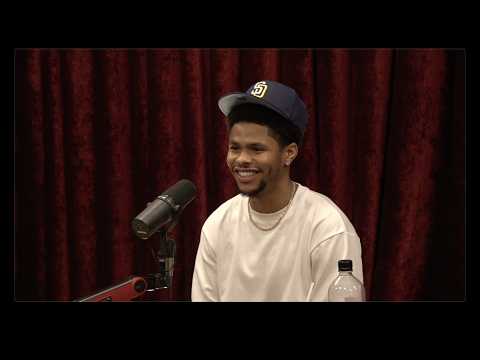
JRE MMA Show #175 with Shakur Stevenson
Joe Rogan (host)
In this episode of The Joe Rogan Experience, featuring Joe Rogan, JRE MMA Show #175 with Shakur Stevenson explores shakur Stevenson on elite boxing, mindset, matchmaking, and clean sport demands Shakur Stevenson and Joe Rogan unpack Stevenson’s dominant performance over Teofimo Lopez as proof of “levels” in elite boxing, highlighting Shakur’s emphasis on defense, tactics, and minimizing long-term brain damage.
Shakur Stevenson on elite boxing, mindset, matchmaking, and clean sport demands
Shakur Stevenson and Joe Rogan unpack Stevenson’s dominant performance over Teofimo Lopez as proof of “levels” in elite boxing, highlighting Shakur’s emphasis on defense, tactics, and minimizing long-term brain damage.
They discuss how judging incentives, matchmaking politics, and fear of looking bad can make it difficult for highly skilled fighters to secure marquee opponents—while belts, not names, sometimes drive legacy goals.
Stevenson credits discipline, family motivation, and high-level mentorship (especially Terence Crawford and Andre Ward) for his ring IQ, composure, and continuous improvement, including film study and self-analysis.
The conversation broadens into weight-cut strategy, rehydration clauses, women’s boxing (Claressa Shields), MMA skill hierarchies, and the persistent problem of performance-enhancing drugs—where Shakur insists on VADA testing for every fight.
Key Takeaways
Stevenson’s edge is tactical control with minimal damage taken.
Rogan praises Shakur’s trap-setting, half-speed jab variations, and ability to frustrate opponents while absorbing few clean shots—framing it as the ideal “smart boxing” model.
Get the full analysis with uListen AI
Modern judging can force stylistic compromises.
Shakur explains that against pressure fighters (e. ...
Get the full analysis with uListen AI
Career longevity is a deliberate choice, not an accident.
Stevenson explicitly rejects “punishment fights,” citing visible long-term damage in many old-school fighters and praising examples like Floyd and Andre Ward who preserved their faculties.
Get the full analysis with uListen AI
Elite confidence must be managed to avoid overconfidence traps.
He describes intentionally “making guys bigger in my brain” to prevent complacency—using boxing history (Tyson–Douglas, Teo–Kambosos) as cautionary examples of mindset failure.
Get the full analysis with uListen AI
Training at the highest level accelerates ring IQ beyond coaching alone.
Shakur credits years around Terence Crawford—watching good and bad days, studying adjustments, and adopting habits like reviewing sparring footage—as transformative to his own development.
Get the full analysis with uListen AI
Sparring can sabotage future superfights.
Stevenson believes sparring Lomachenko (and others) reduced their willingness to fight him later, since they already felt his timing/speed and saw his growth potential.
Get the full analysis with uListen AI
Anti-doping isn’t optional in a ‘life or death’ sport.
Shakur demands VADA testing in every contract and argues PED cheating is uniquely dangerous in combat sports; Rogan supports with MMA examples where physiques and power changed after stricter testing.
Get the full analysis with uListen AI
Notable Quotes
“Taking punishment ain't for me. Like—I wanna make sure that I'm able to really speak well to my kids and my grandkids.”
— Shakur Stevenson
“I felt like my brain just knew how to win… it felt like a out-of-body experience.”
— Shakur Stevenson
“Judges give the fight to mostly the guy that's coming forward.”
— Shakur Stevenson
“I learned that from him… I started doing the same thing [watching sparring back].”
— Shakur Stevenson
“Every fight [VADA]. I don't play that.”
— Shakur Stevenson
Questions Answered in This Episode
On the Lopez fight specifically: what were the top 2-3 traps you built for Teofimo, and what cues told you they were working?
Shakur Stevenson and Joe Rogan unpack Stevenson’s dominant performance over Teofimo Lopez as proof of “levels” in elite boxing, highlighting Shakur’s emphasis on defense, tactics, and minimizing long-term brain damage.
Get the full analysis with uListen AI
You said you had to ‘get Zepeda’s respect early’ because of judging—what would you change in boxing scoring to reward defense and ring generalship more consistently?
They discuss how judging incentives, matchmaking politics, and fear of looking bad can make it difficult for highly skilled fighters to secure marquee opponents—while belts, not names, sometimes drive legacy goals.
Get the full analysis with uListen AI
You’ve said you only showed ‘70%’ of what you can do—what skills (inside fighting, body work, combinations, counters) are still largely unseen by fans?
Stevenson credits discipline, family motivation, and high-level mentorship (especially Terence Crawford and Andre Ward) for his ring IQ, composure, and continuous improvement, including film study and self-analysis.
Get the full analysis with uListen AI
How do you balance ‘never taking punishment’ with the reality that some elite opponents will force exchanges—what’s your decision rule in real time?
The conversation broadens into weight-cut strategy, rehydration clauses, women’s boxing (Claressa Shields), MMA skill hierarchies, and the persistent problem of performance-enhancing drugs—where Shakur insists on VADA testing for every fight.
Get the full analysis with uListen AI
You believe sparring can prevent fights (e.g., Lomachenko). If you could redo your early career, would you spar fewer elites to protect matchmaking leverage?
Get the full analysis with uListen AI
Transcript Preview
Joe Rogan Podcast, check it out
The Joe Rogan Experience
Train by day, Joe Rogan Podcast by night. All day. [upbeat rock music] Well, uh, anyway, thanks for coming down here, man. Appreciate it.
Yeah.
And congratulations on that standout performance against Teofimo, because that was a, that was a giant wake-up call for the entirety of boxing.
Yeah.
The, the level that you're on was at so high that you could be in there with a world champion-
[laughs]
... a world champion-
[laughs]
... and make him look... A guy who beat-
Yeah
... I mean, l- legit guys, including Lo- Lomachenko.
Yeah.
That was a big victory for him, and you made him look like he had no business in there.
Honestly, it's just hard work, dedication, and, um, God-given ability. God-given ability. [laughs]
I think you have all that, plus intelligence, plus you started real young. And there's something about-
Yeah
... those dudes who start real young. You grow up with that.
Yeah.
It's like in your central nervous system as you're a young child.
Yeah.
I mean, what'd you start boxing at, like 5?
I started boxing at 5 but honestly you could say the same for Teo too, 'cause he kinda started at, like, 7.
Mm.
We both was kinda similar in, like, experience, but I just feel like with me, the God-given ability or my instincts always kick in. Like, when we fought, I felt like my brain just knew how to win. Like, it just, everything was just like my instincts kicked in and everything just took over. Like, I didn't even... It w- it felt like a out-of-body experience.
Well, you're a very tactical guy.
Yeah.
Like, you know, there's a thing, one of, one of the things I love about watching you fight is I love watching a guy who sets traps and who avoids damage, and you are one of the absolute very best ever at setting traps and avoid damage. You take so few punches in your fights.
Yeah.
There was that one fight where you deci- recent fight where you decided to stand with that dude. Who was that? Um-
William Zepeda.
That's right.
Yeah.
Zepeda's a tough guy, man.
Oh, he is.
But you fought that a different way. Did you do that on purpose?
Uh, it was partly on purpose and partly to get his respect.
Mm.
'Cause I really ain't have a choice but to get his respect, because if I'da tried to out-box him and move around the ring, I probably woulda made the fight harder than it had to be. So I knew, like, I gotta, like, make him respect me early, and that's what I kinda, like, started the fight.
Hot. Why would it make it harder than it had to be if you boxed him?
Because sometimes when you, like, a guy, like if you watch today's boxing, judges give the fight to mostly the guy that's coming forward. So if I'da went in there and backing up and moving around, around the ring while he was more active, it probably woulda looked as though he's winning the fight.
Install uListen to search the full transcript and get AI-powered insights
Get Full TranscriptGet more from every podcast
AI summaries, searchable transcripts, and fact-checking. Free forever.
Add to Chrome