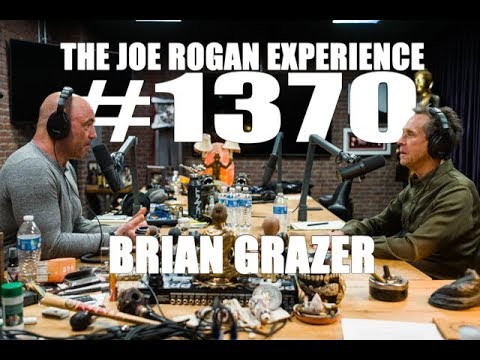
Joe Rogan Experience #1370 - Brian Grazer
Joe Rogan (host), Brian Grazer (guest), Narrator, Narrator, Narrator
In this episode of The Joe Rogan Experience, featuring Joe Rogan and Brian Grazer, Joe Rogan Experience #1370 - Brian Grazer explores brian Grazer Explains Curiosity, Connection, and Crafting Powerful Stories Brian Grazer discusses how childhood dyslexia and shame pushed him to develop intense observational skills and a lifelong practice of 'curiosity conversations'—one-on-one meetings with fascinating people from Nobel laureates to police chiefs. He and Joe Rogan compare these private conversations to podcasting, exploring how deep dialogue, eye contact, and presence build empathy, creativity, and better storytelling.
Brian Grazer Explains Curiosity, Connection, and Crafting Powerful Stories
Brian Grazer discusses how childhood dyslexia and shame pushed him to develop intense observational skills and a lifelong practice of 'curiosity conversations'—one-on-one meetings with fascinating people from Nobel laureates to police chiefs. He and Joe Rogan compare these private conversations to podcasting, exploring how deep dialogue, eye contact, and presence build empathy, creativity, and better storytelling.
Grazer explains how insights from these talks have directly shaped films like *A Beautiful Mind* and *8 Mile*, and why he sees himself as being in the 'feelings business' rather than just producing movies. They also dive into modern disconnection and loneliness driven by digital life, the value of failure and discipline (from jiu-jitsu to exercise challenges), and tools for self‑improvement like meditation, sleep tech, and structured habits.
The conversation ranges from Jay‑Z’s obsessive work ethic to fat‑shaming, Adderall culture, and sleep apnea, tying them back to how people grow, cope, and pursue excellence. Throughout, Grazer emphasizes curiosity, humility, and constant self‑upgrading as the core of his success and personal philosophy.
Key Takeaways
Turn weaknesses into unique strengths by overdeveloping compensating skills.
Grazer’s severe dyslexia forced him to survive in class by reading faces instead of books; that hyper-focus on eye contact and emotion later became his superpower as a producer and interviewer.
Get the full analysis with uListen AI
Schedule deliberate curiosity: treat learning conversations as a non‑negotiable practice.
For 35 years, Grazer has held a rigorously scheduled one-on-one ‘curiosity conversation’ at least every two weeks, often hustling for months to get an hour with someone extraordinary; he credits this habit with fueling both his personal growth and his best creative ideas.
Get the full analysis with uListen AI
Record and synthesize insights; they can later become powerful creative fuel.
Grazer realized too late that he should have documented early conversations, but later notes and recordings let him pull a torture survivor’s “alternate reality” coping mechanism directly into the narrative structure of *A Beautiful Mind*.
Get the full analysis with uListen AI
Create democratic, non-intimidating environments to get the best from creatives.
Rejecting the 1980s ‘power desk’ mentality, Grazer intentionally flattens hierarchy—making his own calls, avoiding intimidation—because artists contribute more and better work when they feel respected and emotionally safe.
Get the full analysis with uListen AI
Use deep, undistracted conversations to improve communication and empathy.
Both Grazer and Rogan describe long, phone-free, one-on-one talks (or podcasts) as the single most powerful way they’ve learned about people, refined communication skills, and expanded their thinking.
Get the full analysis with uListen AI
Combat digital-era loneliness by practicing eye contact and real presence.
Grazer’s second book grew from realizing that simply looking people directly in the eyes made them feel ‘like a human being’; he argues that in a time of texting-in-the-same-room and ghosting, face-to-face connection is becoming a scarce, high-value skill.
Get the full analysis with uListen AI
Anchor self-improvement in clear, rigid rules instead of vague intentions.
Rogan’s Sober October and strict workout goals (fixed hours, fixed days, no exceptions) contrast with ‘I should work out more’; Grazer recognizes that similarly specific structures—like his morning routine and TM—are what actually sustain growth.
Get the full analysis with uListen AI
Notable Quotes
“I'm not a movie producer; I'm in the feelings business.”
— Brian Grazer
“These conversations are basically a podcast that no one’s listening to.”
— Joe Rogan (describing Grazer’s curiosity meetings)
“Just by looking at somebody directly in the eyes, with real interest, it immediately is an equalizer. It makes me feel like a human being.”
— Brian Grazer
“We’re living right now in the loneliest time in our generation. It’s like an epidemic of loneliness.”
— Brian Grazer
“The big problem is holding yourself prisoner to the mistakes of the past. Don’t do that.”
— Joe Rogan
Questions Answered in This Episode
How could you design your own version of Grazer’s weekly ‘curiosity conversations’ to systematically expand your thinking and network?
Brian Grazer discusses how childhood dyslexia and shame pushed him to develop intense observational skills and a lifelong practice of 'curiosity conversations'—one-on-one meetings with fascinating people from Nobel laureates to police chiefs. ...
Get the full analysis with uListen AI
In what ways has your phone or digital life reduced your face-to-face connection, and what concrete rules could you put in place to reverse that?
Grazer explains how insights from these talks have directly shaped films like *A Beautiful Mind* and *8 Mile*, and why he sees himself as being in the 'feelings business' rather than just producing movies. ...
Get the full analysis with uListen AI
What personal failure or trauma could you reframe, as Grazer did with dyslexia, into a unique advantage or area of expertise?
The conversation ranges from Jay‑Z’s obsessive work ethic to fat‑shaming, Adderall culture, and sleep apnea, tying them back to how people grow, cope, and pursue excellence. ...
Get the full analysis with uListen AI
How might your work change if you consciously aimed, like Grazer, to be ‘in the feelings business’—optimizing for emotional impact rather than just output?
Get the full analysis with uListen AI
If you set one rigid, non‑negotiable self‑improvement rule for the next 30 days (like Sober October or a daily workout), what would it be and why?
Get the full analysis with uListen AI
Transcript Preview
Three, two... All right, here we go. What's up, Brian? How are you?
Hey, good.
Thanks for being here, man. Appreciate it.
(laughs) Yeah, I'm p- I'm psyched about it.
I'm psyched about having you.
Yeah, I'm get... now adjusting to the sound, uh-
Oh, in your ears?
Yeah, my ears, and is it muffled? And how's it all sounding?
No, perfect.
All right, good.
Sounds perfect.
All right, cool.
So we were just talking about your books, and I tr- I said, "Let's save it. Let's save it for the podcast," 'cause I, I wanted it to sound fresh.
Okay, yeah.
I don't want you to re-say it. So tell me about... You, you wrote two books?
I wrote two books. And, you know, as you know, I'm a, you know, movie writer and a movie and television producer and stuff.
To say it mildly. I mean-
(laughs)
... you've made some fucking amazing movies.
Wow, thanks. Thanks, Joe.
My pleasure.
Yeah, and, um, uh, in all this, I, I, I think m- you know, uh, my whole life and whatever those stories are, the movies are, and the successes, I kinda think anyone that's really focused can, can do what I do. So that was kinda the end product of the first book, which was, it was called A Curious Mind: The Secret to a Bigger Life. And, um, that book is really about... I mean, how much do you wanna know about it? (laughs)
Everything.
Everything.
Whatever you wanna tell me.
Okay, so basically, I couldn't read at all in elementary school, and it caused a lot of tr- a lot of shame and then a lot of trauma.
Did you have dyslexia or...
I had dyslexia, very, ver- quite acute dyslexia.
Mm-hmm.
And I think we're out in Woodland Hills, which was the fancy part of the valley. I grew up in the flats of Sherman Oaks, uh, actually as a, as a little kid going to Riverside Drive Elementary School and then later to Nobel Junior High and then later Chatsworth High School. And in elementary school, I couldn't read at all, and they didn't classify it as dyslexia. They- it was just you're slow. You're dumb. You, uh, why can't you answer this? Uh, and then you'd say, "I can't read," and then that didn't make sense. It just didn't c- none of those things computed really that somebody couldn't actually read a word, and I really couldn't read a word. So when you can't read a word, then you find ways to, uh, survive, cope, um, and not have the teacher look you in the eyes and say, "Okay, Brian, come to the board and answer this question." Because you're never g- it's just gonna produce more shame 'cause you're not-
Mm-hmm.
Install uListen to search the full transcript and get AI-powered insights
Get Full TranscriptGet more from every podcast
AI summaries, searchable transcripts, and fact-checking. Free forever.
Add to Chrome