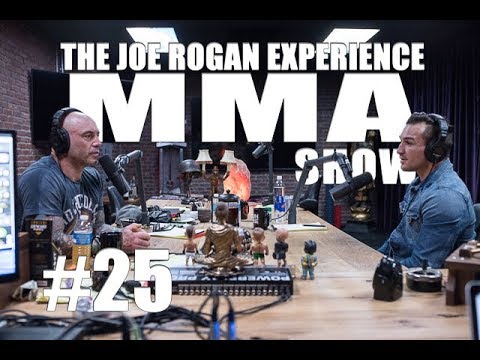
JRE MMA Show #25 with Michael Chandler
Joe Rogan (host), Michael Chandler (guest), Narrator, Narrator
In this episode of The Joe Rogan Experience, featuring Joe Rogan and Michael Chandler, JRE MMA Show #25 with Michael Chandler explores michael Chandler Explains Mindset, Adversity, And Future Beyond Bellator Cage Michael Chandler joins Joe Rogan to dig into the mental and physical evolution behind his MMA career, including a brutal three‑fight losing streak and the 688 days he went without a win. He breaks down how visualization, “mental highlight reels,” and extreme ownership of his mindset transformed him from a purely grind‑focused wrestler into a more composed, confident veteran. They analyze self‑sabotage, confidence, weight‑cutting, judging, and stylistic matchups in MMA, frequently using Chandler’s fights with Eddie Alvarez and others as case studies. The conversation closes with Chandler’s new Nashville gym, his training philosophy, and the open question of if and when he’ll move from Bellator to the UFC.
Michael Chandler Explains Mindset, Adversity, And Future Beyond Bellator Cage
Michael Chandler joins Joe Rogan to dig into the mental and physical evolution behind his MMA career, including a brutal three‑fight losing streak and the 688 days he went without a win. He breaks down how visualization, “mental highlight reels,” and extreme ownership of his mindset transformed him from a purely grind‑focused wrestler into a more composed, confident veteran. They analyze self‑sabotage, confidence, weight‑cutting, judging, and stylistic matchups in MMA, frequently using Chandler’s fights with Eddie Alvarez and others as case studies. The conversation closes with Chandler’s new Nashville gym, his training philosophy, and the open question of if and when he’ll move from Bellator to the UFC.
Key Takeaways
Actively train your mindset, not just your body.
Chandler realized he did everything right physically but neglected his self‑image, confidence, and inner dialogue; he now treats mental work (visualization, affirmations, reflection) as non‑negotiable training, equal in importance to sparring or conditioning.
Get the full analysis with uListen AI
Use a ‘mental highlight reel’ to build real confidence.
He regularly replays his best performances in vivid detail—what he did, how it felt, even the environment—to remind himself he’s capable of excellence and to overwrite a lifelong tendency to downplay or immediately discard his own achievements.
Get the full analysis with uListen AI
Aim for success, not perfection, to avoid performance paralysis.
Chandler’s obsession with perfection made every sparring exchange feel like a win/lose event, eroding his confidence; shifting his focus to overall success and big‑picture progress allowed him to perform looser and smarter under pressure.
Get the full analysis with uListen AI
Simplify your game to what wins for *you*.
He warns against over‑complicating MMA with too many techniques or trying to fight like others (e. ...
Get the full analysis with uListen AI
Extreme ownership means owning losses, emotions, and preparation.
Rather than blaming circumstances, Chandler reframed his losing streak as a product of his own mental lapses and complacency, using it as data to improve his training, mindset, and life structure instead of as a permanent indictment of his abilities.
Get the full analysis with uListen AI
Wrestling’s real edge is as much mental as technical.
He credits collegiate wrestling with making him comfortable being uncomfortable—living dehydrated, exhausted, and overworked—which translates into delayed gratification, coachability, and the psychological toughness to push through MMA adversity.
Get the full analysis with uListen AI
Build an environment that supports performance and longevity.
From carefully structured camps and intelligent strength work to regular soft‑tissue therapy, nutrition, and now his own all‑in‑one Nashville facility, Chandler emphasizes designing systems and surroundings that reduce injury risk and sustain a long career.
Get the full analysis with uListen AI
Notable Quotes
“If you’re not constantly taking extreme ownership of your mental state, of your confidence, your self‑image, I think a healthy self‑image is the most important component of being successful in life.”
— Michael Chandler
“Until you actually see it in your mind’s eye, you can’t actually achieve it—or you’ll get right on the cusp and find a way to sabotage yourself because you don’t truly believe you deserve it.”
— Michael Chandler
“Every single thing that you want to accomplish is waiting for you right outside of your comfort zone.”
— Michael Chandler
“I was focusing on perfection. You can’t be perfect. The greatest athletes in the world will tell you they are not perfect.”
— Michael Chandler
“At the end of the day, somebody has to be the best. Why shouldn’t it be you?”
— Michael Chandler
Questions Answered in This Episode
How would Chandler’s mental‑training framework (visualization, highlight reels, ownership) translate for someone in business or a non‑sports career?
Michael Chandler joins Joe Rogan to dig into the mental and physical evolution behind his MMA career, including a brutal three‑fight losing streak and the 688 days he went without a win. ...
Get the full analysis with uListen AI
To what extent did Chandler’s three‑fight skid actually *help* him become a better, more complete fighter compared to if he had stayed undefeated during that stretch?
Get the full analysis with uListen AI
If major promotions agreed to cross‑promotion, which specific matchups involving Chandler (e.g., Khabib, Gaethje, Poirier, Lee) would most clearly test the limits of his current style and mindset?
Get the full analysis with uListen AI
How could athletic commissions realistically reform MMA judging—more judges, different criteria, mandatory martial arts backgrounds—to address the systemic problems Rogan and Chandler describe?
Get the full analysis with uListen AI
What are the long‑term consequences, both physical and psychological, for fighters like Justin Gaethje who consciously choose chaotic, high‑damage styles, and can they ever truly retool mid‑career?
Get the full analysis with uListen AI
Transcript Preview
(tongue clicking) Four, three, two... (knocks on table) Boom. And we're live.
Oh.
How are you, brother?
I'm great, man. Living the dream.
Great to have you in here, man.
Thank you.
I've been, uh-
Great to be here.
Yeah. I mean, I've been wantin' to have you on for a long time, man. I've been followin' your career forever, and I've been a big fan forever. So, it's nice to be able to sit down with you.
I know, man. This is awesome. This is, uh... I've been a big fan of the, of yours obviously, and the podcast for a long time. So to be in here, get the tour, check out your awesome man warehouse-
This is all just-
... I think every man's dream.
... this is an elaborate plot to convince me to get you to join the UFC.
(laughs)
That's all this is.
Oh, my gosh. Right away?
(laughs)
Right away? We just... We wanna go straight to it? Okay. (laughs)
Well, I just... I mean, I-
All of this could be yours. (laughs)
Look, I appreciate Rory MacDonald going over there.
(laughs)
I know he did what he had to do, but even that one bums me out, you know?
Yeah, right. Yeah.
Uh, I just, I wanted to, I wanna see you fight the best guys in the world.
Mm-hmm.
And I think, uh, right now over in Bellator, you have very good competition, but I don't think you have the best guys. And I think you're one of the best guys.
I think, uh, I think I wake up every morning and think I'm the, I'm the best guy in the world too. You know?
I think that's the way to think if you wanna be the best guy in the world.
So, uh, (laughs) that is, that's the way I've been thinking for a while. Uh, not always in my career. I mean, I've had some losses where I've, you know, had temporary lapses of confidence and whatnot, whether it be my training or my abilities in myself, or my thoughts and my abilities and myself. But, I mean, where I'm at right now, firing on all cylinders, I feel like everything's working, so...
Do you feel like those moments where you haven't been at your best, where you've had lapses, and then you felt those dark moments, do those motivate you to never let that happen again?
Yeah. I mean, I think... I actually went through, for those, the people that don't know, I went through three losses in a row. I mean, that's, that's rough. I mean, the first loss to Eddie Alvarez was a tough split decision. A lot of people thought I won. Um, so you kinda get this, you know, "Oh, woe is me" attitude, which I, I never had really had before. And all of a sudden it's like, "Why did this happen to me?" Then had a back injury and then fought Will Brooks when I shouldn't have on one week's, basically one week of training, which led to another loss, which led to another lack of confidence, and then another loss. So, I went through that tough, dark time, you know? And I think there were certain aspects of it, of it that was, it was me taking, taking the sport for granted. It was me taking my abilities for granted. And also just not taking extreme ownership of my mental state. Like, realizing that I might be the hardest worker in the gym. I am the hardest worker in the gym. At every gym I go to, I'm the hardest worker. I live life right. I do the right things. Um, but if you're not constantly taking extreme ownership of your mental state, of your confidence, your self-image, um, I think a healthy self-image is the, um, the most important component of being successful in life. And I just, I wasn't taking care of that aspect of my life.
Install uListen to search the full transcript and get AI-powered insights
Get Full TranscriptGet more from every podcast
AI summaries, searchable transcripts, and fact-checking. Free forever.
Add to Chrome