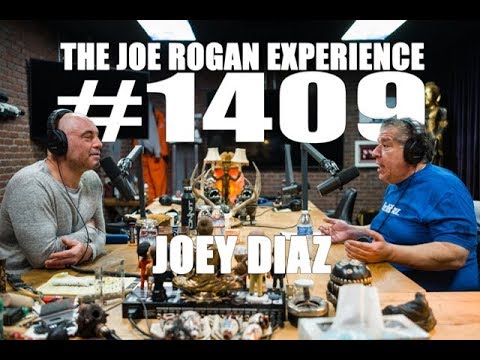
Joe Rogan Experience #1409 - Joey Diaz
Joey Diaz (guest), Joe Rogan (host), Jamie Vernon (host), Jamie Vernon (host), Narrator, Narrator, Jamie Vernon (host), Jamie Vernon (host), Narrator, Jamie Vernon (host)
In this episode of The Joe Rogan Experience, featuring Joey Diaz and Joe Rogan, Joe Rogan Experience #1409 - Joey Diaz explores cars, Comedy, and Chaos: Joey Diaz and Rogan on Life’s Extremes Joe Rogan and Joey Diaz riff through a sprawling, free-form conversation that swings from cars and technology to comedy craft, drugs, sex, crime, and cultural change. They nostalgically dissect old muscle cars, boxing legends, and vintage TV, while comparing past eras to today’s entertainment and political correctness. The pair dig into dark territory—Catholic church abuse, Jeffrey Epstein, R. Kelly, Hollywood predators—and how power, fame, and denial enable predation. Interwoven throughout are insights on stand-up discipline, touring routines, aging, health, and why laughter and self-deprecation are essential survival tools.
Cars, Comedy, and Chaos: Joey Diaz and Rogan on Life’s Extremes
Joe Rogan and Joey Diaz riff through a sprawling, free-form conversation that swings from cars and technology to comedy craft, drugs, sex, crime, and cultural change. They nostalgically dissect old muscle cars, boxing legends, and vintage TV, while comparing past eras to today’s entertainment and political correctness. The pair dig into dark territory—Catholic church abuse, Jeffrey Epstein, R. Kelly, Hollywood predators—and how power, fame, and denial enable predation. Interwoven throughout are insights on stand-up discipline, touring routines, aging, health, and why laughter and self-deprecation are essential survival tools.
Key Takeaways
Reliability and value often matter more than status in big purchases.
Diaz’s almost comical loyalty to Subaru and Toyota/Lexus underlines a practical lesson: choose tools (cars, etc. ...
Get the full analysis with uListen AI
Sustainable creative careers require disciplined systems, not just inspiration.
They emphasize structured writing (pads, iPads, tagging bits), tight travel routines, working out on the road, and limiting distractions (social media, podcasts) to keep stand-up sharp over decades instead of burning out.
Get the full analysis with uListen AI
Testing new material in high-stakes rooms is crucial for growth.
Diaz talks about “sucking a bag of dicks” at The Comedy Store on purpose—using the toughest stage, not side rooms, to develop new jokes—accepting short-term failure for long-term improvement.
Get the full analysis with uListen AI
Power plus secrecy creates ideal conditions for abuse.
Their discussions of priests, Epstein, Weinstein, Fox News, and conversion-therapy camps repeatedly show the same pattern: insulated authority figures, lack of oversight, and communities unwilling to confront uncomfortable truths.
Get the full analysis with uListen AI
Cultural standards shift dramatically, but archives don’t.
From racist songs and blackface-era media to transphobic 90s comedies, they note that much beloved legacy content would be “unairable” today—raising hard questions about whether to censor, context-label, or leave it untouched.
Get the full analysis with uListen AI
Laughter and the ability to laugh at yourself reduce stress.
They frame humor as a core human need—on par with sleep and food—and argue that self-directed jokes and nightly decompression with stand-up or silly videos are essential to coping with life’s pressure and trauma.
Get the full analysis with uListen AI
Money and fame can easily derail skill if discipline slips.
Using Conor McGregor and many comics who chased producing deals as examples, they stress that success often erodes hunger—the key question becomes whether a rich person can still train, write, and grind like they’re broke.
Get the full analysis with uListen AI
Notable Quotes
“All cars are good now. You can’t make a shitty car anymore.”
— Joe Rogan
“The only way you learn how not to be a me-too’er is by me-too’ing somebody once and going, ‘That wasn’t right, I’ll never do that again.’”
— Joey Diaz
“Sometimes great people have done horrible, horrible things.”
— Joe Rogan
“Once you learn how to laugh at yourself, your life changes completely.”
— Joey Diaz
“The question has always been whether or not a rich man has the motivation to work like a poor man.”
— Joe Rogan
Questions Answered in This Episode
How should society handle historically important but offensive media—remove it, label it, or leave it alone?
Joe Rogan and Joey Diaz riff through a sprawling, free-form conversation that swings from cars and technology to comedy craft, drugs, sex, crime, and cultural change. ...
Get the full analysis with uListen AI
What concrete safeguards could reduce abuse in powerful institutions like churches, media, and politics without destroying their core functions?
Get the full analysis with uListen AI
How do comedians balance the need to take big risks onstage with the modern backlash environment around sensitive topics?
Get the full analysis with uListen AI
In what ways do nostalgia for older eras (cars, TV, boxing) blind us to the real dangers and problems of those times?
Get the full analysis with uListen AI
What personal systems or habits are most effective for staying grounded and disciplined after achieving major financial or career success?
Get the full analysis with uListen AI
Transcript Preview
Get that picture of that fucking monkey I sent you this morning for breakfast?
What's that?
Who sends you those type of pictures anymore?
What, what, oh, that-
The pictures.
... that, that, the picture you sent me? Yeah, that, that girl's, uh, lovely private parts?
Oh.
That's the best name for a vagina, monkey. (laughs)
(laughs) I send them to everybody too, presidents of corporations-
(laughs)
... cops, on Monday, happy Monday.
(laughs)
You make their day, everybody's day is a lot better. Start the day on the right foot, you know? (laughs)
Especially p- presidents of corporations, people that... Can you imagine if you had to work in a fucking office for your, your, your whole life, as old as we are now? If we were in an office since the time we were really 23, 24 years old? Right outta school, just every day, button down, trying not to say anything that's gonna get you in trouble. Just trying to fucking make it to five o'clock, and then immediately go to a bar and talk shit with your friends, and then do it all over again on Monday. Oh.
I, I time it so I know you're in a meeting.
(laughs)
I know that you're in a meeting with eight white dudes-
(laughs)
... and they're real serious about, you know, numbers has to be up, statistics. And all of a sudden your phone rings, you fucking open it up and it's a picture of a woman's vagina.
(laughs)
And it breaks up the whole morning, you're like, "Thank God Joey Diaz exists, because he understands what I'm going through."
h-
That's tough, that's tough, going to sales meetings. I used to go to sales meetings and they talk about... Dog, do you know I went to Anthony Robbins, uh, things?
Did you?
When I was a burglar I went to Anthony Robbins things.
To be a better burglar?
No, and I ended up kidnapping the motherfucker. He focused me.
(laughs)
I walked on the coals. I was all in with Anthony Robbins-
You walked on the coals?
... you do know this.
Really, you wa-
Because I worked for a Subaru dealership, so Subaru paid for you to go to Anthony Robbins seminars. So they would give me, like, three bills for the day for per diem. I would go to Denver and do the Anthony Robbins seminar. And I read the books-
Dude, you should be a Subaru spokesperson. Who's more loyal to Subaru than you?
Nobody.
You fucking love Subarus.
Love 'em.
(laughs)
Love 'em. I just cannot...
Because you lived in Boulder.
I lived in Aspen.
Yes.
And I saw vans, I saw every type of high level car spin around, and you just lose control and I... Did you ever lose control in Colorado?
Install uListen to search the full transcript and get AI-powered insights
Get Full TranscriptGet more from every podcast
AI summaries, searchable transcripts, and fact-checking. Free forever.
Add to Chrome