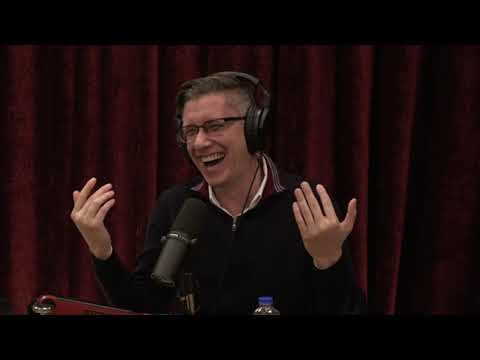
Joe Rogan Experience #1748 - Beeple
Narrator, Narrator, Joe Rogan (host), Mike "Beeple" Winkelmann (guest), Narrator
In this episode of The Joe Rogan Experience, featuring Narrator and Narrator, Joe Rogan Experience #1748 - Beeple explores beeple Explains NFTs, Digital Art Obsession, and Our Techno-Weird Future Joe Rogan talks with digital artist Beeple about his explosive success in NFTs, how they work, and why he believes they’ll become a standard part of the internet like email. They dive into DAOs, using NFTs for charity, and the risks of online voting and manipulation by troll farms. Beeple walks through his 14-year streak of creating daily digital artworks, his tools and process, and the strange evolution of his imagery and career from obscure freelancer to $100M NFT sales. The conversation widens into phones, VR, the metaverse, AI graphics, cyborg futures, global supply chains, and how massive online audiences inevitably generate backlash and misinterpretation of art.
Beeple Explains NFTs, Digital Art Obsession, and Our Techno-Weird Future
Joe Rogan talks with digital artist Beeple about his explosive success in NFTs, how they work, and why he believes they’ll become a standard part of the internet like email. They dive into DAOs, using NFTs for charity, and the risks of online voting and manipulation by troll farms. Beeple walks through his 14-year streak of creating daily digital artworks, his tools and process, and the strange evolution of his imagery and career from obscure freelancer to $100M NFT sales. The conversation widens into phones, VR, the metaverse, AI graphics, cyborg futures, global supply chains, and how massive online audiences inevitably generate backlash and misinterpretation of art.
Key Takeaways
NFTs are primarily a programmable proof of ownership layer for digital stuff.
Beeple frames NFTs as a cryptographic receipt that can attach ownership, access, or voting rights to any digital asset, and expects them to permeate multiple industries far beyond art, becoming a default internet primitive like email.
Get the full analysis with uListen AI
DAOs can rapidly mobilize people and money around shared goals—but are exploitable.
The ConstitutionDAO example shows how 20,000 people quickly pooled ~$40M to bid on a historic document, yet Rogan notes that any online voting or governance can be gamed by paid trolls, bots, or hostile campaigns unless there are strong economic and structural filters.
Get the full analysis with uListen AI
A relentless daily practice can quietly compound into massive opportunity.
Beeple’s 14+ years of creating and posting an artwork every single day—no days off, ever—built skill, a huge library of assets, and a large audience that later made his rapid NFT success and big commercial collaborations (Louis Vuitton, Super Bowl visuals, major artists) possible.
Get the full analysis with uListen AI
Modern digital art is heavily modular, iterative, and toolkit-driven.
Using Cinema 4D, Octane, downloaded 3D models (including $12 penis models and $80 Trump heads), and painterly post-filters, Beeple rapidly kitbashes scenes, often starting from a loose idea and discovering the final concept under time pressure before midnight.
Get the full analysis with uListen AI
Hyperreal game engines are collapsing the line between film, games, and reality.
They look at Unreal Engine demos like The Matrix Awakens, where real-time graphics are nearly indistinguishable from live action, suggesting near-future art, games, and metaverse experiences will be limited more by imagination than by rendering power.
Get the full analysis with uListen AI
Our most advanced devices are built on disturbingly primitive labor conditions.
Rogan highlights how minerals like coltan and many phone components come from child and near-slave labor and harsh Chinese factories, pointing out the moral contradiction of cutting-edge smartphones built on 7-year-olds digging with sticks, and arguing for ethically sourced or U. ...
Get the full analysis with uListen AI
At scale, creators must accept misinterpretation, offense, and online venom as ambient noise.
Beeple notes how people project elaborate meanings and politics onto his work (especially Trump/Hillary/gender pieces), while Rogan emphasizes that a fixed percentage of any large audience will hate you, often revealing more about their own state than about the art itself.
Get the full analysis with uListen AI
Notable Quotes
“I think NFTs are going to be like email. You don't get to be like, 'I don't like it.' It's just going to be part of being on the internet.”
— Beeple
“We did over $100 million this year. It's an incredible amount of money. It's insane.”
— Beeple
“Out of all the things that are ridiculously profitable, this is one of the most confusing and one of the ones I never saw coming.”
— Joe Rogan
“When you see people just going online being a dick and spreading shittiness, that says way more about them and what's going on in their life than about you.”
— Beeple
“The pinnacle of technology is directly connected to slave labor… you follow it down and you get people who are the poorest people on Earth digging holes in the ground with sticks.”
— Joe Rogan
Questions Answered in This Episode
If NFTs become as ubiquitous as email, how will that change the way artists, entertainers, and everyday users relate to ownership and value online?
Joe Rogan talks with digital artist Beeple about his explosive success in NFTs, how they work, and why he believes they’ll become a standard part of the internet like email. ...
Get the full analysis with uListen AI
What safeguards would a realistic, large-scale DAO need to prevent manipulation by troll farms, bots, or hostile governments while still feeling decentralized and democratic?
Get the full analysis with uListen AI
How far can a daily creative practice like Beeple’s “Everydays” go before it becomes more about the streak than about artistic exploration—and does that matter?
Get the full analysis with uListen AI
As game engines and VR/AR make virtual worlds nearly indistinguishable from reality, what kinds of art experiences become possible that can’t exist in the physical world at all?
Get the full analysis with uListen AI
Given the ethical issues in tech supply chains, would you pay significantly more for a phone or device that was verifiably built without slave or child labor—and what would it take for that to go mainstream?
Get the full analysis with uListen AI
Transcript Preview
(drumming music) Joe Rogan podcast, check it out.
The Joe Rogan Experience.
Train by day, Joe Rogan podcast by night. All day. (instrumental music) Hello, Mike.
Hey, how's it going? (laughs)
You, you look exactly how I thought you were gonna look.
(laughs)
Isn't that perfect?
How was that?
Good. You look like a-
(laughs)
... like a eccentric-
(laughs)
... fun art guy.
An eccentric... (laughs) Fun art guy. Okay, I'll take that.
All those things are positive.
I'll take that.
They're all- it's all positive.
I guess that's-
It's all positive.
That's actually pretty accurate right now, I guess.
Yeah.
I guess we're-
You're an eccentric-
... I guess we're right there.
... fun art guy.
Uh, yeah. (laughs)
And I brought you in here for one specific reason.
Okay, what's that?
Or two reasons. One, 'cause I think you're really talented and I enjoy your stuff.
Thank you, thank you.
Two, because I want you to explain NFTs to me. (laughs)
Okay.
Because-
(laughs)
... Jamie's tried, everyone's tried.
Tried multiple times.
Dude-
And y- you are probably the most famous NFT guy right now, in terms of, like, your success with NFTs. Like, your- your NFTs have... What did you... You sold for, like, an exorbitant amount of money.
We did over $100 million this year. (laughs)
$100 million?
Over $100 million.
See, that's what I'm saying.
Not counting, like, secondary sales.
Yeah.
Like, just primary sales, over $100 million.
That's an incredible amount of money.
Yeah, it's an incredible amount of money. It's insane. Like, it's... Like, saying that is just-
What does that mean?
... like, mind-boggling to me.
Does that, does that even-
Like, I don't e- e- I don't know what that means.
It's like you're speaking words in French-
I don't know what that means.
... that you don't know the names or the-
Pretty much.
... you don't know the definitions of?
Yeah, yeah. It's, it's something that I think is gonna take a long time to process, because it's so new and it's something that just came outta nowhere.
Right.
Like, again, I did not know of this, like, a year ago.
What does it mean?
What does NFT mean?
Yeah, what does it mean?
So-
I know it's a non-fungible token, but what is that?
So, it's basically just a proof of sort of, like, ownership of something. It's really can be sort of, like, applied to, like, a bunch of different things. And to be quite honest, there's a bunch of ways you could use it. And, and, like, I think it would be very interesting way to sort of, like, interact with your fans. And I think it will sort of permeate a bunch of different sort of, like, industries, not just art. That's just sort of the beginning of it. I think it's gonna be, like, email. It's gonna be, like, something where you don't get to be, like, "I don't like it." It's just gonna be, like, you have... It's, like, part of being on the internet.
Install uListen to search the full transcript and get AI-powered insights
Get Full TranscriptGet more from every podcast
AI summaries, searchable transcripts, and fact-checking. Free forever.
Add to Chrome