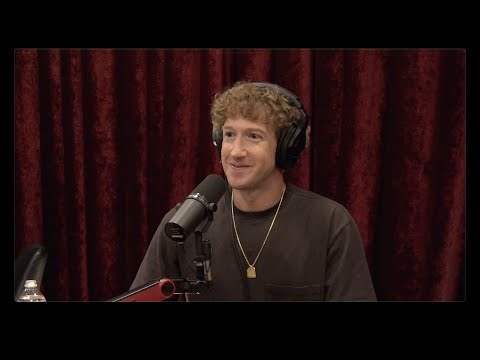
Joe Rogan Experience #2255 - Mark Zuckerberg
Mark Zuckerberg (guest), Joe Rogan (host), Narrator
In this episode of The Joe Rogan Experience, featuring Mark Zuckerberg and Joe Rogan, Joe Rogan Experience #2255 - Mark Zuckerberg explores zuckerberg, Rogan Debate Free Speech, Censorship, AI, and Future Tech Mark Zuckerberg and Joe Rogan trace how Facebook/Meta shifted from early free-expression ideals into a decade of mounting governmental, media, and institutional pressure to censor content—especially around Trump’s 2016 election and COVID-19.
Zuckerberg, Rogan Debate Free Speech, Censorship, AI, and Future Tech
Mark Zuckerberg and Joe Rogan trace how Facebook/Meta shifted from early free-expression ideals into a decade of mounting governmental, media, and institutional pressure to censor content—especially around Trump’s 2016 election and COVID-19.
Zuckerberg details specific attempts by the Biden administration and other officials to coerce Meta into removing true but politically inconvenient information, and explains why Meta is now rolling back fact-checker-driven censorship in favor of higher precision filters and X-style community notes.
They broaden the discussion to global government overreach, Apple’s control over mobile ecosystems, the geopolitical AI arms race, and why Zuckerberg is aggressively open-sourcing Meta’s AI to avoid a single state or company monopoly.
The conversation also explores how martial arts, hunting, AR/VR, and parenting intersect with technology, arguing that both individual resilience and widespread access to powerful tools are critical in a world where trust in institutions has collapsed.
Key Takeaways
Meta is pivoting back toward robust free expression after a decade of ideological pressure.
Zuckerberg says internal reflection on 2016–2024 convinced him Meta over-deferred to media narratives and government pressure, so it is dismantling much of its fact-checker-driven censorship and tightening the scope of what is restricted.
Get the full analysis with uListen AI
Government attempts to control online speech crossed legal and ethical lines during COVID.
He recounts Biden administration officials angrily demanding removal of truthful vaccine side-effect content and even memes, arguing this likely violated First Amendment limits on government-directed censorship of private platforms.
Get the full analysis with uListen AI
Moderation at scale is fundamentally a precision vs. coverage trade-off, and Meta is dialing back aggressiveness.
Because AI classifiers mislabel millions of benign posts when tuned to catch nearly all harmful content, Meta is raising the confidence thresholds required for enforcement, accepting more missed bad content to dramatically reduce wrongful takedowns.
Get the full analysis with uListen AI
Misinformation and hate speech became politicized categories that drifted into suppressing mainstream debate.
Zuckerberg cites examples like prior bans on arguing women shouldn’t serve in certain combat roles—positions openly debated in Congress—as evidence that well-intentioned ‘hate speech’ rules had effectively outlawed legitimate political discourse.
Get the full analysis with uListen AI
Community-driven context (like X’s Community Notes) is seen as a better alternative to centralized fact-checking.
Meta plans to replace much of its third‑party fact-check program with systems that surface additional context from diverse users, aiming to add information rather than covertly suppress reach based on a small group’s judgments.
Get the full analysis with uListen AI
Zuckerberg believes open-sourcing AI is key to avoiding a single-government or single-company ‘god model.’
He argues it’s safer and more democratic if powerful AI is widely available—so AIs can defend against other AIs—than if it’s locked up by one state (e. ...
Get the full analysis with uListen AI
AR glasses, neural interfaces, and AI coworkers will blur digital and physical life rather than isolate people.
He envisions glasses that overlay information, holographic colleagues (human and AI) in meetings, and wrist-based neural inputs for silent texting and AI queries, making computing ubiquitous but less visually isolating than phones.
Get the full analysis with uListen AI
Notable Quotes
“We started off focused on free expression, then got pressure‑tested by Trump and COVID, and realized we’d slid down a slippery slope we weren’t happy with.”
— Mark Zuckerberg
“They basically pushed us and said, ‘Anything that says vaccines might have side effects, you need to take down.’ And I was just like, ‘We’re clearly not going to do that.’”
— Mark Zuckerberg
“Moderating at scale is insane. You’re talking about more than a third of the planet every day.”
— Joe Rogan
“I don’t think you want to live in a world where only one person has all the guns. You certainly don’t want to live in a world where only the government has the AI.”
— Mark Zuckerberg
“We need this whole cultural elite class to get repopulated with people who people actually trust… who will say the stuff you say in your living room with your friends.”
— Mark Zuckerberg
Questions Answered in This Episode
Where should platforms draw the line between responsible moderation and impermissible state-directed censorship, especially during crises like pandemics?
Mark Zuckerberg and Joe Rogan trace how Facebook/Meta shifted from early free-expression ideals into a decade of mounting governmental, media, and institutional pressure to censor content—especially around Trump’s 2016 election and COVID-19.
Get the full analysis with uListen AI
How can AI-driven moderation be made transparent enough that users understand why something was restricted and can challenge it effectively?
Zuckerberg details specific attempts by the Biden administration and other officials to coerce Meta into removing true but politically inconvenient information, and explains why Meta is now rolling back fact-checker-driven censorship in favor of higher precision filters and X-style community notes.
Get the full analysis with uListen AI
Is open-sourcing powerful AI models truly safer, or does it simply democratize the capability for bad actors as well as good ones?
They broaden the discussion to global government overreach, Apple’s control over mobile ecosystems, the geopolitical AI arms race, and why Zuckerberg is aggressively open-sourcing Meta’s AI to avoid a single state or company monopoly.
Get the full analysis with uListen AI
What practical checks could prevent future administrations—of any party—from repeating the kind of behind-the-scenes pressure campaigns described here?
The conversation also explores how martial arts, hunting, AR/VR, and parenting intersect with technology, arguing that both individual resilience and widespread access to powerful tools are critical in a world where trust in institutions has collapsed.
Get the full analysis with uListen AI
As AR glasses and neural interfaces become mainstream, how should society redefine concepts like privacy, attention, and genuine human presence?
Get the full analysis with uListen AI
Transcript Preview
(drumbeats) Joe Rogan podcast. Check it out. The Joe Rogan Experience.
Train by day, Joe Rogan podcast by night. All day. (instrumental music) All right, we're up. What's happening? Good to see you.
You too.
What's going on?
You know, chill week.
Yeah. (laughs)
(laughs)
Sorta. Um, this, uh, recent announcement that you did about, uh, content moderation, how has that been received?
Um, probably depends on who you ask.
Right. (laughs)
But, but, you know ... But look, I mean, I've been working on this for a long time, so, I mean, you gotta do what you think is, is right. You know, we- we've been on a long, a long journey here.
Mm-hmm.
Right? I mean, it's, um ... And I think at some level, you, you start, you only start one of these companies if you believe in giving people a voice. Right? I mean, I mean, the whole point of social media is basically, you know, giving people the ability to share, uh, what they want.
Right.
And, um, and, you know, it goes back to, you know, our original mission, is just give people the power to share and make the world more open and connected.
What do you think started the pathway towards increasing censorship? Because clearly we were going in that direction for the last few years. It seemed like, uh, we really found out about it when Elon bought Twitter and we got the Twitter files, and when-
Yeah.
... you came on here, and when you were explaining the relationship with FBI, where they were trying to get you to take down certain things that were true and real, and certain things they tried to get you to limit the exposure to them. So, it's these kind of conversations. Like, when did all that start?
Yeah, well, well, look, I, I think going back to the beginning, or like I was saying, I think you, you start one of these if you care about, about giving people a voice. You know, I di- ... I wasn't too deep on our content policies for, like, the first 10 years of the company. It was just kinda well-known across the company that, um, we were trying to give people the ability to share as much as possible, and issues would come up, practical issues, right? So, if someone's getting bullied, for example, we'd deal with that, or we'd put in place systems to, to fight bullying. Um ...
Right.
You know, if someone is saying, "Hey," um, you know, someone's pirating copyrighted content on, on the service, it's like, "Okay, we'll build controls to make it so we'll find IP-protected content." But it was really in the last 10 years that people started pushing for, like, ideological-based censorship, and I think it was two main events that really triggered this. In 2016, there was the election of President Trump, um, also coincided with, uh, basically Brexit in the EU and, and sort of the fragmentation of the EU. And then, you know, in 2020, uh, there was COVID, and I, I think that those were basically these two events where, for the first time, um, we just placed ... we just faced this massive, massive institutional pressure to, uh, to basically start censoring content on ideological grounds. And-
Install uListen to search the full transcript and get AI-powered insights
Get Full TranscriptGet more from every podcast
AI summaries, searchable transcripts, and fact-checking. Free forever.
Add to Chrome