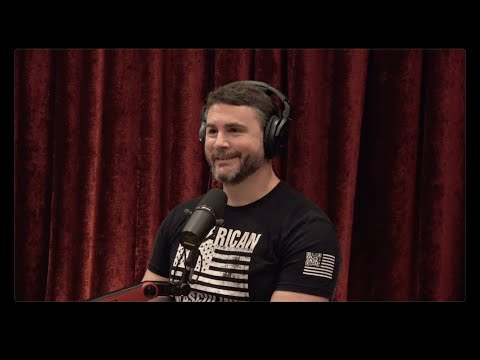
Joe Rogan Experience #2119 - James Lindsay
Joe Rogan (host), Narrator, James Lindsay (guest), Narrator, Narrator, Narrator, Narrator, Narrator, Narrator
In this episode of The Joe Rogan Experience, featuring Joe Rogan and Narrator, Joe Rogan Experience #2119 - James Lindsay explores james Lindsay Warns Joe Rogan: Woke Ideology Is Controlled Demolition Joe Rogan and James Lindsay spend the episode arguing that Western institutions are being deliberately destabilized via open borders, ESG finance, DEI, gender ideology, and captured education systems. Lindsay frames much of this as a long‑term Marxist/technocratic project tied to global governance bodies, Soros-style ‘open society’ funding, and China’s rise. They discuss how culture-war flashpoints—immigration, trans issues, climate policy, race, and COVID—function as tools of social control, surveillance, and economic “degrowth” rather than organic moral progress. Throughout, they compare these trends to historical communism, cult dynamics, and Maoist brainwashing, warning that both radical left and radical right authoritarian responses are potential outcomes.
James Lindsay Warns Joe Rogan: Woke Ideology Is Controlled Demolition
Joe Rogan and James Lindsay spend the episode arguing that Western institutions are being deliberately destabilized via open borders, ESG finance, DEI, gender ideology, and captured education systems. Lindsay frames much of this as a long‑term Marxist/technocratic project tied to global governance bodies, Soros-style ‘open society’ funding, and China’s rise. They discuss how culture-war flashpoints—immigration, trans issues, climate policy, race, and COVID—function as tools of social control, surveillance, and economic “degrowth” rather than organic moral progress. Throughout, they compare these trends to historical communism, cult dynamics, and Maoist brainwashing, warning that both radical left and radical right authoritarian responses are potential outcomes.
Key Takeaways
System overload can be a political strategy, not a policy failure.
Lindsay cites the Cloward–Piven strategy: flooding social services and border systems can intentionally create crises that justify new centralized controls like digital ID, expanded federal power over states, or global governance mechanisms.
Get the full analysis with uListen AI
Follow the money: ESG and DEI act as enforcement tools for ideology.
They argue ESG scores and related frameworks let asset managers and NGOs redirect trillions in pension and passive investment capital toward companies that adopt specific political agendas (DEI, climate, LGBT lobbying), effectively creating a corporate social-credit system.
Get the full analysis with uListen AI
Education faculties are a primary capture point for long‑term social change.
Lindsay claims Marxist ‘critical pedagogy’ took over colleges of education by the early 1990s, which means those faculties now shape most teachers and administrators, and thus what K–12 students are exposed to across generations.
Get the full analysis with uListen AI
Queer theory is framed as anti‑normativity, not just gay rights.
He emphasizes that, in the theory’s own texts, “queer” means opposition to the normal and legitimate, not simply same‑sex attraction—so activism around drag queen story hours, school curricula, and pronouns is about destabilizing norms, including boundaries around childhood and sexuality.
Get the full analysis with uListen AI
Authoritarian systems always eat their own activists once power is consolidated.
Drawing on Mao’s Red Guard and Soviet history, Lindsay warns that radicalized youth movements are useful for destabilizing society, but historically are purged or sidelined once a new regime is secure—leaving former revolutionaries discarded or persecuted.
Get the full analysis with uListen AI
Climate and public‑health emergencies can be leveraged to centralize authority.
They argue proposed WHO pandemic treaties, “misinformation” rules, and aggressive climate targets (like ‘absolute zero’ carbon, meat bans, and flight reduction) are less about science and more about creating legal pretexts for censorship, travel limits, and economic ‘degrowth’ in the West.
Get the full analysis with uListen AI
Strong personal and religious frameworks can inoculate against cult-like politics.
Lindsay suggests traditional religions—especially when God is seen as above the state—make it harder for totalitarian ideologies to fully capture individuals, whereas secular people often fill that void with political or social-justice cults.
Get the full analysis with uListen AI
Notable Quotes
“Communism is what's happening to this country. It just doesn’t look like communism, because it's Nike, it's Boeing, it's Disney.”
— James Lindsay
“Stability repels revolutions. If you can destabilize a population, you can get them to crave radical political change.”
— James Lindsay
“Queer theory opens the gates to hell.”
— James Lindsay
“If you put your tinfoil hat back on and believe there are people pulling strings, I promise you they do not care whether a radical left or a radical right breaks the Constitution—as long as the Constitution gets broken.”
— James Lindsay
“It’s weird to watch human folly at scale, at the scale that we’re witnessing.”
— Joe Rogan
Questions Answered in This Episode
Which of Lindsay’s claims are most strongly supported by primary sources, and which rest more on inference or pattern recognition?
Joe Rogan and James Lindsay spend the episode arguing that Western institutions are being deliberately destabilized via open borders, ESG finance, DEI, gender ideology, and captured education systems. ...
Get the full analysis with uListen AI
How can societies distinguish between legitimate public-health or climate measures and those primarily intended to centralize political or financial power?
Get the full analysis with uListen AI
What safeguards—legal, educational, or cultural—could realistically prevent universities from becoming long-term ideological monopolies?
Get the full analysis with uListen AI
Is there a way to protect LGBT people from genuine discrimination while drawing firm boundaries around childhood, medicalization, and school content?
Get the full analysis with uListen AI
If both aggressive ‘woke’ progressivism and reactionary Christian nationalism can drift into authoritarianism, what does a robust, non‑authoritarian alternative look like in practice?
Get the full analysis with uListen AI
Transcript Preview
(drumbeats) Joe Rogan podcast, check it out.
The Joe Rogan Experience.
Train by day, Joe Rogan podcast by night. All day. (rock music plays) James Jensen, how are you, sir?
I'm good, Joe.
'Cause you're an American masculine already, sure. We both, uh, we didn't even coordinate, but we're both wearing American flags.
Yeah, well, I mean, it's that kind of ... It's, it's that time, right? It's-
Yeah.
... time to start saying, "You know what? I'm an American," (laughs) and that's cool.
Before you say, uh, that, I mean, if you don't, we're, we're on the way to saying, "I'm Chinese." (laughs)
Yeah. (laughs)
(laughs)
Uh, well, uh, how's your Mandarin?
Yeah. Might be a good time to learn it as they're, they're all sneaking in across the border. That's one of the more disturbing things. When I talked to Bret Weinstein, he was talking about how many, uh, Chinese m- military-aged men are sneaking across the border. And you wanna, you wanna look at it the best way possible. You say, well, it's probably a bunch of people that are looking for work, and it's probably a bunch of people that are ... You know, there's not as many Chinese women, and they're trying, looking for a girlfriend or something. And-
Yeah.
... why do they have military haircuts? Well, they're probably, you know, it's just like a young man thing, hmm?
Yeah. I mean, I've heard more specifically, I can't vet it, so I can't prove it, and so I like... There's the grain of salt upfront, but I have, I've heard that even Chinese special forces ... If I was a special forces of a hostile country, I'd try to sneak across and do infiltration. So, I've heard that there might be even, you know, hundreds or thousands of those. Not hundreds of thousands, hundreds or thousands. But I don't know if that's true, but ...
Well, I wouldn't ... I- it's not even really sneaking in anymore, is it?
No, you just kinda walk across and ... I mean, there's even memes that are like, "I'm gonna go to Honduras and give up my American citizenship and come back across-
Yeah.
... so everything will be paid for for me." You know? It's like, no, it's not sneaking across. It's, it's, like f- as they are saying, full-scale invasion.
Well, it's just weird. It's weird that we've just kind of gone, "Well, well ..." We've always, uh, agre- ... I mean, there was always customs. There's always, you land, they check out your stuff, they look at your paperwork. They go through your passport. They ask you questions.
Yeah.
Why are you in this country? You know? And it's always been that way. Like, I, I was watching this video with the ... You know who Deadmau5 is?
Yeah.
Deadmau5, the m- musician, um, the DJ. He was, uh, uh, they ... He was trying to come into the country to visit his friend, and, uh, they said, "No, you're coming in to work." He's like, "No, no, I'm coming ..." 'Cause he's famous.
Install uListen to search the full transcript and get AI-powered insights
Get Full TranscriptGet more from every podcast
AI summaries, searchable transcripts, and fact-checking. Free forever.
Add to Chrome