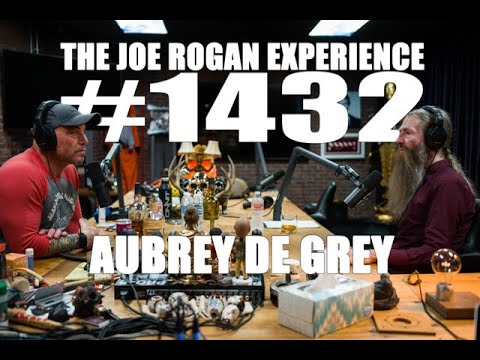
Joe Rogan Experience #1432 - Aubrey de Grey
Aubrey de Grey (guest), Joe Rogan (host)
In this episode of The Joe Rogan Experience, featuring Aubrey de Grey and Joe Rogan, Joe Rogan Experience #1432 - Aubrey de Grey explores aubrey de Grey Explains How We Might Defeat Aging This Century Aubrey de Grey outlines his damage-repair model of aging, arguing that we’ve basically understood the core biology for 20 years and now face an engineering and funding problem, not a conceptual one.
Aubrey de Grey Explains How We Might Defeat Aging This Century
Aubrey de Grey outlines his damage-repair model of aging, arguing that we’ve basically understood the core biology for 20 years and now face an engineering and funding problem, not a conceptual one.
He describes emerging therapies like stem cells, senolytics, and gene editing as components of a comprehensive rejuvenation toolkit that could plausibly yield human-scale benefits within a few decades, with key proof-of-concept work in mice coming within 3–5 years.
De Grey emphasizes philanthropy- and startup-driven research on the hardest aging problems, criticizes conservative funding structures and the cultural ‘pro‑aging trance,’ and predicts a sudden global policy and economic upheaval once the public realizes radical life extension is coming.
They also discuss ethical fears (overpopulation, dictators, inequality), lifestyle factors (stress, fasting, alcohol), and interactions with other technologies like AI, concluding that extended healthy life is both feasible and morally urgent.
Key Takeaways
Treat aging as a repairable accumulation of damage, not an inevitable decline.
De Grey compares the body to a car: normal operation slowly produces cellular and molecular damage; if we can periodically repair all major damage types, we can maintain or even reverse biological age.
Get the full analysis with uListen AI
Focus resources on the hardest aging problems that markets and governments neglect.
Because mainstream funding rewards low-risk, incremental work, SENS targets high-risk, high-reward approaches (e. ...
Get the full analysis with uListen AI
Use philanthropy and startups strategically to unlock orders-of-magnitude more capital.
Once a SENS project is de‑risked enough to spin into a company, investor money multiplies the budget, letting the foundation recycle its limited funds into earlier-stage, harder problems.
Get the full analysis with uListen AI
Expect a societal shock when expert opinion openly concedes aging is ‘solvable.’
De Grey predicts that once enough mouse data exist, cautious researchers will publicly agree aging can be defeated, prompting media figures to demand a ‘war on aging’ and forcing politicians to adopt anti-aging platforms almost overnight.
Get the full analysis with uListen AI
Don’t overestimate lifestyle hacks; they help, but won’t rival true rejuvenation tech.
Fasting, low stress, and healthy habits likely add a few years and reduce illness, but in long‑lived species the gains from caloric restriction are modest compared to what comprehensive damage-repair therapies could do.
Get the full analysis with uListen AI
Overpopulation and resource concerns can be addressed by parallel tech advances.
De Grey argues that renewable energy, lab-grown meat, desalination, and plastic cleanup will increase Earth’s carrying capacity faster than population grows, while fertility rates are already falling in most large countries.
Get the full analysis with uListen AI
Measure progress probabilistically and communicate uncertainty honestly.
He frames his ‘17‑year’ horizon for robust human rejuvenation as a 50/50 estimate that has drifted slowly over 15+ years, emphasizing that hardest bottlenecks and prior underfunding drive the residual risk.
Get the full analysis with uListen AI
Notable Quotes
“Aging is simply the same thing in a living organism as it is in a car. It’s the accumulation of damage from normal operation.”
— Aubrey de Grey
“Our understanding of aging has been pretty much complete for about 20 years. Now it’s all about solving the problem.”
— Aubrey de Grey
“People have had to find ways not to think about aging. I call it the pro‑aging trance.”
— Aubrey de Grey
“Once my colleagues can’t plausibly be pessimistic anymore, the world will switch from business as usual to a war on aging in about a week.”
— Aubrey de Grey
“Asking how long you want to live is like asking what time you want to go to the toilet next Sunday.”
— Aubrey de Grey
Questions Answered in This Episode
If we truly accept aging as a repairable medical problem, how should governments redesign healthcare, pensions, and education right now rather than waiting for a crisis of public expectation?
Aubrey de Grey outlines his damage-repair model of aging, arguing that we’ve basically understood the core biology for 20 years and now face an engineering and funding problem, not a conceptual one.
Get the full analysis with uListen AI
What safeguards are needed to ensure that powerful rejuvenation therapies don’t massively widen inequality between those who can and can’t afford them?
He describes emerging therapies like stem cells, senolytics, and gene editing as components of a comprehensive rejuvenation toolkit that could plausibly yield human-scale benefits within a few decades, with key proof-of-concept work in mice coming within 3–5 years.
Get the full analysis with uListen AI
Which specific mouse experiments or clinical milestones should the public watch for as indicators that we are nearing the ‘tipping point’ De Grey describes?
De Grey emphasizes philanthropy- and startup-driven research on the hardest aging problems, criticizes conservative funding structures and the cultural ‘pro‑aging trance,’ and predicts a sudden global policy and economic upheaval once the public realizes radical life extension is coming.
Get the full analysis with uListen AI
How should we balance prudent caution about unregulated stem cell tourism against the potential learning and relief it may already be providing to patients?
They also discuss ethical fears (overpopulation, dictators, inequality), lifestyle factors (stress, fasting, alcohol), and interactions with other technologies like AI, concluding that extended healthy life is both feasible and morally urgent.
Get the full analysis with uListen AI
If human work becomes largely automated while people live centuries in good health, what new systems of meaning, contribution, and social structure should we start designing today?
Get the full analysis with uListen AI
Transcript Preview
Three, two, one. Boom. Here we go.
What's up, man?
How are you? What's up?
Hey, did you trim your beard since I've seen you last?
No, I'm afraid not.
I feel like you have.
No. It may be a fraction shorter, but that's only because it's been falling out more.
It falls out?
Oh, yeah. I mean-
Wow.
... I stroke it all the time, you know? It's compulsive.
Oh. And so then you get these weird hairs that you have to-
(laughs) Well, actually, I don't notice it enough. I mean, it falls out slowly, you know, but-
Yeah.
... I guess, you know, I guess there's a certain amount of attrition.
So the beard's the same length?
Pretty much.
Have you gotten any younger since I've seen you last?
Yeah, hard to say.
Hard to say. But that is your, that is your business?
That's my business, yes.
How many years has it been since I saw you? Four?
Uh, f- nearly five, I think.
Five? Five years.
It was A- April of 2015.
Mm. And you have not, you have not gotten younger?
I have not gotten younger. I-
Have you maintained?
I think I've pretty much maintained, yes.
Yeah?
But not through my own work. Um, so the work is still very much ongoing, though we have come an awfully long way in the past five years. Uh, but, you know, this is a complicated thing to fix.
Yes.
And so... And we need to fix all of it in order to really make people start getting biologically younger.
So let's bring people up to speed. What, what have the, what are the latest revelations? What's the, the latest in terms of, uh, what we understand in, in terms of what could possibly be fixed about human aging?
All right, so the fantastic answer to that question is there are no new revelations in terms of what we understand. Our understanding seems to have been pretty much complete already, like 20 years ago. The fact that we haven't found out any fundamental new stuff that we didn't know before then is fantastic news, because of course it means that we're unlikely to find anything out in the future either. It means that we are pretty much on top of the description of the problem, and therefore it's all about solving the problem.
Is it b- possible to summarize the problem?
Sure.
What is the problem? What causes human aging?
Sure, that's easy. So aging is simply the same thing in a living organism like you or me as what it is in a car or an airplane or any other simple manmade machine. It's a fact of physics, nothing to do with biology, that any machine that has moving parts is gonna do itself damage in the course of its normal operation, as an intrinsic consequence of its normal operation.
Install uListen to search the full transcript and get AI-powered insights
Get Full TranscriptGet more from every podcast
AI summaries, searchable transcripts, and fact-checking. Free forever.
Add to Chrome