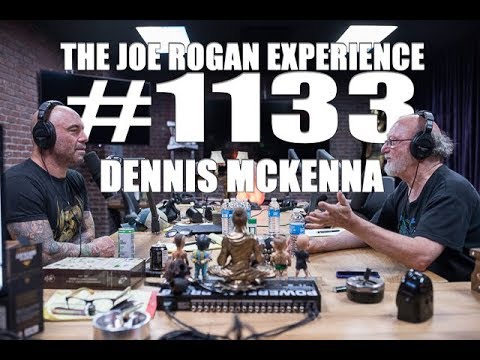
Joe Rogan Experience #1133 - Dennis McKenna
Joe Rogan (host), Dennis McKenna (guest), Narrator
In this episode of The Joe Rogan Experience, featuring Joe Rogan and Dennis McKenna, Joe Rogan Experience #1133 - Dennis McKenna explores dennis McKenna, Psychedelics, and Rethinking Humanity’s Future With Nature Dennis McKenna joins Joe Rogan to trace his history with the Institute for Ecotechnics, Biosphere 2, and the long-suppressed field of ethnopharmacology, culminating in his two‑volume book “Ethnopharmacologic Search for Psychoactive Drugs.”
Dennis McKenna, Psychedelics, and Rethinking Humanity’s Future With Nature
Dennis McKenna joins Joe Rogan to trace his history with the Institute for Ecotechnics, Biosphere 2, and the long-suppressed field of ethnopharmacology, culminating in his two‑volume book “Ethnopharmacologic Search for Psychoactive Drugs.”
They explore how psychedelics like ayahuasca, psilocybin, and DMT function as powerful learning tools, spiritual catalysts, and potential therapies, contrasting indigenous traditions with today’s tightly controlled clinical research.
McKenna argues that modern society is spiritually impoverished, politically broken, and ecologically destructive, and that psychedelics can help restore a symbiotic relationship with nature and foster wiser use of technology.
He outlines his plan for the McKenna Academy of Natural Philosophy in Peru—an interdisciplinary “psychedelic university” merging science, shamanism, and environmental thinking to support global consciousness change.
Key Takeaways
Psychedelics can replace blind faith with direct experience.
McKenna argues that substances like ayahuasca and psilocybin provide intensely personal, undeniable encounters with the sacred, reducing reliance on dogmatic belief systems and fostering critical, experiential spirituality instead.
Get the full analysis with uListen AI
Clinical trials are vital but too narrow a frame for psychedelics.
Current research (e. ...
Get the full analysis with uListen AI
Ayahuasca and plant teachers are underused yet globally impactful.
Despite regulatory hurdles and the complexity of whole-plant brews, ayahuasca is already transforming lives worldwide through retreats and traditional use, and deserves parity with synthesized compounds in research and policy.
Get the full analysis with uListen AI
Ethnopharmacology still holds vast, untapped discovery potential.
McKenna notes that many psychoactive plants, beta-carbolines, and associated “diet plants” remain poorly studied; systematic, respectful research could yield new therapeutics and a better understanding of human–plant coevolution.
Get the full analysis with uListen AI
Modern society suffers from spiritual and ecological amnesia.
He contends that Abrahamic religions and industrial culture have severed our sense of kinship with nature, legitimizing domination and extraction; psychedelics can help re-establish a symbiotic, systems-level view of life on Earth.
Get the full analysis with uListen AI
We need new institutions that merge science, shamanism, and philosophy.
The planned McKenna Academy aims to be a ‘natural philosophy’ hub—hosting retreats, research, and global conferences that integrate rigorous science with indigenous knowledge, free from corporate and narrow academic constraints.
Get the full analysis with uListen AI
Technology is powerful but morally neutral; wisdom must guide its use.
McKenna differentiates between human cleverness and wisdom, warning that without a moral compass informed by compassion and interconnection (which psychedelics can catalyze), advanced technologies may accelerate ecological and existential risk.
Get the full analysis with uListen AI
Notable Quotes
“Psychedelics are the antidote to faith. You don’t need faith to take a psychedelic. What you need is courage.”
— Dennis McKenna
“We are extremely clever, but we’re not wise.”
— Dennis McKenna
“We’re living in a hallucination, essentially, that’s constructed by our brains… psychedelics temporarily give you an opportunity to lower those mechanisms.”
— Dennis McKenna
“As a society, we are spiritually bereft… people crave spiritually meaningful experiences, and our culture needs it more than ever.”
— Dennis McKenna
“I think these psychedelics are medicines for the soul and medicines for our species in a certain sense.”
— Dennis McKenna
Questions Answered in This Episode
How would mainstream acceptance of ayahuasca and other plant medicines realistically change our healthcare and spiritual landscapes over the next 20 years?
Dennis McKenna joins Joe Rogan to trace his history with the Institute for Ecotechnics, Biosphere 2, and the long-suppressed field of ethnopharmacology, culminating in his two‑volume book “Ethnopharmacologic Search for Psychoactive Drugs.”
Get the full analysis with uListen AI
What safeguards and ethical frameworks are needed if we start combining cutting‑edge science with shamanic practices in places like the McKenna Academy?
They explore how psychedelics like ayahuasca, psilocybin, and DMT function as powerful learning tools, spiritual catalysts, and potential therapies, contrasting indigenous traditions with today’s tightly controlled clinical research.
Get the full analysis with uListen AI
How should we weigh the risks and benefits of psychedelics for people with serious trauma versus for the “well” who seek growth and creativity?
McKenna argues that modern society is spiritually impoverished, politically broken, and ecologically destructive, and that psychedelics can help restore a symbiotic relationship with nature and foster wiser use of technology.
Get the full analysis with uListen AI
If human cleverness continues to outpace wisdom, can psychedelics meaningfully alter our trajectory with technology, AI, and ecological collapse—or will they be co‑opted by the same systems?
He outlines his plan for the McKenna Academy of Natural Philosophy in Peru—an interdisciplinary “psychedelic university” merging science, shamanism, and environmental thinking to support global consciousness change.
Get the full analysis with uListen AI
To what extent do DMT entities and UFO-like experiences need to be ‘objectively real’ for them to be psychologically or culturally important?
Get the full analysis with uListen AI
Transcript Preview
Four, three, two, one. (claps) And we're live. Hello, Dennis.
Hi, Joe.
(laughs)
(laughs)
Great to see you, as always.
It's great to be here, as always. It's great to be here.
So tell me about this, these, these cards that you gave me and what, what this is all about.
Okay. Well, this is an interesting project. This is about the RV Heraclitus, which is a, which was associated with the Institute for Ecotechnics, which is ... Try to keep this, like, close to your face.
Yeah. Okay. There you go.
Further, uh, associated with, uh ... (sighs) You know, how do I explain it? It was actually a theater company called The Theater of All Possibilities. But the Institute for Ecotechnics was started in the early '70s, and they built a ship, this, this, uh, Chinese junk, essentially, with a ferro-concrete hull. And my connection was they have cruised, cruised the world, essentially, since 1973, looking into different things relevant to global ecology. They've done sampling in the Antarctic. And in 1981, they decided to go to the Amazon, and I was doing my graduate work in, in Iquitos at that time. So, that was my connection with the Institute of Ecotechnics. And, uh, you know, (laughs) a- at the time, uh, I thought, "These people are nuts." I mean, they were kind of nuts, and they were very, um, naive about what they were doing, as far as doing ethnobotanical work. Not that I wasn't naive about it at the time, but I had a better handle on it than they did.
(laughs)
Anyway, that was the original connection. And the same group, years after I had more or less, uh, you know, kind of severed ... I didn't really sever my relationship, but I kind of distanced myself from them. But then that same group went on in the '80s to build Biosphere 2-
Ah.
... which you probably heard of.
Yeah.
And they had financing f- for Biosphere 2, so they'd gone to a whole other level of ambition and, and, you know, madness. But, um ... And Biosphere 2 went off track.
Explain that to people who don't know what we're talking about.
Well, Biosphere 2 was the idea of building a, a terrestrial environment that was completely shut off from everything and that was self-sustaining. And it was a huge complex. It was a big, a series of domes, really. Each dome replicated some earthly biome, like the desert, the rainforest, the ocean, and so on. And the idea was that, uh, it was a, uh, it was a dry run for building a Mars colony, you know, a- or some planetary colony. And the idea was Mars. And they put, uh, people into this environment for, like, two years at a time to see if they could make it work, if they could really have a, a balanced ecosystem. Well, as it turned out, it didn't work so well. (laughs) But they learned a great deal from this, and they also got a lot of adverse publicity because I think the, uh, I think the science establishment, in a way, became kind of jealous. And, you know, like, "These people, they don't know anything about what they're doing. They got $600 million to build this. What the hell?" (laughs) You know?
Install uListen to search the full transcript and get AI-powered insights
Get Full TranscriptGet more from every podcast
AI summaries, searchable transcripts, and fact-checking. Free forever.
Add to Chrome