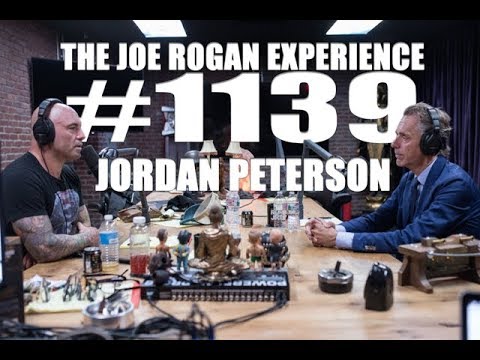
Joe Rogan Experience #1139 - Jordan Peterson
Joe Rogan (host), Jordan Peterson (guest), Narrator
In this episode of The Joe Rogan Experience, featuring Joe Rogan and Jordan Peterson, Joe Rogan Experience #1139 - Jordan Peterson explores jordan Peterson and Joe Rogan Deconstruct Politics, Hierarchies, and Responsibility Jordan Peterson and Joe Rogan explore why long-form conversations and platforms like podcasts have exploded, arguing that new technology has unleashed a mass appetite for complex ideas previously constrained by TV’s short formats.
Jordan Peterson and Joe Rogan Deconstruct Politics, Hierarchies, and Responsibility
Jordan Peterson and Joe Rogan explore why long-form conversations and platforms like podcasts have exploded, arguing that new technology has unleashed a mass appetite for complex ideas previously constrained by TV’s short formats.
Peterson outlines his critique of identity politics, equality of outcome, and mainstream media, linking them to failing institutions, ideological capture in universities, and the clickbait death spiral of legacy journalism.
A substantial portion of the discussion centers on personal responsibility, self-improvement, and hierarchies—how they inevitably form, how they can corrupt, and why a continuous left–right dialogue is necessary to keep them healthy.
They also delve into controversial topics like gender differences, the gender pay gap, enforced monogamy, and Peterson’s extreme carnivore diet, using them to illustrate how nuance is lost in edited media and why unedited, long-form formats matter.
Key Takeaways
Long-form dialogue reveals a latent public appetite for complexity.
With bandwidth limits removed, podcasts and YouTube show that large audiences will engage with 2–3 hour nuanced discussions, challenging the TV-era assumption that people can only handle short, simplified content.
Get the full analysis with uListen AI
Hierarchies are inevitable and partly competence-based, but must be constantly checked.
Any sustained cooperative activity generates hierarchies where some excel more than others; the political task is a continual left–right negotiation to prevent rigidity and corruption without destroying necessary structure.
Get the full analysis with uListen AI
Equality of outcome is framed as a dangerous doctrine with historical precedents.
Peterson argues that pursuing enforced equal outcomes (rather than equal opportunity) quickly collapses into oppressor–oppressed narratives, which historically fueled mass repression and violence in Soviet and Maoist regimes.
Get the full analysis with uListen AI
Identity politics undermines individual responsibility and free speech.
In collectivist frameworks where people are treated as mouthpieces of demographic groups, individual speech is reinterpreted as power-justification, eroding the notion of personal agency and honest dialogue.
Get the full analysis with uListen AI
Sustainable self-improvement relies on honest, modest goals and daily iteration.
Instead of aiming at grand, abstract change, Peterson recommends setting small, doable targets (like cleaning a room or making a bed), using them to build competence, confidence, and a trajectory of continuous growth.
Get the full analysis with uListen AI
Media editing often distorts nuance, rewarding outrage over understanding.
Short, heavily edited segments incentivize glib soundbites and caricatures (e. ...
Get the full analysis with uListen AI
Personal anecdotes can challenge nutritional orthodoxies but aren’t universal proof.
Peterson describes dramatic improvements in depression, autoimmune symptoms, and weight on a strict carnivore diet, while repeatedly acknowledging that this is anecdotal, poorly understood, and not a general prescription.
Get the full analysis with uListen AI
Notable Quotes
“If you're surfing, you don't confuse yourself with the wave.”
— Jordan Peterson
“You don't want to win a single game at the cost of losing the championship of life.”
— Jordan Peterson
“The only thing worse than the pain of inequality is the pain of forced equality.”
— Jordan Peterson
“They’re killing themselves trying to win.”
— Jordan Peterson
“You are the most misrepresented person I’ve ever met in my life.”
— Joe Rogan
Questions Answered in This Episode
How can societies preserve necessary hierarchies of competence while minimizing unjust dispossession and resentment at the bottom?
Jordan Peterson and Joe Rogan explore why long-form conversations and platforms like podcasts have exploded, arguing that new technology has unleashed a mass appetite for complex ideas previously constrained by TV’s short formats.
Get the full analysis with uListen AI
Where should we draw a clear, principled line for when left-wing activism has ‘gone too far’—analogous to how overt racism marks the extreme right?
Peterson outlines his critique of identity politics, equality of outcome, and mainstream media, linking them to failing institutions, ideological capture in universities, and the clickbait death spiral of legacy journalism.
Get the full analysis with uListen AI
To what extent should personal anecdotes like Peterson’s carnivore diet influence public health conversations, given the lack of rigorous controlled studies?
A substantial portion of the discussion centers on personal responsibility, self-improvement, and hierarchies—how they inevitably form, how they can corrupt, and why a continuous left–right dialogue is necessary to keep them healthy.
Get the full analysis with uListen AI
Can identity politics be reformed to recognize group-based injustice without erasing individual agency and responsibility for self-improvement?
They also delve into controversial topics like gender differences, the gender pay gap, enforced monogamy, and Peterson’s extreme carnivore diet, using them to illustrate how nuance is lost in edited media and why unedited, long-form formats matter.
Get the full analysis with uListen AI
How might legacy media realistically adapt to the long-form, unedited model without succumbing to the same clickbait and polarization pressures that are eroding trust today?
Get the full analysis with uListen AI
Transcript Preview
5, 4, 3, 2, 1. Hello, Jordan Peterson.
Hello, Mr. Rogan. How you doing?
You look very spiffy today.
Thank you, sir.
This is a new look for you. You're, you've been rocking these a lot, these big, gigantic, uh ... What do you call those things? These concerts that you guys are doing? What do you ... Speeches?
Well, lectures.
What-
Discussions is really what I-
Discussions.
... think of them as, yeah-
Yes.
... because I'm discussing ... I mean, you might think it's kinda perverse to be discussing with a 3,000-person audience, but it's not, because if you pay attention to the audience, they're constantly ... And the individuals in the audience, they're constantly providing feedback. So it's a discussion as far as I'm concerned.
Feedback in applause, laughter. Sometimes they shout things out too, right?
Shuffling.
Shuffling?
Yeah. Well, really what you want, if, if you're on track, if you're where you should be, then it's dead silent, and everyone's focused and listening. And so if that's not happening ... I mean, you know, there can be laughter and that kind of thing, but generally speaking, you don't wanna hear noise from the audience. So if, if you're, if you're on a r- if you're pursuing a complicated topic and you're paying attention ... And I'm always looking at individual people in the audience, you know, in the first few rows 'cause that's all I can see because of the lights. I'm trying to make sure that everyone's on track with the talk. And, you know, there's ... People gesture with their face and they gesture with their eyes and they shake their head and they nod and there's lots of things to pick up. And if you're not speaking with notes, you can really pay attention to the audience, and then you know if you're in the dialogue, and that's where everyone wants to be.
Yeah, it's an interesting thing you're doing because you have experience in doing that with lectures in colleges and universities, but now it's the general public, and people just pay to see it, and you fill up these huge, gigantic theaters. I mean, I've seen some of the places that you guys are doing it. You and Sam just got done doing one in Vancouver, and it's huge places.
We did two.
You did two, that's right.
Yeah, yeah, back to back, and yeah, so it was about five hours of intense discussion over two days. And you know, we were supposed to talk for an hour each night and then go to Q&A, but we asked the audience ... Brett Weinstein, who was moderating, asked the audience if they wanted to go to Q&A or continue the discussion, and, you know, the, the response from the crowd was definitely continue the discussion, and so we ended up talking for about two and a half hours each night. And again, it was ... The audience is along for the ride.
Install uListen to search the full transcript and get AI-powered insights
Get Full TranscriptGet more from every podcast
AI summaries, searchable transcripts, and fact-checking. Free forever.
Add to Chrome