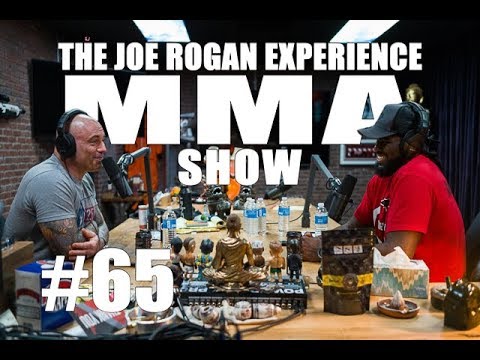
JRE MMA Show #65 with Corey Anderson
Joe Rogan (host), Corey Anderson (guest), Narrator, Narrator
In this episode of The Joe Rogan Experience, featuring Joe Rogan and Corey Anderson, JRE MMA Show #65 with Corey Anderson explores corey Anderson on hunting, hardship, and building elite MMA discipline Corey Anderson sits down with Joe Rogan to trace his evolution from an unmotivated, injured high school kid to a top UFC light heavyweight built on obsessive work ethic, wrestling roots, and calculated training. He explains how bowhunting became his mental reset after tough losses, his system for strength, weight, and cardio, and why he crafts his own unconventional formula instead of following fads. Anderson also details the influence of coach Mark Henry’s intricate coding system, the politics and frustrations of UFC rankings and matchmaking, and his long-term view of eventually challenging Jon Jones. The conversation closes on Anderson’s deep passion for hunting, his desire to be a visible Black bowhunter, and how he’s turning that into a future path through filming and sharing ethical, self-reliant hunting.
Corey Anderson on hunting, hardship, and building elite MMA discipline
Corey Anderson sits down with Joe Rogan to trace his evolution from an unmotivated, injured high school kid to a top UFC light heavyweight built on obsessive work ethic, wrestling roots, and calculated training. He explains how bowhunting became his mental reset after tough losses, his system for strength, weight, and cardio, and why he crafts his own unconventional formula instead of following fads. Anderson also details the influence of coach Mark Henry’s intricate coding system, the politics and frustrations of UFC rankings and matchmaking, and his long-term view of eventually challenging Jon Jones. The conversation closes on Anderson’s deep passion for hunting, his desire to be a visible Black bowhunter, and how he’s turning that into a future path through filming and sharing ethical, self-reliant hunting.
Key Takeaways
Use a demanding hobby as mental balance, not distraction.
After the OSP loss, daily tree-stand bowhunting in New Jersey helped Anderson stop obsessing over the fight and reset his mindset. ...
Get the full analysis with uListen AI
Fuel and size matter as much as skill at elite levels.
Initially terrified of being over 212 lbs, Anderson chronically under-ate and over-ran, coming into fights small and depleted. ...
Get the full analysis with uListen AI
Cardio is largely mental; train to be uncomfortable and “act fresh.”
His heavyweight wrestling background built an engine where he leads in takedowns and outlasts opponents by refusing to show fatigue. ...
Get the full analysis with uListen AI
Bad experiences and doubters can become powerful fuel—if you reframe them.
Being labeled lazy, dealing with racism, and enduring a toxic college coach who benched him despite outwrestling starters all pushed Anderson toward his current relentless work ethic. ...
Get the full analysis with uListen AI
Elite coaching often looks like controlled chaos and constant learning.
Mark Henry builds individualized “codes” (often in multiple languages) for combinations, footwork, and wrestling, forcing fighters to stay mentally sharp and adapt every camp. ...
Get the full analysis with uListen AI
Social media commentary is mental junk food for fighters.
Anderson admits he reads negative comments and even argues mentally with critics, which Joe warns is like eating bad fast food for your brain. ...
Get the full analysis with uListen AI
Hunting can be both ethical meat gathering and a future career path.
He butchers and eats what he kills, sees it as healthier than feedlot meat, and is building a YouTube channel to show hunting’s reality—long sits, misses, field dressing—not just grip-and-grin photos. ...
Get the full analysis with uListen AI
Notable Quotes
“After that OSP fight and hunting every day, I told my wife, ‘I found my balance.’”
— Corey Anderson
“My dad used to tell me, ‘It can only last so long.’ That’s my mentality now for everything hard.”
— Corey Anderson
“Overtraining is mostly a mental state. If you eat, sleep, and manage intensity, you can push way further than you think.”
— Corey Anderson
“Mark Henry’s got codes in English, Portuguese, Russian… he’s like a mad scientist in a pizzeria apron.”
— Corey Anderson
“Social media is like fast food for your brain. It’s so tempting, but afterward you’re like, ‘Why did I consume that garbage?’”
— Joe Rogan
Questions Answered in This Episode
How different would Corey Anderson’s career have been if he’d found proper nutrition, strength work, and Mark Henry-type coaching earlier in wrestling or in his first MMA years?
Corey Anderson sits down with Joe Rogan to trace his evolution from an unmotivated, injured high school kid to a top UFC light heavyweight built on obsessive work ethic, wrestling roots, and calculated training. ...
Get the full analysis with uListen AI
What’s the right balance between using online criticism as fuel and protecting a fighter’s mental health by ignoring it entirely?
Get the full analysis with uListen AI
Could Mark Henry’s coded, language-based system be formalized and taught more widely, or does its power depend on being so customized and secretive?
Get the full analysis with uListen AI
In a sport that rewards wild knockouts in matchmaking and rankings, is a disciplined, high-percentage style like Anderson’s inherently under-valued by fans and promoters?
Get the full analysis with uListen AI
How might visible, high-level athletes like Corey change public perceptions of bowhunting and lead more people toward ethical, self-sourced meat rather than industrial farming?
Get the full analysis with uListen AI
Transcript Preview
Three, one, boom. (fingers snapping) Corey Anderson, ladies and gentlemen. What's up? How are you, man?
What's going on, Joey? What's good?
We finally did it.
Finally did it. We here.
Yeah. And, uh, got some TechnoHunt in as well.
Yeah.
That, that... I told you about that game.
(laughs)
That game is very addictive, isn't it?
I'm already re- trying to get back out there to do some more when this is over, so-
I know. You get itchy, right?
Yeah.
Yeah. No, it's amazing, man. That, that game is incredible. How long you been bow hunting for?
I've been bow hunting since I was 16 or 17, but I've been hunting my whole life.
Wow. What switched you over to bow hunting?
Uh, my high school teammate, actually. I used to go rabbit hunting and stuff with a shotgun, and I've been shooting a bow since I was, like, 12 or 11, just 3D shooting. He's like, "You ever been bowhunting?" I went like, "You can hunt with this?" He's like, "Yeah." Like, "We go hunting all the time." So one day before school, he picked me up and, like, we went over to my buddy's house and got up in the stand. Well, he got in the stand. I couldn't climb 'cause I didn't know what I was doing. I got stuck at the bottom (laughs) of the tree-
(laughs)
... sitting there with my bow in my lap, so... But that was my first time, and after that I just kept going. And every now and then in between practices and whatnot, but now when I got time between fighting and whatnot, I'm all hunting. That's it.
Oh, I can tell by your Instagram, man.
(laughs)
I follow your Instagram. All... You're, you're constantly shooting and hunting and practicing, and s- it's- it gets in your blood.
I mean, it's just like fighting. Like I said, we were doing TechnoHunt is... I do it so much, it's just muscle memory. And like everybody think, "Oh, you spend too much time hunting, you're not training." When I go win a fight, and they're like, "Oh, that was impressive." Like, I still train two, three times a day, but I get home from the gym and my... I always have a bow in my truck. I have three bows and one is always in my truck. So I pull up, pop the doors open, grab my speaker, and the targets is right there. Get like 30 to 60 shots and then go in, spend time with the family, eat, go back to the gym, come... go to the range and shoot indoors when it's dark. And I'm always shooting, I just enjoy it.
Wow. So is it like a part of meditation for you, do you think?
100%. Coming off the OSP fight, that was actually the first time I hunted in Jersey. I've been in Jersey since 2014 when the show came out. And after OSP fight and all that stuff, and everybody told me like, "Don't pay atten-... You was winning that fight, you got caught. Don't let the people get in your head and tell you you're not there." So actually next day I went home, I went and bought my hunting license and bought a stand and hunted in Jersey for the first time, and that helped me. I didn't think about it all. From November to February 1st I was in a tree stand every day. And when I went back to training, like full camp with everything, my mind, I fou- forgot all about that OSP fight. And that's when I told my wife, "I found my balance." You know, the thing was-
Install uListen to search the full transcript and get AI-powered insights
Get Full TranscriptGet more from every podcast
AI summaries, searchable transcripts, and fact-checking. Free forever.
Add to Chrome