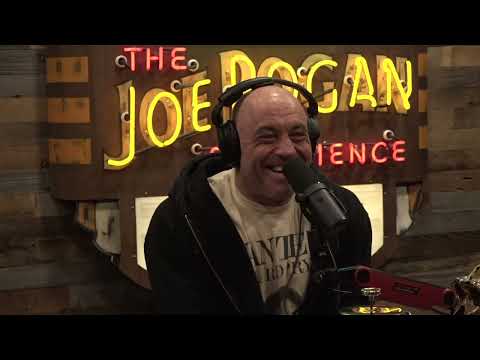
Joe Rogan Experience #1950 - Derek Wolfe
Joe Rogan (host), Narrator, Derek Wolfe (guest), Guest (guest), Guest (guest), Guest (guest), Guest (guest), Guest (guest), Guest (guest)
In this episode of The Joe Rogan Experience, featuring Joe Rogan and Narrator, Joe Rogan Experience #1950 - Derek Wolfe explores ex–NFL Viking: From Childhood Trauma To Mushrooms, Lions, Legacy Former NFL defensive lineman and Super Bowl champion Derek Wolfe talks with Joe Rogan about his brutal football career, severe injuries, and why he walked away while still physically capable of more. He details using microdosed psilocybin and Adderall to enter a controlled rage state on game days, and how combat-sport training and bowhunting channeled his aggression after retirement.
Ex–NFL Viking: From Childhood Trauma To Mushrooms, Lions, Legacy
Former NFL defensive lineman and Super Bowl champion Derek Wolfe talks with Joe Rogan about his brutal football career, severe injuries, and why he walked away while still physically capable of more. He details using microdosed psilocybin and Adderall to enter a controlled rage state on game days, and how combat-sport training and bowhunting channeled his aggression after retirement.
Wolfe opens up about an abusive, chaotic childhood, suicidal thoughts, and how therapy, past-life regression experiences, and learning his Viking/Scandinavian ancestry reshaped his identity. He also describes a notorious Colorado mountain lion hunt, broader hunting ethics and predator management, and life as a ‘Viking’ family man trying to break generational cycles.
Along the way they dive into topics like CTE and NFL culture, genetic memory and past lives, human evolution and ancient civilizations, cold plunges and training, the culture of money and fame in pro sports, and the failures of modern governance on issues from conservation to homelessness.
Key Takeaways
Elite performance often rides on pain, risk, and denial.
Wolfe played through a bruised spinal cord, temporary paralysis, constant numbness, a near-fatal seizure, double hip surgeries, and a dislocated elbow that likely cost him ~$20 million, illustrating how NFL culture normalizes extreme sacrifice and medical minimization (“they told me it was a stinger”).
Get the full analysis with uListen AI
Psychedelics can be weaponized into a ‘controlled rage’ state.
He microdosed psilocybin with Adderall before games to slow down perception, heighten focus, and channel childhood rage into explosive but precise violence on the field, essentially using mushrooms as a tactical performance tool rather than for recreation.
Get the full analysis with uListen AI
Unprocessed childhood trauma shapes identity until it’s actively confronted.
Growing up with an alcoholic mother, no father, and an abusive stepfather, Wolfe internalized violence and chaos as normal; EMDR-style light therapy and guided regression let him ‘comfort’ his younger self and release stored trauma instead of staying permanently stuck in survival mode.
Get the full analysis with uListen AI
Narratives about ancestry can provide grounding and purpose.
A vivid “Viking” past-life regression combined with DNA testing confirming heavy Scandinavian/German/Irish roots gave Wolfe a coherent story for his aggression and physicality; embracing that identity (tattoos, mythology, ‘Viking’ mentality) brought him peace and direction.
Get the full analysis with uListen AI
Predator hunting is both conservation and lightning rod.
His viral Colorado mountain lion hunt—killing a ~220 lb tom preying near homes—was physically brutal and ethically defended as population management benefiting deer, lions, livestock, and people, but he’s acutely aware of public outrage and emphasizes using all the meat and following strict regulations.
Get the full analysis with uListen AI
Modern comfort masks how recently humanity was brutally primal.
Their discussions of Vikings, wolves, ancient Egypt, volcanic disasters, and Graham Hancock’s ‘Ancient Apocalypse’ frame current civilization as a fragile, recent layer over millennia of war, predation, and possible catastrophic resets—yet our nervous systems and instincts are still built for that older world.
Get the full analysis with uListen AI
Breaking cycles requires choosing different models of love and masculinity.
Wolfe credits his wife and daughters with transforming him from a rage-fueled survivor into a present father; learning unconditional love for his children (which he never received) and providing stability, not chaos, is his core measure of success after football.
Get the full analysis with uListen AI
Notable Quotes
“I’d been in survival mode since the day I came out of the womb.”
— Derek Wolfe
“If you play pussy, you’re gonna get fucked.”
— Derek Wolfe (on NFL line play and mentality)
“I was taking mushrooms and fucking Adderall before I played… the focus is out of control.”
— Derek Wolfe
“I didn’t know what unconditional love felt like until I had a daughter.”
— Derek Wolfe
“We survived long enough; then you can learn how to thrive.”
— Derek Wolfe
Questions Answered in This Episode
How should leagues like the NFL balance player autonomy with protection when athletes are clearly willing to sacrifice their long-term health to stay on the field?
Former NFL defensive lineman and Super Bowl champion Derek Wolfe talks with Joe Rogan about his brutal football career, severe injuries, and why he walked away while still physically capable of more. ...
Get the full analysis with uListen AI
Where is the ethical line between using substances like psilocybin as performance enhancers versus as tools for healing and self-understanding?
Wolfe opens up about an abusive, chaotic childhood, suicidal thoughts, and how therapy, past-life regression experiences, and learning his Viking/Scandinavian ancestry reshaped his identity. ...
Get the full analysis with uListen AI
To what extent can experiences like Wolfe’s ‘Viking’ past-life regression be understood as psychological metaphor versus evidence of something deeper like genetic memory?
Along the way they dive into topics like CTE and NFL culture, genetic memory and past lives, human evolution and ancient civilizations, cold plunges and training, the culture of money and fame in pro sports, and the failures of modern governance on issues from conservation to homelessness.
Get the full analysis with uListen AI
How can wildlife managers and hunters better communicate the ecological logic of predator control to an urban public that mainly sees charismatic animals, not population dynamics?
Get the full analysis with uListen AI
What practical steps can someone from a violent, chaotic background take—without money or fame—to start breaking their own generational cycle the way Wolfe describes?
Get the full analysis with uListen AI
Transcript Preview
(drumming music) Joe Rogan podcast, check it out. The Joe Rogan Experience.
Train by day, Joe Rogan podcast by night, all day. (rock music) So, uh, first of all, that's a fucking hell of a ring, sir. Look at that, that's the real deal. I always wanted to see what one of those, like... Holy shit, fuck, look at the size of his finger. (laughs)
(laughs) Bro, my thumb slides over that like nothing. (laughs)
That's hilarious. If you don't think Vikings were real.
(laughs) Size 18.
That's hilarious. That is so fucking big, dude. What's your thumb?
I don't know.
Your thumb's like a fucking broomstick. That's ridiculous.
Fucking giant thumb.
(laughs)
(laughs)
How big were you in high school?
Uh, my senior year, I was like 6'5", 280 pounds.
(laughs)
I wrestled, I was a heavyweight, I wrestled heavyweight, so...
Wow. Did you ever think about doing MMA when you-
Yeah.
Yeah, did you?
Oh, yeah. Well, I, tr- you know, I trained... I started boxing with Henry Hooft down in South Florida-
No shit.
... with the, with the Blackzilians-
I love those guys.
... back in 2011, 2012, when I first got into the league. And I was training for the combine, and I was like, "Man, I really like... I'm really into this MMA stuff." And I just started doing it, and, uh, like, sparring with, uh, just, like, wrestling with, uh, Overeem a little bit.
Oh, wow.
So I would wrestle with him, keep him against the cage and, you know, just hold, you know, drop to a single, bring him down, you know? And he's like-
Right.
... "You wrestle?" You know? I was like, "Yeah, I wrestle, man, I know what I'm doing."
(laughs)
Um, and then I, then I, when I moved to Colorado, like fulltime training, 'cause I used to go to South Florida to train, and I stopped that once I got married, (laughs) you know, so I had to st- I had to end that, and I moved to, uh, um, Trevor Wittman's gym.
Oh, that's a great fucking gym, too.
So I started training with Trevor. Yeah. And Trevor was like, "Hey, you should really think about maybe fighting, you know? 'Cause it's like, you're 290 pounds and you're moving like this, imagine at 265." And I was like, "Dude, I, I'm not doing that. It's just not worth it."
Is it not wor- well, did y- like, you know, I know you retired from football, and, um, you're still in the prime of your life. Uh, uh, did you retire 'cause of injuries? Did you d- decide that you had, you had enough? Like... (sighs)
Yeah, it was a combination of all that. So I had, I had, uh, double hip surgeries, I tore the labrums off the bone.
Install uListen to search the full transcript and get AI-powered insights
Get Full TranscriptGet more from every podcast
AI summaries, searchable transcripts, and fact-checking. Free forever.
Add to Chrome