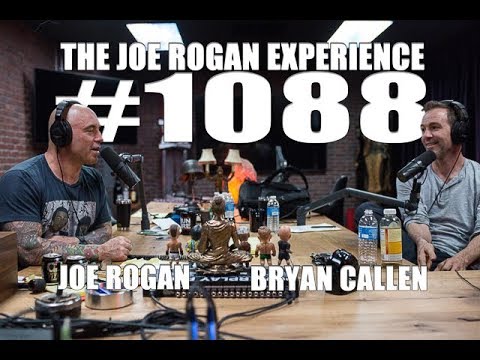
Joe Rogan Experience #1088 - Bryan Callen
Bryan Callen (guest), Joe Rogan (host), Narrator
In this episode of The Joe Rogan Experience, featuring Bryan Callen and Joe Rogan, Joe Rogan Experience #1088 - Bryan Callen explores rogan and Callen riff on aging, culture, power, and future shocks This episode is a long, free‑flowing conversation between Joe Rogan and Bryan Callen that moves from aging and vanity into deeper territory like race and genetics in sports, free speech and campus activism, tech power and universal basic income, police violence, mental health, and the coming impact of AI and automation. They use personal stories, dark humor, and anecdotes about comics, fighters, and historical figures to explore how humans handle status, identity, and tribalism. A major theme is how often we misdiagnose complex social problems with single-variable explanations—whether it’s racism versus tribalism, patriarchy versus culture, or guns versus mental health. Underneath the jokes and tangents is a concern about how fragile modern systems are—from parenting and pharmaceuticals to democracy and the global economy—paired with a cautious optimism that humans will adapt if we stay honest and keep talking. The episode is part social critique, part history lesson, part therapy session, all wrapped in stand-up-comic energy.
Rogan and Callen riff on aging, culture, power, and future shocks
This episode is a long, free‑flowing conversation between Joe Rogan and Bryan Callen that moves from aging and vanity into deeper territory like race and genetics in sports, free speech and campus activism, tech power and universal basic income, police violence, mental health, and the coming impact of AI and automation. They use personal stories, dark humor, and anecdotes about comics, fighters, and historical figures to explore how humans handle status, identity, and tribalism. A major theme is how often we misdiagnose complex social problems with single-variable explanations—whether it’s racism versus tribalism, patriarchy versus culture, or guns versus mental health. Underneath the jokes and tangents is a concern about how fragile modern systems are—from parenting and pharmaceuticals to democracy and the global economy—paired with a cautious optimism that humans will adapt if we stay honest and keep talking. The episode is part social critique, part history lesson, part therapy session, all wrapped in stand-up-comic energy.
Key Takeaways
Human behavior is far more tribal and situational than ideological labels allow.
Rogan and Callen argue that we overuse words like ‘racist’ and ‘sexist’ as single-variable explanations, when much conflict comes from deep-rooted tribal instincts and local context rather than purely ideological hatred.
Get the full analysis with uListen AI
Elite performance often combines genetics, culture, and obsessive focus rather than any single cause.
Their discussion of Black dominance in certain sports, African genetic diversity, and figures like Jordan and LeBron emphasizes that opportunity channels, culture, and extreme work ethic overlay natural traits, making simple genetic or social explanations misleading.
Get the full analysis with uListen AI
Free speech is being undermined by performative activism and a fear of ideas.
They highlight episodes where speakers like Christina Hoff Sommers and Jordan Peterson are shouted down, arguing that this reflects insecurity and group signaling rather than confidence in one’s ideas—and that it ultimately harms genuine progressivism.
Get the full analysis with uListen AI
Modern policing problems are often about competence, stress, and training, not just racism.
Rogan points out how most police interactions end peacefully, suggesting that deadly incidents frequently involve unfit officers whose mental health and decision-making have been eroded by stress, rather than purely racial animus, even though racism can play a role.
Get the full analysis with uListen AI
We are massively overmedicating kids and adults for problems often created by lifestyle and systems.
They criticize widespread ADHD diagnoses and SSRI use, arguing many kids are just high-energy boys forced into sedentary classrooms, and many adults are medicated for lives that are misaligned with their needs for movement, purpose, and connection.
Get the full analysis with uListen AI
Concentrated tech wealth and data power are historically unprecedented and politically fragile.
The conversation about Google, Apple, Facebook, and Amazon notes that a handful of left-leaning tech billionaires now hold wealth comparable to billions of people, raising questions about accountability and the long-term stability of such power, even if their current values are relatively benign.
Get the full analysis with uListen AI
AI and automation will force a redefinition of work, value, and social safety nets.
They discuss ‘jobocalypse’ scenarios—self-driving vehicles, burger-flipping robots, factory automation—and suggest ideas like universal basic income may become necessary as millions of routine jobs disappear, pushing humans toward creativity, craftsmanship, and meaning rather than mere survival work.
Get the full analysis with uListen AI
Public shaming and moral panics risk erasing nuance, growth, and proportionality.
Using examples from #MeToo and cases like Al Franken versus Roman Polanski, they argue we are blurring serious crimes with bad jokes or poor judgment, and that a society without paths to redemption or context will be both unjust and unstable.
Get the full analysis with uListen AI
Notable Quotes
““We want a single-variable answer. ‘You’re a racist, you’re a sexist, you’re a homophobe’—as if that explains everything.””
— Bryan Callen
““If everybody was the same color, we’d still find ways to hate each other. Please see the Middle East.””
— Bryan Callen
““The government is us. The military isn’t some alien thing—it’s just people.””
— Joe Rogan
““You really think you’d be this funny if you liked yourself? Keep hating yourself. It’s the best part of you.””
— Bryan Callen (quoting a friend’s advice)
““Failure is a huge part of success. It’s a giant part of being a human.””
— Joe Rogan
Questions Answered in This Episode
How convincing is their argument that tribalism, rather than racism alone, drives much intergroup conflict, and what might they be overlooking?
This episode is a long, free‑flowing conversation between Joe Rogan and Bryan Callen that moves from aging and vanity into deeper territory like race and genetics in sports, free speech and campus activism, tech power and universal basic income, police violence, mental health, and the coming impact of AI and automation. ...
Get the full analysis with uListen AI
Where is the line between responsible medication for mental health and the systemic over-drugging of kids and adults to fit unhealthy environments?
Get the full analysis with uListen AI
Are Rogan and Callen too optimistic about tech billionaires’ benevolence, or too dismissive of the risks of massive corporate surveillance and influence?
Get the full analysis with uListen AI
How should society distinguish between unforgivable acts and mistakes people can genuinely atone for in the era of social media shaming?
Get the full analysis with uListen AI
If nearly half of today’s jobs are automated away, what kinds of work—or non-work—should we actually be preparing children for now?
Get the full analysis with uListen AI
Transcript Preview
... thin nose.
Not any more.
It behooved me.
Yeah, have you ever looked at, like, Abe Vigoda's ears?
Yeah, they were big.
They-
The ears and the nose grow.
They keep growing.
Yeah, age is a very annoying thing.
Well, that's a weird one. It's almost like to let someone know, like, "Hey, look at this guy. His proportions are all fucked up. He's got bad juice."
Yeah.
You know what I mean?
Yeah. So how do I reduce ... I wanted to get an ear reduction and a nose sharpening.
And a nose reduction. I'm sure people have done that. I could only imagine. If girls are getting-
Well, Bruce Jenner.
(laughs) Well, girl ... That's a different one.
(laughs)
You know what I'm saying?
(imitates laughing)
Uh, look at the big ass crazy ears.
Look at the, the hair on his ears. Abe.
Hey, he's not 12.
Shave those ears.
Yeah, I've, I've got hair growing out of my ears. I have to, I have to put a trimmer, run a trimmer on it.
Well, that, I'm vain. I pluck my ... Yeah.
Hmm.
If I see hair that doesn't belong somewhere, I, I have ... I'll take it out.
Go wax it.
My father, like, lets his nose hair grow, his eyebrows.
Savage.
I'm like, "Bro, would it kill you to ... Can you ... I'm looking into your nose. It's a, it's a f- a nest, a sparrow nest."
Do you really call your father "bro"?
Yeah, sometimes.
(laughs)
I get so mad at him 'cause the way he eats sometimes. Like, we were in Mexico and he, uh, he would just show up. You go to breakfast, he has this belly and he's got, like ... He's got four French toasts, and a waffle-
Oof.
... and a banana. And I, and I'm just sitting there, and I g- I get so mad. And then I started texting him. I text him, I go, "Listen, man. You gotta start changing the way you eat." And, and I go ... And I'm angry as I'm texting this. I'm getting more angry, more angry. "So stop the bullshit and start eating n-" (laughs) I, I was so angry I had to tell him that I'm getting ... My heart was beating. I was furious. I couldn't have text faster. I go, "Get it together. Get it together and stop eating bullshit. And would it kill you to fucking move a little bit?" Bang! And I just sent that.
Whoa.
Yeah.
Strong.
I don't want him to die.
Does he exercise at all?
Fuck, no. And I'll tell you why.
(laughs)
When he was young, he was poor and he had to do manual labor.
Install uListen to search the full transcript and get AI-powered insights
Get Full TranscriptGet more from every podcast
AI summaries, searchable transcripts, and fact-checking. Free forever.
Add to Chrome