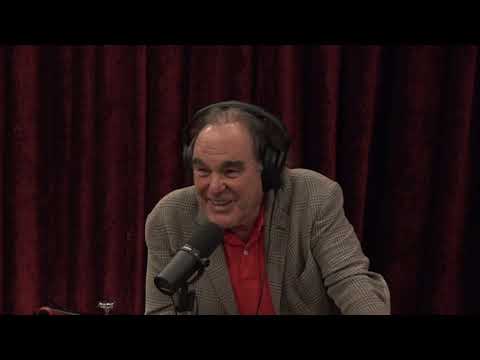
Joe Rogan Experience #1759 - Oliver Stone
Oliver Stone (guest), Joe Rogan (host)
In this episode of The Joe Rogan Experience, featuring Oliver Stone and Joe Rogan, Joe Rogan Experience #1759 - Oliver Stone explores oliver Stone Dissects JFK Assassination, Deep State Power, And Media Deceit Oliver Stone joins Joe Rogan to argue that John F. Kennedy’s assassination marked a key turning point where America surrendered civilian control to an entrenched national security state.
Oliver Stone Dissects JFK Assassination, Deep State Power, And Media Deceit
Oliver Stone joins Joe Rogan to argue that John F. Kennedy’s assassination marked a key turning point where America surrendered civilian control to an entrenched national security state.
Drawing on declassified documents and his new documentary *JFK Revisited*, Stone challenges the lone‑gunman narrative, detailing evidence manipulation, CIA involvement with anti‑Castro Cubans, and a broad institutional cover‑up.
He contrasts Kennedy’s emerging peace agenda—on Cuba, Vietnam, and the Soviet Union—with the interests of the military‑industrial complex, suggesting this agenda motivated his removal.
The conversation broadens into a critique of U.S. foreign policy, the role of the CIA, systemic media complicity, and the rise of independent journalism as a counterweight.
Key Takeaways
Question official narratives when evidence chains are broken or altered.
Stone highlights missing or falsified chains of custody for the ‘magic bullet,’ the rifle, and autopsy materials; when basic investigative protocols are violated, citizens should be skeptical of the conclusions built on that evidence.
Get the full analysis with uListen AI
Study primary documents and declassifications, not just secondary histories.
The Assassination Records Review Board (ARRB) and CIA Inspector General reports overturn key myths—such as Kennedy authorizing Castro’s assassination—showing the value of going back to original records instead of relying on entrenched academic or media narratives.
Get the full analysis with uListen AI
Recognize how ‘threat inflation’ sustains permanent war and vast budgets.
From the Cold War to Vietnam to modern adversaries like Russia, China, and Iran, Stone argues U. ...
Get the full analysis with uListen AI
Understand the structural danger of a permanent security bureaucracy.
Intelligence and Pentagon officials don’t rotate with elections; Stone contends this ‘frozen bureaucracy’ accumulates power and can quietly undermine or remove elected leaders who challenge it, as he believes happened with JFK.
Get the full analysis with uListen AI
Support and consume independent journalism to counter media capture.
Because major outlets either ignored or attacked *JFK Revisited* without addressing its evidence, Stone urges turning to independent platforms (Substack, YouTube, shows like Rogan’s, Greenwald, Taibbi, etc. ...
Get the full analysis with uListen AI
Reevaluate the CIA’s role and the need for covert powers.
Stone suggests abolishing or radically restructuring the CIA’s covert operational arm, keeping only a transparent intelligence‑gathering function to prevent abuses such as coups, assassination plots, and drug operations.
Get the full analysis with uListen AI
See JFK’s assassination as a political turning point, not just a crime.
Stone frames the killing as the moment America veered from a potential peace‑oriented foreign policy back into permanent militarization; understanding this context is crucial to understanding later U. ...
Get the full analysis with uListen AI
Notable Quotes
““From the time he was killed in ’63… not one American president has ever challenged the military or the national security state or the intelligence agencies.””
— Oliver Stone
““We are the biggest bully on the block around the world… and we keep insisting on enemies.””
— Oliver Stone
““If he doesn’t go to war twice in Cuba, why would he go to war in Vietnam?””
— Oliver Stone
““They didn’t even tape the interrogation of the man who supposedly shot the president.””
— Oliver Stone
““This is history. One day, 200 years from now, somebody’ll see it and they’ll wake up. This is why we fell apart as a country.””
— Oliver Stone
Questions Answered in This Episode
If JFK’s peace‑oriented policies had continued, how might U.S. foreign policy in Vietnam, Latin America, and the Middle East have differed over the last 60 years?
Oliver Stone joins Joe Rogan to argue that John F. ...
Get the full analysis with uListen AI
What specific institutional reforms—of the CIA, Pentagon, and oversight mechanisms—would realistically be required today to prevent another ‘national security’ override of an elected president?
Drawing on declassified documents and his new documentary *JFK Revisited*, Stone challenges the lone‑gunman narrative, detailing evidence manipulation, CIA involvement with anti‑Castro Cubans, and a broad institutional cover‑up.
Get the full analysis with uListen AI
Why do major media outlets refuse to seriously engage with the declassified evidence Stone cites, and what does that imply about their relationship to state power?
He contrasts Kennedy’s emerging peace agenda—on Cuba, Vietnam, and the Soviet Union—with the interests of the military‑industrial complex, suggesting this agenda motivated his removal.
Get the full analysis with uListen AI
How can an average citizen distinguish between legitimate, document‑based historical revision and unfounded conspiracy theorizing in cases like the JFK assassination?
The conversation broadens into a critique of U. ...
Get the full analysis with uListen AI
If the JFK assassination is indeed a turning point, what modern political events show similar patterns of threat inflation, secrecy, and narrative control by the security state?
Get the full analysis with uListen AI
Transcript Preview
(drumbeats) Joe Rogan podcast, check it out. The Joe Rogan Experience. (rock music plays)
Train by day, Joe Rogan podcast by night, all day. (rock music plays) Uh, so thank you, Oliver, thanks for being here, man. I r- I really appreciate it, and I really enjoyed your documentary. I, like you, well not as much as you, but I am a, a conspiracy freak when it comes to the JFK assassination. And, uh, I, I've been fascinated by it for decades and, uh, but no one is, I don't think anybody is as fascinated by it as you. And-
(clears throat) Well, I get the impression that you have the impre- I'm a full-timer, but no-
No, not a full-timer.
... I have a career. (laughs)
Well, I know you do.
Yeah.
Listen, I'm a huge fan of yours. But it's kind of fascinating that your d- your film, the JFK film, was approximately 30 years after the assassination.
Yeah.
And then this is approximately 30 years after that.
Yeah.
We're still going through this.
Yes.
And they're still withholding documents.
Yeah.
It's really kind of amazing, isn't it?
No, it's not. It's, you know, everybody's dead from this, from that era, but it's all the more important that we understand our history 'cause it's, it's fading, but the reason we're in this kind of disbalanced situation in the United States, where we have no, less and less trust is because of the past. And if we go to this particular incident in '63, it's a, it's a demarcation point, it's a turning point for the country. And I think, that's what's fascinating to me 'cause I have a historical interest. I've written and made The Untold History of United States and-
Yes.
... I'm very interested in history and I just think we have to pay attention because the roots of our problem are here. A- and do you want me to talk about that or do you want me to go up?
Sure, yeah, please.
I, you know, I don't want... Uh, I, I'm, I'm gonna, I have to generalize because from the time he was killed, in '63, that November, we... Think about it, w- not one American president, not one, and you can name them all, have ever challenged the military or the national security state or the intelligence agencies. Not one. They haven't been successful. They, they've cut the budgets occasionally, but not by much, but essentially they keep going up and the Defense Department has a record year this year of 700 and some $60 billion. Who says, who says you can't to the military or to the intelligence agencies? They seem to have a inordinate amount of power. Kennedy was the last one who was trying to curb it and he made a serious effort towards peace. He was, you know, last of the presidents to talk about peace very nobly. And people have said, "Oh, he just talks," but no, he was doing things and we can talk about that too.
Install uListen to search the full transcript and get AI-powered insights
Get Full TranscriptGet more from every podcast
AI summaries, searchable transcripts, and fact-checking. Free forever.
Add to Chrome