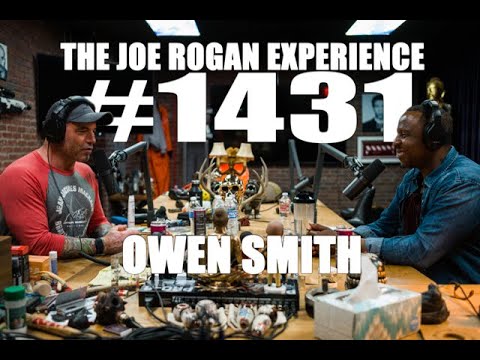
Joe Rogan Experience #1431 - Owen Smith
Joe Rogan (host), Owen Smith (guest), Guest (guest), Guest (guest), Narrator, Guest (guest)
In this episode of The Joe Rogan Experience, featuring Joe Rogan and Owen Smith, Joe Rogan Experience #1431 - Owen Smith explores from Comedy Rejection To Arena Dreams: Owen Smith With Rogan Joe Rogan and comedian-writer Owen Smith dive deep into standup craft, career setbacks, and the long road from raw talent to polished headliner. Owen recounts pivotal experiences with Russell Simmons, Dave Chappelle, Damon Wayans, Mitch Hedberg, and others, showing how early rejection and industry politics shaped his voice. They contrast pure standup with Hollywood’s executive culture, arguing that TV development, notes, and fear of controversy often dilute comedy’s edge. The conversation also touches on yoga, athletic greatness, drugs, and how podcasts and independent projects now offer comics more control than traditional gatekeepers.
From Comedy Rejection To Arena Dreams: Owen Smith With Rogan
Joe Rogan and comedian-writer Owen Smith dive deep into standup craft, career setbacks, and the long road from raw talent to polished headliner. Owen recounts pivotal experiences with Russell Simmons, Dave Chappelle, Damon Wayans, Mitch Hedberg, and others, showing how early rejection and industry politics shaped his voice. They contrast pure standup with Hollywood’s executive culture, arguing that TV development, notes, and fear of controversy often dilute comedy’s edge. The conversation also touches on yoga, athletic greatness, drugs, and how podcasts and independent projects now offer comics more control than traditional gatekeepers.
Key Takeaways
Raw and polished are tools, not goals, in standup.
Rogan and Smith argue there’s no single “right” style—Joey Diaz is raw and explosive, Jeselnik and Owen are highly polished—what matters is that the stage persona matches who you really are, or it feels fake.
Get the full analysis with uListen AI
Rejection can quietly fuel long‑term growth.
Owen’s Def Jam near‑miss (seven applause breaks but no airing) and being ignored by Russell Simmons initially devastated him, but pushed him to evolve beyond bravado into a more personal, substantive comic—and eventually, Russell publicly validated him years later.
Get the full analysis with uListen AI
Voluntary difficulty makes everyday stress feel trivial.
Rogan uses yoga, jiu-jitsu, and intense training as “voluntary hardship,” arguing that enduring a 90‑minute hot yoga class or a brutal roll prepares your nervous system so normal life stress feels manageable by comparison.
Get the full analysis with uListen AI
Old notebooks are a goldmine for growth and new material.
Owen’s ‘Notebooks’ concept—comics revisiting their earliest joke books on camera—shows how bad, naive writing evolves into strong material, and often reveals forgotten premises that can be revived with today’s skills.
Get the full analysis with uListen AI
TV notes and fear of controversy often ruin strong ideas.
They describe how executives, legal teams, and “mandates” (diversity boxes, anti‑controversy rules) can sand down sharp concepts—like Kyle Dunnigan’s rejected Comedy Central bits—resulting in safer but forgettable shows that rarely connect with real audiences.
Get the full analysis with uListen AI
Greatness usually rides the edge of madness and obsession.
Through stories of Michael Jordan, LeBron, Tyson Fury, and others, they frame greatness as a mix of talent, extreme competitiveness, and psychological scars—often including slights and childhood adversity that become lifelong fuel.
Get the full analysis with uListen AI
Comics need to own distribution instead of waiting on gatekeepers.
Rogan presses Owen to put his ‘Notebooks’ series and standup directly on YouTube and to build via textowen. ...
Get the full analysis with uListen AI
Notable Quotes
“Greatness and madness are next door neighbors and they borrow each other’s sugar.”
— Joe Rogan
“Don’t wait on Hollywood to give you permission to be great.”
— Owen Smith, quoting Ernest Thomas
“If you worry about yourself, you’ll have a busy, busy time.”
— Owen Smith (via his mother‑in‑law)
“You should be filling arenas… you are one of the best comics in the world.”
— Joe Rogan, to Owen Smith
“Yoga is about breathing in difficult situations. That’s what life is—if you don’t remember to breathe, you’re fucked.”
— Joe Rogan (building on Russell Simmons’ advice)
Questions Answered in This Episode
How much should a comedian adapt their style to fit platforms and trends versus stubbornly protecting their authentic voice?
Joe Rogan and comedian-writer Owen Smith dive deep into standup craft, career setbacks, and the long road from raw talent to polished headliner. ...
Get the full analysis with uListen AI
What’s the right balance between using personal pain or adversity as creative fuel and not letting it consume your mental health?
Get the full analysis with uListen AI
In a world of YouTube and podcasts, when—if ever—does it still make sense for a comic to pursue traditional TV development deals?
Get the full analysis with uListen AI
How might Owen’s ‘Notebooks’ concept change how fans and newer comics understand the amount of failure and iteration behind a great bit?
Get the full analysis with uListen AI
Do you agree with Rogan’s idea that voluntary physical hardship (yoga, combat sports) actually re‑calibrates how you handle emotional or professional stress?
Get the full analysis with uListen AI
Transcript Preview
It is?
Yeah.
Three, two-
D-
... one, boom. And we're live.
Oh.
We're talking about yoga and-
Yeah.
... Russell Simmons?
Yeah.
Russell Simmons, he moved to Bali because he's worried about them extraditing him?
I don't know if he's worried, but I, I, and this is all-
Really?
... this is, I'm, this is all conjecture. This is what I've heard.
Right.
But I, I, I just brought him up because, um, we, we had a yoga studio here.
Did he?
Yeah, and he gave me a month free. A month free, high-end yoga thing, like you just show up in your clothes. They give you the mat, towels-
Really?
... blocks, everything, and everybody was awesome. And I went every day for a month and did yoga next to Russell Simmons.
Wow.
And he was, like, amazing. And, uh, and I was, like, really feeling it. I felt great. And then, uh, all the stuff happened. (laughs)
(laughs) It's so easy to slide.
Oh, man. Oh, man.
It's so easy to slide away.
Yeah, man, I, I, I love that guy dearly. I have a funny story. What do you think is more important in standup, uh, to be polished or to be raw?
There's no more important thing. They're-
Mm-hmm.
They're both very important, but Joey Diaz is not polished at all-
Mm-hmm.
... and he's the funniest guy that I've ever seen.
Yeah.
No one's ever made me laugh harder.
Yeah.
He's not polished. He's raw as fuck.
He's just, but it's, but it's real.
But raw alone is not good because some guys, like Jeselnik is very polished-
Right.
... and he's very funny.
Yeah.
You're very polished.
Thank you.
You're very funny.
Yes.
It's, there's no, there's no one thing, you know? It's like comedy is a, it's a art, you know?
It's a art, right?
It's an expression of who you are. If you're a polished person and you try to come off raw, it's gonna look corny.
So, so I, I brought that up because I am tw- I don't know, young 20s. Def Jam is having auditions. It just moved from New York to LA, and Beverly Hills was where they're taping, which was ironic in itself. And, uh, but I was raw. You, you remember those, when you go, "Hit it, DJ," and you have music cue, like, beats?
Yeah.
(laughs) So I auditioned and, uh, Bushwick Bill, uh, was one of the judges. It was like a... I auditioned at All Jokes Aside in Chicago and I got picked, I was one of the people to get picked to tape Def Jam. First time I was ever flown out anywhere, first time I ever came to, was flown to Los Angeles. I had been here before, stayed at the Hotel Sofitel.
Install uListen to search the full transcript and get AI-powered insights
Get Full TranscriptGet more from every podcast
AI summaries, searchable transcripts, and fact-checking. Free forever.
Add to Chrome