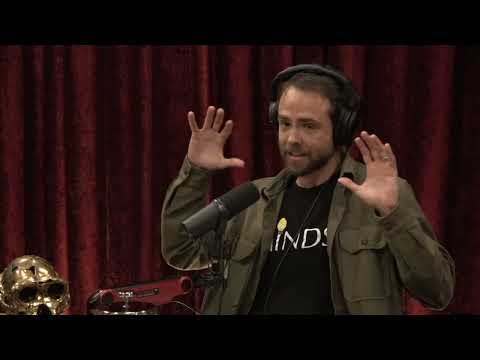
Joe Rogan Experience #1970 - Bill Ottman
Narrator, Narrator, Narrator, Joe Rogan (host), Bill Ottman (guest), Joe Rogan (host), Bill Ottman (guest), Narrator
In this episode of The Joe Rogan Experience, featuring Narrator and Narrator, Joe Rogan Experience #1970 - Bill Ottman explores decentralized social media, surveillance, AI, and UFO secrecy collide here Joe Rogan and Bill Ottman, founder of Minds.com, discuss decentralized social media, free speech, and how government and corporate power intersect with online platforms and surveillance. They explore encryption, Pegasus spyware, and the risks of mandated backdoors, as well as proposed laws like the RESTRICT Act and California’s AB 587 that Ottman argues are effectively censorship frameworks. The conversation widens into AI, data ownership, OpenAI vs open‑source models, and how social networks monetize attention while shaping public discourse. They close by speculating on UFO disclosure, classified information, and how much hidden knowledge—governmental and corporate—could fundamentally reshape society if revealed.
Decentralized social media, surveillance, AI, and UFO secrecy collide here
Joe Rogan and Bill Ottman, founder of Minds.com, discuss decentralized social media, free speech, and how government and corporate power intersect with online platforms and surveillance. They explore encryption, Pegasus spyware, and the risks of mandated backdoors, as well as proposed laws like the RESTRICT Act and California’s AB 587 that Ottman argues are effectively censorship frameworks. The conversation widens into AI, data ownership, OpenAI vs open‑source models, and how social networks monetize attention while shaping public discourse. They close by speculating on UFO disclosure, classified information, and how much hidden knowledge—governmental and corporate—could fundamentally reshape society if revealed.
Key Takeaways
Decentralized identity can give users leverage over platforms.
By using protocols like Nostr and cryptographic key pairs, users can own their social graph (followers, posts, identity) and port it between apps, which limits a platform’s power to deplatform or lock them in.
Get the full analysis with uListen AI
Backdoors into encryption make everyone less safe, including governments.
Ottman argues that while agencies want access to private communications, any systemic backdoor weakens security for officials, citizens, and infrastructure alike, because adversaries can exploit the same vulnerabilities.
Get the full analysis with uListen AI
Censorship framed as fighting ‘hate’ or ‘misinformation’ is easily politicized.
Laws like California’s AB 587 and the RESTRICT Act use vague terms (hate, extremism, radicalization) that can be selectively enforced, pressuring platforms to police speech in ways that align with prevailing political narratives.
Get the full analysis with uListen AI
Algorithmic opacity lets platforms quietly shape economic and political outcomes.
From suppressing external links to deranking certain topics, non‑transparent recommendation systems can throttle competition, punish dissenting views, and make or break creators’ livelihoods without clear accountability.
Get the full analysis with uListen AI
AI systems are built on everyone’s data, raising questions of ownership and reward.
Large models like ChatGPT scrape the public internet—including creators’ work—without direct permission or compensation, suggesting future models may need revenue‑sharing or data‑rights frameworks if they’re monetized at scale.
Get the full analysis with uListen AI
Open-source and transparent infrastructure can counter Big Tech’s surveillance incentives.
Ottman advocates open-source code, non‑surveillance analytics, and user revenue‑sharing as ways to build trust and redistribute value, contrasting this with closed, data‑extractive systems from major platforms and cloud providers.
Get the full analysis with uListen AI
If major UFO claims are true, current secrecy could destabilize trust more than disclosure.
They note that leaks about Nord Stream, Twitter Files, and UAP programs already erode public confidence; a controlled, law‑backed path to greater transparency on classified programs might be less disruptive than ongoing leaks and denials.
Get the full analysis with uListen AI
Notable Quotes
“We’re decentralizing as fast as possible, getting it out of our hands so that we need to protect ourselves from ourselves.”
— Bill Ottman
“Banning hate does not stop hate.”
— Bill Ottman
“If it wasn’t for social media, that act would have slipped right through, like the Patriot Act did.”
— Joe Rogan
“The US government should be stockpiling Bitcoin right now. It is a national security risk to not do that.”
— Bill Ottman
“I don’t want to die without knowing… and having these people that I don’t know who they are, and why do they get to know?”
— Bill Ottman
Questions Answered in This Episode
How realistic is it for decentralized identity protocols like Nostr to gain mainstream adoption without sacrificing usability?
Joe Rogan and Bill Ottman, founder of Minds. ...
Get the full analysis with uListen AI
Where should the legal line be drawn between legitimate national security concerns and censorship of online speech?
Get the full analysis with uListen AI
Should companies developing large AI models be obligated to compensate the creators whose data they trained on, and if so, how?
Get the full analysis with uListen AI
Can open-source, privacy‑respecting platforms ever economically compete with highly optimized surveillance‑capitalism giants?
Get the full analysis with uListen AI
If definitive evidence of non‑human technology were made public, what concrete changes would you expect in geopolitics, religion, and the global economy?
Get the full analysis with uListen AI
Transcript Preview
(drumming) Joe Rogan podcast, check it out.
The Joe Rogan Experience.
Train by day, Joe Rogan podcast by night. All day. (instrumental music)
And we're up. Hello, Bill.
Hey, man.
Good to see you, buddy. What's going on?
Good to see you. We're here, man. (sighs)
You are here.
Everything's going wild.
How was your, uh, site going?
It's going. We're decentralizing as fast as possible, getting it out of our hands so that... We need to protect ourselves from ourselves.
Hmm. How do you do that? Tell everybody, it's Maps.
Minds.
Minds, rather. Sorry.
Minds.com, M-I-N-D-S.com.
I just had, uh, Rick Doblin on-
R- Rick, no, I- w- yeah, yeah.
... psychedelics on the brain.
I sense kinship with Maps.
(laughs)
Yeah, um-
Yeah, Minds and Maps, the- the two of them should go together perfectly.
They probably should work together.
Seamlessly.
Yeah. So, basically there's protocols and there's platforms. So, you know, Twitter, Minds, um, other social networks, these are platforms. They're kind of built in the traditional social media style, which is on servers that are, you know, live in huge cloud centers. Um-
Right.
And, but, there's also protocols. The one that we're working with now is called Nostr, which stands for Notes and Other Stuff transmitted by Relay. So, there's no company owns this protocol. The founder is anonymous. Sort of similar to Bitcoin. And what it is, is it's all about crypto key pairs and signing stuff. So, with Nostr, it- this is all happening in the background on Minds. Every user has a cryptographic key pair, which you can download in your settings. You're the only one who gets the private key. That's your identity. Your content, your followers, all that is tied to your identity. So, when you post something, when you follow somebody, that is creating a signature on this decentralized network of relay nodes. So, we run a relay, thousands of other people run relays. Snowden's on Nostr now. He, it- it's like getting serious endorsement. And it's ama- because it doesn't have a company, you know, e- 'cause companies are choke points.
Hmm.
That can, you know, we saw what happened with Napster, for instance.
What happened with Napster?
Napster just got rocked by the music industry and they basically died. I mean, they still sort of exist, but they pretty much got taken down because there was that entity to go after.
I see. So, if there were decentral... But there was no real decentralization back then, was there?
Well, torrents are decentralized.
Bit torrents, right.
Torrents, actually, and Nostr is, there's work that w- we're involved with now on integrating Nostr with torrents, so that more heavy files, video, and rich media can be shared over the network. Right now, it's- it's text and links, essentially.
Install uListen to search the full transcript and get AI-powered insights
Get Full TranscriptGet more from every podcast
AI summaries, searchable transcripts, and fact-checking. Free forever.
Add to Chrome