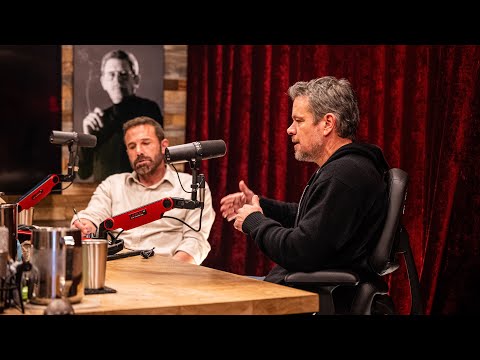
Joe Rogan Experience #2440 - Matt Damon & Ben Affleck
Joe Rogan (host), Joe Rogan (host), Matt Damon (guest)
In this episode of The Joe Rogan Experience, featuring Joe Rogan and Joe Rogan, Joe Rogan Experience #2440 - Matt Damon & Ben Affleck explores damon and Affleck on filmmaking shifts, authenticity, AI, and legacy The conversation begins with storytelling (Hunter S. Thompson encounters) and quickly centers on how streaming, phones, and algorithm-driven retention have reshaped what gets made and how it’s paced.
Damon and Affleck on filmmaking shifts, authenticity, AI, and legacy
The conversation begins with storytelling (Hunter S. Thompson encounters) and quickly centers on how streaming, phones, and algorithm-driven retention have reshaped what gets made and how it’s paced.
Damon and Affleck argue theatrical films became more risk-averse (IP/sequels) due to marketing costs and box-office math, while streamers can finance riskier work—but also pressure creators to optimize for distracted viewing.
They describe a “participation/bonus” model on Netflix for “The Rip” that shares upside with the entire crew, positioning it as both fair and a practical way to improve morale, craftsmanship, and the sustainability of middle-class film jobs.
The back half expands into AI (as tool vs. hype), authentic acting and lived experience, cancellation/forgiveness, and an extended detour into combat sports, greatness, and the costs of peak performance.
Key Takeaways
Streaming changed not just distribution, but storytelling cadence.
They describe streamers pushing for early “set pieces” and repeated plot exposition because viewers are distracted or ready to click away—pressures that can quietly rewrite the grammar of film.
Get the full analysis with uListen AI
Theatrical economics incentivize sequels and conservatism.
They outline the break-even math: marketing often matches production spend and theaters take a significant cut, so original mid-budget films face harsher risk/return demands than franchise IP.
Get the full analysis with uListen AI
Great TV removed the old stigma of “TV actor” vs “movie star.”
They contrast the ER-era barrier (Clooney needing to escape TV contracts) with today’s prestige series and streaming productions that match or exceed film-quality writing and performances.
Get the full analysis with uListen AI
Profit participation for crews is both fairness and performance strategy.
Their model isn’t framed as philanthropy: giving bonuses to everyone increases investment, collaboration, and care—making the movie better while addressing industry resentment about upside flowing only to the top.
Get the full analysis with uListen AI
A template matters more than good intentions.
They emphasize institutionalizing the bonus structure so others can “plug and play” it; once paperwork exists, claiming you support crew participation becomes measurable rather than rhetorical.
Get the full analysis with uListen AI
AI is likely more incremental tool than total replacement—yet labor and likeness rules are urgent.
Affleck argues LLM writing trends toward the mean and hype is partly valuation-driven; the real near-term stakes are consent, watermarking, and fair governance as AI reduces costs in VFX and background replication.
Get the full analysis with uListen AI
Authentic performances come from lived experience, not photorealism.
Damon’s example of Dwayne Johnson drawing on personal trauma for a pivotal scene illustrates why humans detect truth in micro-behavior—and why “looking real” isn’t the same as “being real.”},{
Get the full analysis with uListen AI
Research produces realism that audiences feel even if they can’t explain it.
Affleck cites mining prisons, FBI conversations, and real tactical teams for details (e. ...
Get the full analysis with uListen AI
Forgiveness is culturally endangered by permanence and pile-ons.
They critique “in perpetuity” reputational punishment: without redemption, people are disincentivized from admitting fault, and moral judgment becomes tribal sport rather than ethical growth.
Get the full analysis with uListen AI
Longform conversations now outperform traditional junket promotion in trust.
They say a single high-attention podcast can exceed a week of scripted press hits because audiences value context and can detect “ritualized” marketing; authenticity scales via word-of-mouth in feeds.
Get the full analysis with uListen AI
Notable Quotes
““Can we get a big one in the first five minutes… and it wouldn’t be terrible if you reiterated the plot three or four times… because people are on their phones while they’re watching.””
— Matt Damon
““It’s completely self-serving… in order to do the job well, everybody… has to be really invested… If this thing actually blows up… you should benefit from that.””
— Ben Affleck
““There’s no fucking AI that can do that.””
— Matt Damon
““The win doesn’t have to be get away with the bag of money… at the end of the day, if you can live with yourself… that’s the win.””
— Ben Affleck
““No talking for the first 27 minutes of this movie.””
— Matt Damon
Questions Answered in This Episode
On “The Rip” bonus model: What exact metric did Netflix agree to use (hours viewed, completion rate, unique viewers), and why that one?
The conversation begins with storytelling (Hunter S. ...
Get the full analysis with uListen AI
How did you decide the bonus tiers and percentages—especially how to keep it “fair” across departments with very different pay scales?
Damon and Affleck argue theatrical films became more risk-averse (IP/sequels) due to marketing costs and box-office math, while streamers can finance riskier work—but also pressure creators to optimize for distracted viewing.
Get the full analysis with uListen AI
You mention algorithm-driven notes (big opening, repeated exposition). Where have you actually pushed back successfully, and what arguments work with streamers?
They describe a “participation/bonus” model on Netflix for “The Rip” that shares upside with the entire crew, positioning it as both fair and a practical way to improve morale, craftsmanship, and the sustainability of middle-class film jobs.
Get the full analysis with uListen AI
You call LLM writing “shitty” because it goes to the mean—what would have to change technically for you to consider AI-generated writing genuinely competitive?
The back half expands into AI (as tool vs. ...
Get the full analysis with uListen AI
What protections do you think are essential for name/likeness (extras and principals): watermarking, union contract clauses, new federal law, or all of the above?
Get the full analysis with uListen AI
Transcript Preview
[upbeat music] Joe Rogan Podcast, check it out!
The Joe Rogan Experience.
Train by day, Joe Rogan Podcast by night, all day. [upbeat music]
That's wild.
And I went in 'cause I came in from Miami, I think I was living at the time. And I went in, and, uh... And, uh, I'm sitting in the waiting room, and it was, like, on a Sunday because it was... I was like: "I'm only in town for a..." And, and Stan was like: "I'll come into the office." I'm like, "Thank you so much." I had to have some, a filling or something, whatever I needed.
[chuckles]
It's kind of an emergency. So I'm sitting in the thing, and, uh, [click] and I'm not getting called in, but the, the, the lady's just... Uh, no, no, there's not even a receptionist. And Stan comes out with his mask on. No, the first thing I hear is, "Pig fucker! Fucking piece of cocksucker," [laughing] "fucking pig fucker."
[laughing]
And I'm like, "What is happening in there?" It's in the other room. And Stan comes in with his mask on. He goes, "Sorry." He goes: "I'll be with you soon." He goes, "I got Hunter in the chair." [laughing]
[laughing]
And he goes back, [whooshes] and I hear... Listen to, to Hunter Thompson swear for, like, 15 minutes. I'm like, "This is amazing." And then Stan goes, "Okay, come on back." And Hunter's kind of getting out, and he goes, "Oh, you're sitting down with this guy? He's a fucking assassin." [laughing]
[laughing]
So I... And then he goes, and he's got this jug of clear, uh, of clear fluid, and he's like: "You're gonna need a sip of this." And I'm like, "Oh, my God, this is fucking Hunter S. Thompson's moonshine." [laughing] I'm like, "This is-
[laughing] Fucking ethyl alcohol, like-
... I'm like, "This is fucking amazing!"
2,000 proof.
I'm like, I'm, I'm talking to this dude for 30 seconds, and I'm getting a sip.
[laughing]
And, like, and it was, like, 10 in the morning on a Sunday.
Was it?
Yeah.
Oh, it's-
He was halfway through the jug.
It was just pure, pure-
Like, fucking, like-
... catch fire from it.
Yeah, it was-
Where was this?
In Beverly Hills.
[laughing]
Yeah. Yeah. Yeah, Brentwood. Yeah, Brentwood-
That's wild
... was Stan's office, yeah.
Oh, my God, that's amazing.
Yeah, it was, it really was ama- it was, it was... And I... So I had probably a total of seven minutes, you know, with him, and it was like I, I, I, it could, it could not have been a better seven minutes. [chuckles]
That's incredible. I went to the Woody Creek Tavern just to go there 'cause I know he used to go there.
Yeah.
And, like, you could, like, feel him in the building. You know, there's all the pictures on the walls-
Yeah, yeah, yeah
... this cool little place.
Yeah.
That, I mean, those books, fucking Hell's Angels and, and, you know, Fear and Loathing, is some of the best writing. I, I just fucking... Like, he really had his own voice. Rum Diary, spectacular, you know. It was, like, really descriptive and punchy and fucking interesting and fucked up, and [chuckles] he also just lived that life. It was like-
Install uListen to search the full transcript and get AI-powered insights
Get Full TranscriptGet more from every podcast
AI summaries, searchable transcripts, and fact-checking. Free forever.
Add to Chrome