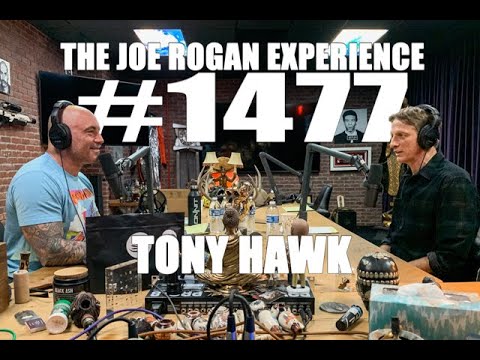
Joe Rogan Experience #1477 - Tony Hawk
Joe Rogan (host), Tony Hawk (guest), Narrator, Jamie Vernon (host)
In this episode of The Joe Rogan Experience, featuring Joe Rogan and Tony Hawk, Joe Rogan Experience #1477 - Tony Hawk explores tony Hawk on Skating’s Evolution, Longevity, Risk, and Staying True Tony Hawk discusses how skateboarding evolved from a simple transportation toy into a global culture and Olympic sport, recounting its history from Dogtown pools to street skating and the X Games era.
Tony Hawk on Skating’s Evolution, Longevity, Risk, and Staying True
Tony Hawk discusses how skateboarding evolved from a simple transportation toy into a global culture and Olympic sport, recounting its history from Dogtown pools to street skating and the X Games era.
He shares his personal trajectory from teenage pro and 80s star, through the early 90s collapse of vert skating and financial hardship, to renewed fame via the X Games and his landmark video game.
The conversation explores physical risk and longevity—concussions, broken bones, training, and recovery—and how he’s adapted his skating style at 52 while largely ignoring traditional strength and conditioning.
They also touch on skatepark advocacy, COVID-era life, media criticism, and the deeper meaning of skateboarding as art, community, and a viable life path, not just a sport.
Key Takeaways
Adapt your craft as the environment and industry change.
When vert skating fell out of favor and parks closed, Tony shifted toward street, exhibitions, video editing, and eventually capitalized on new platforms like the X Games and his video game, rather than quitting the culture entirely.
Get the full analysis with uListen AI
Longevity requires evolving how you perform, not just how often.
Hawk has shifted from massive, high-impact airs to more technical, lower-impact vert tricks, allowing him to keep progressing creatively into his 50s while reducing the chance of catastrophic injuries.
Get the full analysis with uListen AI
Community infrastructure can transform a ‘frivolous’ hobby into public good.
Through his foundation, Hawk has helped fund over 900 public skateparks, arguing that they combat obesity, build community, and give misfit kids a positive outlet, reframing skating as preventative health and social support.
Get the full analysis with uListen AI
Ignore purist gatekeeping when you’re genuinely innovating.
Early on, established skaters accused Hawk of “cheating” for using ollies into airs and called his tricks circus-like, but he stayed with his approach until it became the new standard, showing that criticism often follows innovation.
Get the full analysis with uListen AI
In high-risk pursuits, proactively manage brain and body health.
After numerous concussions and knockouts, Hawk sought genetic testing for CTE risk, uses supplements, and consciously avoids the kinds of tricks that previously caused bad head injuries, instead of pretending the risks don’t exist.
Get the full analysis with uListen AI
Financial success can vanish; build skills and save during peaks.
When skate sales collapsed in the early ’90s, Hawk’s royalty-based income was halved month after month; his dad’s push to buy a house and his side work in video editing and low-paying demos helped him survive the downturn.
Get the full analysis with uListen AI
You don’t have to be the absolute best to build a life in your passion.
Hawk emphasizes that kids can build careers around their scenes—through filming, art, events, or other support roles—rather than chasing only the #1 podium spot, redefining what “success” can look like.
Get the full analysis with uListen AI
Notable Quotes
“At this point, the skateboard is kind of an extension of my body.”
— Tony Hawk
“I knew I wouldn’t quit skating because I just loved it. When I started, no one could be rich or famous from skating.”
— Tony Hawk
“By building those skateparks, you are preventing cancer, you’re preventing obesity.”
— Lance Armstrong (as recounted by Tony Hawk)
“Skateboarding is like this art form to me, where there’s this blank canvas and it’s just like, ‘Go. Make it your own.’”
— Tony Hawk
“I’m just so thankful that I still get to do this for a living… it’s beyond any dream I could have ever imagined, and it’s all because I just kept skating.”
— Tony Hawk
Questions Answered in This Episode
How will the inclusion of skateboarding in the Olympics change the culture and values of the global skate community over the next decade?
Tony Hawk discusses how skateboarding evolved from a simple transportation toy into a global culture and Olympic sport, recounting its history from Dogtown pools to street skating and the X Games era.
Get the full analysis with uListen AI
What would a truly next-generation skateboard made from new materials look and feel like, and how might it change what’s possible on a board?
He shares his personal trajectory from teenage pro and 80s star, through the early 90s collapse of vert skating and financial hardship, to renewed fame via the X Games and his landmark video game.
Get the full analysis with uListen AI
Where is the line between healthy innovation in extreme sports and reckless pursuit of ever-bigger, more dangerous feats?
The conversation explores physical risk and longevity—concussions, broken bones, training, and recovery—and how he’s adapted his skating style at 52 while largely ignoring traditional strength and conditioning.
Get the full analysis with uListen AI
How can older athletes in high-impact disciplines systematically adapt their training and style to maximize both longevity and progression?
They also touch on skatepark advocacy, COVID-era life, media criticism, and the deeper meaning of skateboarding as art, community, and a viable life path, not just a sport.
Get the full analysis with uListen AI
In what ways could cities rethink public space—beyond skateparks—to support youth subcultures as engines of health, creativity, and community?
Get the full analysis with uListen AI
Transcript Preview
And we're rolling. (door shuts) How are you, Tony?
Awesome, thank you.
My pleasure. Thanks for having m- uh, thanks for coming here, man. It was really-
Yeah, hey, thanks for inviting me.
... cool to meet you.
It's an honor.
It's interesting to see you even just fuck around with your skateboard, just the way you maneuver it.
(laughs)
You're so, you're so adept. It's w- really weird, like y- the way you move your feet and just pick it up and-
Oh, it's very impressive. I mean, it really is just, a- at this point, kind of an extension of my body.
It seems like it.
And, uh, it, it's w- I guess it's weird. I don't think about how comfortable I am, and a lot of times we'll be in a city or something, or just like now, I didn't know where to park, right? So I just park somewhere kinda close and just, I go skate. And I feel way better about doing that than, like, parking and then walking somewhere, and, and it just, you know, I know I can get around people and sort of be indiscreet and, and, uh, stealthy.
D- and we were indiscreet?
Well, I'm just saying, like-
Tony Hawk on a skateboard is indiscreet? (laughs)
(laughs)
That's ridiculous. That might be the most ridiculous thing.
I do get weird looks for sure.
For sure.
I get, yeah.
They're like, "Is that-"
I get a lot of, "Do a kick flips out from car windows."
Oh, really?
Yeah.
Oh, that's funny. (laughs)
Yeah. That's my curse that I, that I... (laughs) That's my burden I carry.
I'm seeing these new skateboards that are... They look like convertibles where as these guys flip the board, the wheels flip up and go to the other side.
Oh, yeah, that's a, that's sort of a phenomenon, sort of a s- social media thing going on.
Ah, like-
And-
... so you can see it in slow-mo? Is that what it is?
No, where... The board is actually a contraption, right?
Yes, yeah.
Yeah, I don't, I don't really understand what that is. There's a, there's a select few people doing that.
Yeah.
And I've seen a couple where they actually have figured out how to make their board grind and then do a flip around a rail as they jump back on it.
Oh, boy.
Yeah, that's... It's very specialized though. I can't say that's a movement.
(exhales)
It's just a few key people that are doing it.
How many bones do you have to break to perfect that?
(laughs)
When I see this dude sliding down rails, I'm like, "How many times do you fuck that up-"
Yeah.
"... and snap a forearm?"
Install uListen to search the full transcript and get AI-powered insights
Get Full TranscriptGet more from every podcast
AI summaries, searchable transcripts, and fact-checking. Free forever.
Add to Chrome