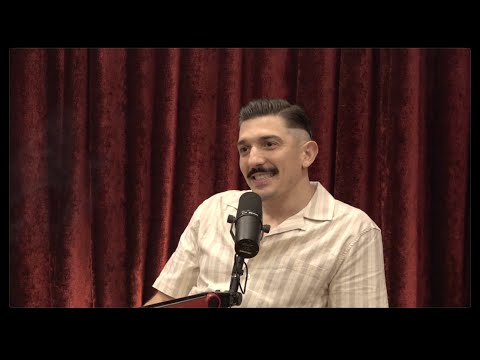
Joe Rogan Experience #2132 - Andrew Schulz
Joe Rogan (host), Narrator, Andrew Schulz (guest), Narrator, Narrator, Narrator, Narrator, Narrator
In this episode of The Joe Rogan Experience, featuring Joe Rogan and Narrator, Joe Rogan Experience #2132 - Andrew Schulz explores joe Rogan and Andrew Schulz Dive Into Power, Corruption, Comedy, Control Joe Rogan and Andrew Schulz range from gossip (Diddy, Epstein, Clinton body counts) to deep structural critiques of media, pharma, the military‑industrial complex, and intelligence agencies. They argue that incentives, not cartoonish masterminds, quietly shape news coverage, war, public health narratives, and even hit pieces on public figures like Andrew Huberman and Rogan himself.
Joe Rogan and Andrew Schulz Dive Into Power, Corruption, Comedy, Control
Joe Rogan and Andrew Schulz range from gossip (Diddy, Epstein, Clinton body counts) to deep structural critiques of media, pharma, the military‑industrial complex, and intelligence agencies. They argue that incentives, not cartoonish masterminds, quietly shape news coverage, war, public health narratives, and even hit pieces on public figures like Andrew Huberman and Rogan himself.
They explore how absolute power and unchecked wealth warp human behavior, drawing parallels between rappers, Roman emperors, modern billionaires, and alleged alien civilizations nudging human evolution. Comedy and podcasting are framed as rare spaces where unpopular truths, taboo questions, and real personalities can still surface.
The conversation also turns inward: how comics manage fame, sociopathy vs empathy, why hard things (cold plunges, standup, hunting) are essential to character, and how to protect personal sovereignty when institutions or media try to co‑opt you. They close on America’s contradictions—deeply flawed yet uniquely capable of individual greatness and reinvention.
Underlying the entire episode is a theme of mistrust: of official narratives about vaccines, wars, censorship, UFOs, and crime, and a plea for individuals to seek primary sources, value personal experience, and cultivate communities of honest, high‑character people.
Key Takeaways
Follow incentives, not slogans, to understand media and policy behavior.
Rogan and Schulz argue that pharmaceutical ad dollars, defense contracts, and political funding quietly dictate what TV news can or cannot say about vaccines, wars, and scandals—without explicit orders. ...
Get the full analysis with uListen AI
Question one‑sided hit pieces and ask what key facts are missing.
Using the Andrew Huberman article as an example, they highlight how omitting the accuser’s DOJ fraud investigation radically distorts the story. ...
Get the full analysis with uListen AI
Comfort is a slow poison; deliberately choose hard things to stay sharp.
Rogan’s routines—cold plunges, grueling hunts, daily workouts—and Schulz’s commitment to scary, high‑stakes bits illustrate how voluntarily doing difficult tasks preserves character, resilience, and mental health in a life that could easily become too easy.
Get the full analysis with uListen AI
Power corrupts in predictable patterns across eras and industries.
From Roman emperors (Caligula) to modern moguls (Diddy), war profiteers (Cheney/Halliburton), and intelligence operatives, they see the same arc: once incentives and impunity align, people justify extreme behavior unless constrained by strong norms or counter‑power.
Get the full analysis with uListen AI
Free speech platforms like X/Twitter are a pressure‑release valve for society.
They contend that Elon Musk’s loosening of content restrictions may have “saved” something vital by allowing competing narratives, ugly truths, and bad takes to coexist—so better arguments can beat bad ones instead of everything being centrally curated.
Get the full analysis with uListen AI
Comedy works best when it’s personal, dangerous, and deeply cared about.
Both comics stress that great bits come from topics they feel strongly about, not from chasing trends. ...
Get the full analysis with uListen AI
America’s core strength is still individual upward mobility and reinvention.
Despite deep cynicism about U. ...
Get the full analysis with uListen AI
Notable Quotes
“Comfort is a warm and enticing poison. And it’s a slow poison.”
— Joe Rogan
“Everything you want is on the other side of what you fear.”
— Andrew Schulz
“The answer to bad speech is not silencing speech. It’s better speech.”
— Joe Rogan
“If you’re trying to stop greatness in this country, you’re un‑American.”
— Andrew Schulz
“He might not even be biological anymore, but he might still need souls.”
— Joe Rogan
Questions Answered in This Episode
How should ordinary people practically investigate claims about vaccines, wars, or scandals when both mainstream and alternative media have clear incentive biases?
Joe Rogan and Andrew Schulz range from gossip (Diddy, Epstein, Clinton body counts) to deep structural critiques of media, pharma, the military‑industrial complex, and intelligence agencies. ...
Get the full analysis with uListen AI
If advanced civilizations are hypothetically ‘nudging’ human progress, what ethical obligations—if any—do we have in how we develop AI, weapons, and social systems?
They explore how absolute power and unchecked wealth warp human behavior, drawing parallels between rappers, Roman emperors, modern billionaires, and alleged alien civilizations nudging human evolution. ...
Get the full analysis with uListen AI
Where is the line between necessary national security secrecy and democratically intolerable government censorship and manipulation of information?
The conversation also turns inward: how comics manage fame, sociopathy vs empathy, why hard things (cold plunges, standup, hunting) are essential to character, and how to protect personal sovereignty when institutions or media try to co‑opt you. ...
Get the full analysis with uListen AI
In comedy and public discourse, how far should creators go in addressing accusations or scandals about powerful figures before it becomes exploitative rather than satirical?
Underlying the entire episode is a theme of mistrust: of official narratives about vaccines, wars, censorship, UFOs, and crime, and a plea for individuals to seek primary sources, value personal experience, and cultivate communities of honest, high‑character people.
Get the full analysis with uListen AI
Given their critique of institutional capture, what reforms (media funding, lobbying limits, transparency laws) would most effectively reduce corruption without crippling necessary institutions like the CIA, FDA, or Pentagon?
Get the full analysis with uListen AI
Transcript Preview
(drum roll) Joe Rogan podcast, check it out.
The Joe Rogan Experience.
Train by day, Joe Rogan podcast by night, all day. (rock music) Like, I think of, I think he has that, that CIA guy on with the hair.
Yeah.
You know? And, uh-
What do you think of that guy?
So after the pod- (snaps fingers)
I guess we're up. Let's go.
You wanna go?
We're rolling.
Let's do it.
Let's go.
Okay, so, um, he came on, and he was very, like, forthco- first of all, he's very charming, but like, when you're talking to anybody who's worked for the CIA, you're looking at him through the same lens as you look at, like, a therapist.
Right.
Where it's like, "Wait, are you analyzing? Like, what's going on?"
Right, "What's going on here?"
Very charming, very smart, very, like, seems to really know what's going on in the world, but like, straight up told us, he's like, "Yeah, the CIA, you know, I guess one of the advantages I have is like I'm pretty close to a sociopath. Like, I'm not there, but like I don't, I don't feel the same emotions that everybody feels. There's like a lack of guilt, but I know when I should feel it in these moments."
Whoa.
But that's a huge advantage. Imagine if you're trying to, like, find assets and flip assets.
Yeah.
If you and I, like, build a relationship with somebody and we, like, feel empathy for them-
Right.
... maybe we wouldn't be able to say, "Hey, now it's time for you to cough up the information or else."
Right.
But somebody else in that position might, so I would imagine if you were at the fucking CIA, you're like, "Okay, we're looking for people who have gone through these things in their life that'll- that have curated this kind of, like, personality type."
Well, isn't it just, like, part of the gig? Like, here- here's a for instance. Like, your bit about Puffy. (laughs)
(laughs) How are you gonna connect these two fucking dots?
You're- y- y- that bit is, like, look, you don't have any real personal beef with Diddy.
Mm-mm.
But it's gotta go down. The- the- the bits are there. I'm a gold miner. I just found some gold.
You're right, maybe I'm a sociopath.
It's not that you're a sociopath. It's just that that's part of the gig.
Yes.
Like, you're not a sociopath with your friends.
No, I think I'm maybe an empath.
Yes.
But I guess it's one of those things where, like, you justify, you go, "Okay, if there's a- I think this person might've done something bad."
Yes.
And he can get jokes, and we're all gonna tell jokes.
Install uListen to search the full transcript and get AI-powered insights
Get Full TranscriptGet more from every podcast
AI summaries, searchable transcripts, and fact-checking. Free forever.
Add to Chrome