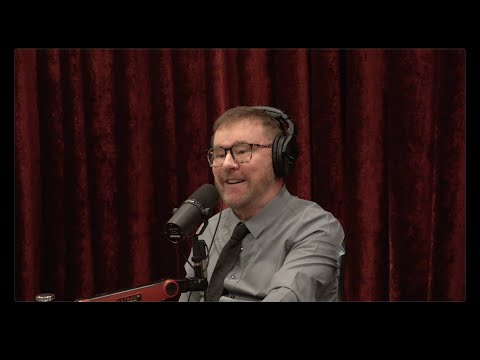
Joe Rogan Experience #2372 - Garry Nolan
Garry Nolan (guest), Joe Rogan (host), Narrator
In this episode of The Joe Rogan Experience, featuring Garry Nolan and Joe Rogan, Joe Rogan Experience #2372 - Garry Nolan explores stanford cancer scientist explores AI, UFO evidence, and hidden tech Stanford immunologist and cancer researcher Garry Nolan explains how tumors evade the immune system, the rise of personalized cancer treatment, and how his lab uses advanced instruments and AI to decode massive biological datasets. He then shifts into his controversial work analyzing alleged UFO-related injuries and materials, describing isotopic anomalies and molten metal samples that strongly suggest engineered origins. Nolan outlines how AI will transform science, medicine, and possibly governance, and argues that if non-human technology exists, it should be carefully declassified to spur commercial and scientific breakthroughs. Throughout, he stresses rigorous, peer‑reviewed methods, the dangers of secrecy and dogma, and the need to treat UFOs as a legitimate scientific question rather than ridicule or belief.
Stanford cancer scientist explores AI, UFO evidence, and hidden tech
Stanford immunologist and cancer researcher Garry Nolan explains how tumors evade the immune system, the rise of personalized cancer treatment, and how his lab uses advanced instruments and AI to decode massive biological datasets. He then shifts into his controversial work analyzing alleged UFO-related injuries and materials, describing isotopic anomalies and molten metal samples that strongly suggest engineered origins. Nolan outlines how AI will transform science, medicine, and possibly governance, and argues that if non-human technology exists, it should be carefully declassified to spur commercial and scientific breakthroughs. Throughout, he stresses rigorous, peer‑reviewed methods, the dangers of secrecy and dogma, and the need to treat UFOs as a legitimate scientific question rather than ridicule or belief.
Key Takeaways
Cancer is an evolutionary process that subverts immune surveillance.
Tumors arise through mutations and then progressively learn to disable immune detection—such as by turning off MHC presentation and exploiting inflammatory pathways—shifting from precancerous lesions to metastatic disease. ...
Get the full analysis with uListen AI
Medicine is moving rapidly toward deep personalization driven by rich cellular data.
Nolan’s lab built instruments that can measure 50–60 proteins per cell and scale single-cell genomics 100‑fold, revealing that superficially similar cancers can be biologically distinct. ...
Get the full analysis with uListen AI
AI is becoming a genuine scientific collaborator, not just a tool.
By building an agentic AI “immunologist in a box” on top of large language models, Nolan’s group can feed raw experimental data in and get networks, hypotheses, and experiment designs back in hours rather than months. ...
Get the full analysis with uListen AI
Our current medical technologies carry underappreciated tradeoffs that need mitigation.
Organ transplants require systemic immunosuppression that raises cancer and infection risk; CT scans clearly increase cancer incidence; and vaccine platforms involve adjuvants that can cause harm in some people. ...
Get the full analysis with uListen AI
There is physical and medical evidence around UAP that warrants serious study, not belief.
After debunking the Atacama “alien” as a human with mutations, Nolan was approached by CIA-linked officials about brain injuries in personnel—many later classified as Havana Syndrome—and a smaller subset allegedly connected to close UAP encounters. ...
Get the full analysis with uListen AI
If advanced non-human technology exists, over-classification may be choking human progress.
Nolan argues that crash-retrieved materials, if real, likely embody physics and materials science far beyond current capabilities and could trigger enormous commercial, energy, and scientific advances. ...
Get the full analysis with uListen AI
AI and non-human tech imply profound societal shifts, possibly including AI-assisted governance.
The conversation explores how AI may automate large swaths of work, push us toward universal basic income debates, and even function as a less corrupt decision-maker than humans. ...
Get the full analysis with uListen AI
Notable Quotes
“Cancer is not a forward evolution; it’s a breaking of social contracts between cells.”
— Garry Nolan
“Some of my best students hallucinate. The human is still in the loop.”
— Garry Nolan (on AI ‘hallucinations’ in research)
“If we could scrape just the tiniest bit of understanding off the top of this [UAP] technology, what would that do to change our own civilization?”
— Garry Nolan
“There’s not enough evidence for me to tell a colleague it’s real—but there’s enough evidence to say there’s a question worth answering.”
— Garry Nolan (on UAP)
“We’re basically governed by lawyers. China is governed by engineers.”
— Garry Nolan
Questions Answered in This Episode
If Nolan’s isotopic and structural anomalies in UAP-linked materials are accurate, what are the most conservative, non-extraterrestrial explanations—and how could we falsify them experimentally?
Stanford immunologist and cancer researcher Garry Nolan explains how tumors evade the immune system, the rise of personalized cancer treatment, and how his lab uses advanced instruments and AI to decode massive biological datasets. ...
Get the full analysis with uListen AI
How might agentic AI change the culture and training of scientists when hypothesis generation and experimental design can be largely automated?
Get the full analysis with uListen AI
What governance model could responsibly manage access to potentially civilization-altering technologies (e.g., gravity manipulation, near-limitless energy) without triggering global conflict or authoritarian control?
Get the full analysis with uListen AI
In what specific ways could early, carefully controlled disclosure of non-human technology accelerate breakthroughs in energy, medicine, or materials science while minimizing economic and religious disruption?
Get the full analysis with uListen AI
How should psychiatry and medicine evolve to support people reporting UAP encounters or anomalous experiences, balancing skepticism with trauma-informed care and avoiding automatic pathologizing?
Get the full analysis with uListen AI
Transcript Preview
(drumbeats) Joe Rogan podcast. Check it out. The Joe Rogan Experience. Train by day, Joe Rogan podcast by night. All day. (instrumental music)
Gary, very nice to meet you, sir.
Nice to meet you as well.
Thank you for doing this. I really appreciate it. Um, tell everybody what you do. Tell everybody what your official position is. You- you're a professor at the School of Medicine at Stanford. What- what do you do?
So, my day job is in cancer research and cancer biology, mostly immunology and cancer. Much of what my laboratory does is not so much the biology of cancer, but developing instruments that create the data that allow us to analyze the complexities of how the immune system interfaces with tumors, and how tumors basically re-enable, uh, the immune system to help the cancer itself. So the problem's been we don't have the ability to collect enough data, or not until recently, to collect and understand what all of that means, so we've been kind of poking in the dark for decades. And so probably for the last 20 years, I've developed a number of instruments and turned them into companies that allow everybody to access a level of information they couldn't get before.
So, uh, ex- ex- explain that. The- the immune system allows the tumors? Ex- wh- wh- wh- wh-
So what happens is that there's sort of a, there's a dance between the mutations that initiate a tumor and then, uh, sort of an evolution of how the tumor eventually learns how to trick the immune system to not recognize it. So we have all kinds-
Hmm.
... of inter- I mean, literally every day, uh, every person, you'll develop five cancer-like objects inside of your body, but the immune system, uh, and your body has a way of shutting it down very quickly. But with enough time and with enough variation, tumors will eventually evolve in a way that trick the immune system, not only to- to not recognize them, but in fact, to help them and feed them in a way, to create an inflammatory environment that actually then the tumor uses to propagate its own cell division and then metastasize.
So it's a normal function of natural human biology to create tumors?
It's not so much a normal function. It's a byproduct of what evolution is, that when the genes mutate when a cell divides, or if you go out and, you know, stand in the- in the sun, uh, too much for instance, you get skin cancers because you're getting ionizing radiation that's changing the DNA, making a mutation, and some of those random mutations will initiate a cancer. So for instance, I have, um, a mutation called MIDF E318K. It's, uh, a mutation that I was born with. It didn't- it wasn't in my family, and it causes both melanoma and kidney cancer, which I've had both. I've had a dozen, uh, melanomas alone. Um, you know, we didn't find that out until a couple of years ago, but I've been following it over the years and we basically figured out, okay, it's gonna have to be this. So we had my sequ- my genome sequenced. But there's... That's just one of hundreds of different kinds of mutations that can occur that are on a path towards creating a cancer. But the cancer can't survive if the immune system recognizes it. So eventually what happens is there's this detente that is reached between the immune system and the cancer, where the immune system basically ignores the cancer. So Jim Allison here in Houston, uh, won the Nobel Prize back in 2018, uh, for understanding one of these turn-off signals about the immune system u- that the cancers use to turn off the immune system, and that by showing he could block it, his wife, Pam Sharma, ran a bunch of clinical trials at MD Anderson that showed in fact that this could actually turn a 5% survival disease in melanoma to a 50% survival. And that then created the whole immunotherapy field that the world is, uh, taking advantage of today.
Install uListen to search the full transcript and get AI-powered insights
Get Full TranscriptGet more from every podcast
AI summaries, searchable transcripts, and fact-checking. Free forever.
Add to Chrome