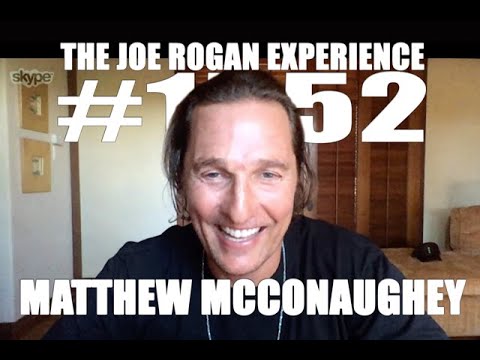
Joe Rogan Experience #1552 - Matthew McConaughey
Joe Rogan (host), Matthew McConaughey (guest), Narrator
In this episode of The Joe Rogan Experience, featuring Joe Rogan and Matthew McConaughey, Joe Rogan Experience #1552 - Matthew McConaughey explores matthew McConaughey On Greenlights, Growth, Faith, And Modern America Matthew McConaughey joins Joe Rogan to discuss his memoir *Greenlights* and the personal journaling, self-reflection, and life experiments that shaped it.
Matthew McConaughey On Greenlights, Growth, Faith, And Modern America
Matthew McConaughey joins Joe Rogan to discuss his memoir *Greenlights* and the personal journaling, self-reflection, and life experiments that shaped it.
They dive into habits that keep McConaughey grounded—daily lists, exercise, sleep, deliberate solitude, and self-imposed “resistance” when life gets too easy.
The conversation expands into parenting, discipline, child stardom, faith and religion, Hollywood’s culture, social media, policing, homelessness, and McConaughey’s emerging civic role in Austin as a self-described “Minister of Culture.”
Throughout, McConaughey frames life as a series of “green, yellow, and red lights,” emphasizing responsibility, delayed gratification, and values-based living amid a chaotic, changing world.
Key Takeaways
Dissect success, not just failure.
McConaughey realized he only journaled when life was bad; by also documenting what he did when life was going well—habits, people, places—he later had a blueprint to recalibrate when he fell into ruts.
Get the full analysis with uListen AI
Check in with yourself before checking in with the world.
His happiest periods share a pattern: mornings start with reading, writing, or quiet reflection ‘between me and me’ before phones, emails, or other people, which anchors his mindset for the day.
Get the full analysis with uListen AI
Create healthy resistance instead of self-sabotage.
When life feels ‘too easy,’ people often unconsciously wreck good situations; McConaughey advocates intentionally adding constructive challenge (physical training, hard projects, solitude) rather than manufacturing drama.
Get the full analysis with uListen AI
Stress, fear, and negative feelings are useful if you work through them.
He rejects “no stress / no fear” slogans, arguing that fear kept him from bad decisions as a kid and that bad days clarify what you don’t want to repeat—if you use them as data rather than deny them.
Get the full analysis with uListen AI
Body maintenance is non-negotiable for mental clarity.
Daily exercise, sweating, and sufficient sleep (he aims for ~9. ...
Get the full analysis with uListen AI
Solitude can recalibrate a life distorted by fame or noise.
Overwhelmed by sudden stardom, McConaughey disappeared to a monastery and then the Amazon for weeks; forced solitude helped him strip away external validation, forgive himself, and decide who he actually wanted to be.
Get the full analysis with uListen AI
Values and shared social contracts matter more than popularity or growth.
In discussing Austin, policing, and homelessness, he argues that communities must protect core values—responsibility, fairness, reverence for hard jobs—while they grow, rather than chasing popularity or simplistic slogans like “defund the police.”
Get the full analysis with uListen AI
Notable Quotes
“We dissect failure and hardships in life, but we don’t dissect success.”
— Matthew McConaughey
“When I lose my wink, I’m taking things too seriously.”
— Matthew McConaughey
“Hollywood’s not a place to go find yourself. Hollywood’s a place where you can be anything you want.”
— Matthew McConaughey
“I give you 100% of my trust until you don’t have it.”
— Matthew McConaughey
“There’s a place where what’s best for us is also best for the most amount of people. That’s the honey hole.”
— Matthew McConaughey
Questions Answered in This Episode
How would your daily life change if you consistently ‘checked in with yourself’ before looking at your phone or engaging with others?
Matthew McConaughey joins Joe Rogan to discuss his memoir *Greenlights* and the personal journaling, self-reflection, and life experiments that shaped it.
Get the full analysis with uListen AI
In what areas of your life might you be unconsciously self-sabotaging when things start going well?
They dive into habits that keep McConaughey grounded—daily lists, exercise, sleep, deliberate solitude, and self-imposed “resistance” when life gets too easy.
Get the full analysis with uListen AI
What specific habits were present the last time you felt truly ‘on a roll,’ and how could you systematically reintroduce them?
The conversation expands into parenting, discipline, child stardom, faith and religion, Hollywood’s culture, social media, policing, homelessness, and McConaughey’s emerging civic role in Austin as a self-described “Minister of Culture.”
Get the full analysis with uListen AI
Where do you see the line between healthy discipline and harmful punishment in parenting or self-discipline?
Throughout, McConaughey frames life as a series of “green, yellow, and red lights,” emphasizing responsibility, delayed gratification, and values-based living amid a chaotic, changing world.
Get the full analysis with uListen AI
How can communities practically balance empathy for vulnerable populations (e.g., homeless individuals, stressed police) with the need for safety, order, and clear shared values?
Get the full analysis with uListen AI
Transcript Preview
(drumming music) Joe Rogan podcast, check it out. The Joe Rogan Experience. Train by day, Joe Rogan podcast by night, all day. (rock music plays) Hello, Matthew.
Hello, Joe.
What's going on, man? You got a book out?
Got a book out, called Greenlights.
(laughs)
Trying to catch them, trying to get 'em.
What makes a guy who is successful as you as an actor, what makes you wanna expose more of yourself? 'Cause that's kinda what you're doing by writing a memoir, right? You're exposing your thought process, your, your, your life, your lessons.
Another mo- another way of communicating. Uh, you know, what I do in my day job as an actor, um, it's got four filters from the raw expression. There's what I've ... There's my raw expression, there is what's being recorded, there's what's being edited, and there's what's being put on the screen. Um, I wanted to do something where I got rid of the filters. Writing a book, there is one filter, 'cause it's the written word. Um, what you do, what we're doing now, when you do standup, that's no filters. You know, that's the direct, it's live, the sh- the he- the Big Show is always recording, uh, sort of ultimate goal. But I wanted to, uh, I wanted to put it down and say, "Hey, I want to..." I'm part of these movies. They're usually s- written by somebody else, directed by somebody else, edited by someone else, financed by someone else. I was like, "No, I wanna go direct my own movie. I want to produce my own movie." Well, how do I do that? I wanna put the words on the page and I'd been writing for 36 years, so I had a lot of content to go through and see if it was something worthy of sharing.
Yeah, so you've been keeping a journal for 36 years?
Yep.
What made you start doing that?
I think probably the, in the beginning, the usual reason someone writes in a journal, you know? "Well, my heart's broken, Gretchen Donnelly broke up with me."
(laughs)
"Well, why do I have all these dimples on my face? Why do I only have peach fuzz over my pecker and everyone else has-"
(laughs)
And then, in my early 20s, um, I remember I was, I was kinda rolling. I was in college, I had a job, I had money in my pocket, I had a, had a nice girlfriend, uh, making my grades, my relationships were good. And I remember going, "Oh, you hadn't been writing in your journal near as much. Uh, noticed you don't do that so much when things are going well." And I said, "I think you better start writing down things when things are going well." Being, my go- my idea was that, "Hey, you're gonna get in a rut again. You'll lose your frequency again in life. You might want this to go back and look at, to help you recalibrate." And that proved to be true. Um, you know, so many times we dissect failure and, and, and, and hardships in life, but we don't dissect success. And going back in those journals, I found that there were times when I got in a rut later and I was able to go back to those journals and go, "What were your habits when you were rolling, man? Well, who were you hanging out with? Where were you going? What were you eating? What were you drinking? How much, how much sleep were you getting? How were you looking at life?" And they'd help me recalibrate in the times when I was off frequency and get back on the rails again and find my frequency again.
Install uListen to search the full transcript and get AI-powered insights
Get Full TranscriptGet more from every podcast
AI summaries, searchable transcripts, and fact-checking. Free forever.
Add to Chrome