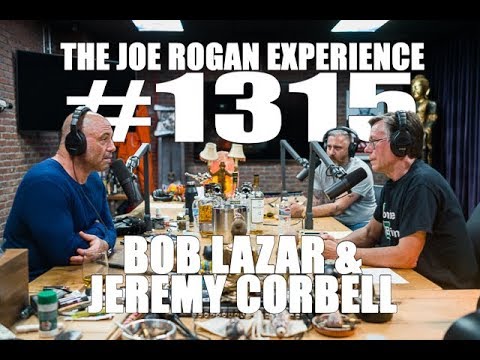
Joe Rogan Experience #1315 - Bob Lazar & Jeremy Corbell
Joe Rogan (host), Bob Lazar (guest), Jeremy Corbell (guest), Guest (guest), Guest (guest), Guest (guest), Guest (guest), Narrator
In this episode of The Joe Rogan Experience, featuring Joe Rogan and Bob Lazar, Joe Rogan Experience #1315 - Bob Lazar & Jeremy Corbell explores bob Lazar revisits Area 51 UFO claims amid new Pentagon context Joe Rogan interviews Bob Lazar and filmmaker Jeremy Corbell about Lazar’s longstanding claim that he worked on alien propulsion systems at a secret facility called S‑4 near Area 51 in the late 1980s. Lazar describes being hired via weapons physicist Edward Teller, flown into Area 51, then bussed to S‑4 where he says he helped attempt to reverse‑engineer one of nine recovered craft powered by a stable form of element 115 that generated its own gravity. He recounts seeing the craft fly, feeling an apparent gravity field from a basketball‑sized reactor, reading briefings alleging an extraterrestrial origin (Zeta Reticuli), and ultimately going public after security concerns and surveillance spilled into his personal life. Corbell and Rogan frame Lazar’s story against modern developments like Pentagon UFO programs and Navy Tic Tac encounters, arguing that recent admissions and corroborating details (e.g., hand‑scanner tech, Los Alamos records) make it harder to dismiss his account outright, while Lazar emphasizes he cares primarily about the technology, not UFO culture.
Bob Lazar revisits Area 51 UFO claims amid new Pentagon context
Joe Rogan interviews Bob Lazar and filmmaker Jeremy Corbell about Lazar’s longstanding claim that he worked on alien propulsion systems at a secret facility called S‑4 near Area 51 in the late 1980s. Lazar describes being hired via weapons physicist Edward Teller, flown into Area 51, then bussed to S‑4 where he says he helped attempt to reverse‑engineer one of nine recovered craft powered by a stable form of element 115 that generated its own gravity. He recounts seeing the craft fly, feeling an apparent gravity field from a basketball‑sized reactor, reading briefings alleging an extraterrestrial origin (Zeta Reticuli), and ultimately going public after security concerns and surveillance spilled into his personal life. Corbell and Rogan frame Lazar’s story against modern developments like Pentagon UFO programs and Navy Tic Tac encounters, arguing that recent admissions and corroborating details (e.g., hand‑scanner tech, Los Alamos records) make it harder to dismiss his account outright, while Lazar emphasizes he cares primarily about the technology, not UFO culture.
Key Takeaways
Lazar alleges he worked at a sub‑facility called S‑4 on recovered craft, not just at Area 51 broadly.
He distinguishes S‑4 as a separate, highly compartmentalized site carved into a mountain near Papoose Lake, where he claims he was assigned specifically to the power and propulsion division of a back‑engineering program.
Get the full analysis with uListen AI
The core of his story is a gravity‑based propulsion system powered by a stable isotope of element 115.
Lazar describes a basketball‑sized reactor creating a local gravitational field—repelling his hand like magnetic poles—and asserts this stable 115 came with the craft, predating its later (unstable) laboratory synthesis and naming as moscovium.
Get the full analysis with uListen AI
He claims there were nine distinct craft with radically advanced, non‑human design and minimal visible controls.
Inside the disc he allegedly worked on, the interior was small, seamless, and optimized for beings roughly half his height, with three seats, gravity “amplifiers,” and archways—one of which could turn transparent—rather than conventional panels or wiring.
Get the full analysis with uListen AI
Lazar’s credibility hinges on a mix of unverifiable claims and later‑validated details.
Skeptics note missing school and work records; supporters point to independent confirmation that he worked at Los Alamos, the later discovery of element 115, and the existence of the unusual hand‑geometry scanners he described decades before photos surfaced.
Get the full analysis with uListen AI
Going public brought surveillance, career damage to associates, and long‑term stress rather than fame and fortune.
Lazar says after he showed friends test flights and Knapp aired his story, he was threatened, associates had clearances pulled or were audited, and his personal records were “erased,” leading him to largely withdraw from UFO circles.
Get the full analysis with uListen AI
Recent U.S. government acknowledgments of UFO study programs give his account new context.
Corbell links Lazar’s propulsion descriptions to modern Navy sightings like the Tic Tac and Gimbal videos and to leaked documents (e. ...
Get the full analysis with uListen AI
The conversation broadens into how technological evolution might naturally produce entities like the reported “grays.”
Rogan and Lazar speculate that just as humans quickly jumped from primitive tools to complex tech, other civilizations might progress toward synthetic or cyborg life optimized for operating advanced craft, making today’s extreme UFO performance plausible endpoints of a long tech curve.
Get the full analysis with uListen AI
Notable Quotes
““What we worked on in the desert was a machine that makes gravity.””
— Bob Lazar
““This project was to back‑engineer the alien craft and see if we can duplicate the technology with available materials.””
— Bob Lazar
““It’s like dropping a small portable nuclear reactor into Victorian times and watching them take it apart.””
— Bob Lazar
““Whoever gets this wins, dude. You literally become invincible once you master the technology.””
— Joe Rogan
““If you have a machine that can make gravity, you can pretty much do anything… all that stuff that’s in science fiction becomes reality.””
— Bob Lazar
Questions Answered in This Episode
Which specific technical tests or measurements, if any, from Lazar’s time at S‑4 could be independently reconstructed or falsified today?
Joe Rogan interviews Bob Lazar and filmmaker Jeremy Corbell about Lazar’s longstanding claim that he worked on alien propulsion systems at a secret facility called S‑4 near Area 51 in the late 1980s. ...
Get the full analysis with uListen AI
How should we weigh Lazar’s missing academic records against corroborating details like employment directories, coworkers, and now‑verified technologies he described?
Get the full analysis with uListen AI
If private aerospace contractors are indeed custodians of exotic materials or craft, what mechanisms—if any—should exist for public oversight or scientific access?
Get the full analysis with uListen AI
To what extent do modern Navy UFO encounters (Tic Tac, Gimbal) align—or conflict—with Lazar’s descriptions of gravity‑propelled craft behavior?
Get the full analysis with uListen AI
What broader implications would confirmed gravity‑control technology have for energy, transportation, warfare, and the structure of global power?
Get the full analysis with uListen AI
Transcript Preview
... two, one, boom. (slaps table) And we're live. (slaps table) First of all, cheers, gentlemen. Let's have a little toast, relax. Bob, thank you very much for doing this. I really appreciate it. I understand that you've told this story many, many times. You've been grilled many, many times, and it's very stressful for you, so I v- I really, really appreciate your time. For people who don't know the story, um, there is a documentary. Um, Jeremy Corbell has a documentary out right now. It's called Bob Lazar: Area 51 and UFOs.
A- and Flying Saucers.
And Flying Saucers. Not-
Bob Lazar: Area 51 and Flying Saucers.
Okay.
Yeah.
Um, I first heard your story decades ago. I've, uh, I told you last night when we went out to dinner, I've seen pretty much every interview you've ever given. I've followed the story incredibly closely.
Mm-hmm.
But for people who don't know the story, let's give them the bullet points. You used to work at Area 51, and Area 51 ... Oh, God, you, you went, like, "Huh?"
Well, you know, we wanna-
Careful.
... be accurate.
Okay.
Area S-4.
S-4, okay.
It's about 15 miles south of Area 51.
Okay.
But-
Um, you worked in, what would you, how would you describe it? A-
I, I, I guess within the Area 51 compound. You can call that a subset of Area 51.
And you got that job, you, before that you were working ...
Before that, I had worked at Los Alamos-
Right.
... National Labs in New Mexico.
And you were involved in what kind of work?
Nuclear weapon development, physics. I mean, that's, they, they do everything there.
So, how do they approach you to say, "Hey, Bob, why don't you come on out to the Nevada desert?"
Well, the way this went down was, um, at that time, it was 1982. I, um, I put, uh, a jet engine in my, my Honda, and Los Alamos put it on the front page of the paper. Said, you know, uh, Los Alamos man, physicist at the lab, you know, built this 200-mile-an-hour, you know, Honda Jet Car, that I, I drove to work every day.
(laughs)
So, uh, so I was, I was known in Los Alamos as the guy with the weird car and that, you know, you could hear it from, you know, a mile away. Anyway, the day that came out on the front page of the paper was the day Edward Teller, the father of the hydrogen bomb, was giving a lecture down there at the lab. And we didn't have much going on that day in our group, and I asked if I could go down there. And, um, I went down there early, and Ed Teller was outside leaning on a brick wall there and reading the front page of the paper. Now, this is a guy out of history, so I introduced myself, "Hey, I'm the guy you're reading about there." And we talked for a little while and it was cool. Uh, you know, fast-forward to years later. I had moved out to Las Vegas, and had, you know, left Los Alamos and, you know, went on to other things, and I wanted to get back into the scientific community. You know, I left to start other businesses and, and that sort of thing. So, I sent resumes out, and one of them went out to Ed Teller, and referenced our meeting, you know, back in, back in the, the day. And, uh, anyway, he remembered me, and gave me a reference, somebody to contact at EG&G. And that's pretty much how it started.
Install uListen to search the full transcript and get AI-powered insights
Get Full TranscriptGet more from every podcast
AI summaries, searchable transcripts, and fact-checking. Free forever.
Add to Chrome