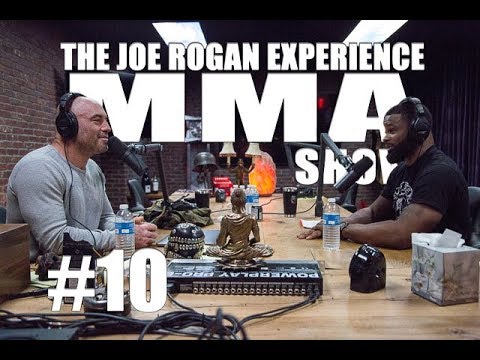
JRE MMA Show #10 with Tyron Woodley
Joe Rogan (host), Tyron Woodley (guest), Narrator, Narrator
In this episode of The Joe Rogan Experience, featuring Joe Rogan and Tyron Woodley, JRE MMA Show #10 with Tyron Woodley explores tyron Woodley Reveals Rehab, Resentments, and Vision for Greatness Tyron Woodley walks through his recent shoulder surgery and aggressive rehab, detailing stem cell treatments, ARP Wave therapy, and how he managed to beat Demian Maia with a badly injured shoulder. He explains his evolution as a fighter, including meticulous game-planning, late-career coaching changes, and why he believes his toughest welterweight challenges are already behind him.
Tyron Woodley Reveals Rehab, Resentments, and Vision for Greatness
Tyron Woodley walks through his recent shoulder surgery and aggressive rehab, detailing stem cell treatments, ARP Wave therapy, and how he managed to beat Demian Maia with a badly injured shoulder. He explains his evolution as a fighter, including meticulous game-planning, late-career coaching changes, and why he believes his toughest welterweight challenges are already behind him.
Woodley is candid about his frustrations with MMA politics, promotional bias, and how he feels the UFC narrative and some fans undervalue his resume compared to other welterweight greats. He and Joe Rogan debate the Conor McGregor effect, entertainment vs. martial arts respect, and how star-making really works in the UFC.
They break down key fights and fighters across divisions—Wonderboy, Maia, Lawler, RDA, Usman, Ngannou, Stipe, Khabib, Tony, Max Holloway, Mighty Mouse, and more—offering technical insight into styles, game plans, and matchups. Woodley repeatedly pushes for a superfight with Georges St-Pierre, framing it as the bout that could cement him as the greatest welterweight of all time.
Key Takeaways
Aggressive, tech-assisted rehab can significantly shorten recovery windows.
Woodley combines stem cell injections, PRP, intensive two-a-day PT, and an ARP Wave neuromuscular stim device to regain shoulder function quickly, illustrating how elite athletes use advanced modalities to return to training and contact in as little as two months.
Get the full analysis with uListen AI
Elite game planning is as important as raw athleticism.
He describes obsessively studying opponents—tracking stance habits, punch counts, defensive patterns, cardio tendencies—and designing strategies that remove their best weapons, which he credits for neutralizing specialists like Wonderboy, Maia, and Condit.
Get the full analysis with uListen AI
Public narratives and promoter comments materially shape a champion’s brand.
Woodley argues that when the UFC president publicly labels tactical title defenses as “boring,” it damages fan perception and marketability, showing how messaging from the top can override the underlying difficulty and brilliance of certain performances.
Get the full analysis with uListen AI
Star power requires more than winning—it needs story, style, and support.
In contrasting himself with Conor McGregor, Woodley notes that timing, national backing (Ireland), risk-taking, charisma, and UFC promotional “jumper cables” all combined to create a unique phenomenon that other fighters can’t easily replicate by just talking trash.
Get the full analysis with uListen AI
Many fighters feel the sport’s martial arts ethos is eroding.
Woodley dislikes the current incentive structure where trash talk and image can leapfrog hard-earned records, seeing it as disrespectful to foundational martial arts values of discipline, respect, and deep technical drilling.
Get the full analysis with uListen AI
Judging criteria and systems in MMA remain deeply flawed.
He recounts a judge telling him he “wasted a minute in a guillotine” in the Wonderboy fight, and Rogan critiques the 10-point must system as too narrow for MMA’s complexity, underscoring how outcomes and legacies can hinge on poorly aligned scoring frameworks.
Get the full analysis with uListen AI
Career satisfaction often depends on balancing grind with genuine enjoyment.
Woodley admits he doesn’t love fighting itself and was burning out when he trained constantly; now he largely stops hard MMA training between camps, focuses on family and media work, and says that missing it slightly helps him come into camps sharper and more motivated.
Get the full analysis with uListen AI
Notable Quotes
“I don't really even like fighting—to be honest. I'm just good at it.”
— Tyron Woodley
“People say, ‘Don’t leave it in the hands of the judges.’ Nobody goes in there saying, ‘Today I’m gonna leave it in the hands of the judges.’”
— Tyron Woodley
“When I decided that I'm the best, I started carrying myself as if I was already the champion.”
— Tyron Woodley
“If you only sold 300,000 pay-per-view buys because of the Wonderboy fight, there's not much they can do about that… they’re numbers people.”
— Joe Rogan
“Conor’s like lightning in a bottle. Whatever reason it worked with him, I don’t know if it’s even possible with a lot of people.”
— Joe Rogan
Questions Answered in This Episode
How much responsibility should champions bear for being ‘entertaining’ versus purely effective, especially in high-risk tactical fights?
Tyron Woodley walks through his recent shoulder surgery and aggressive rehab, detailing stem cell treatments, ARP Wave therapy, and how he managed to beat Demian Maia with a badly injured shoulder. ...
Get the full analysis with uListen AI
To what extent do promoter narratives and commentary shape fan perception of “boring” versus “brilliant” performances?
Woodley is candid about his frustrations with MMA politics, promotional bias, and how he feels the UFC narrative and some fans undervalue his resume compared to other welterweight greats. ...
Get the full analysis with uListen AI
Could a revamped scoring system—beyond the 10-point must—meaningfully reduce controversial decisions in MMA?
They break down key fights and fighters across divisions—Wonderboy, Maia, Lawler, RDA, Usman, Ngannou, Stipe, Khabib, Tony, Max Holloway, Mighty Mouse, and more—offering technical insight into styles, game plans, and matchups. ...
Get the full analysis with uListen AI
Is it realistic or fair for other fighters to model themselves after Conor McGregor’s path, or is that case too unique to emulate?
Get the full analysis with uListen AI
Would a Woodley vs. Georges St-Pierre matchup genuinely settle the debate about the greatest welterweight of all time, or would it just shift the argument?
Get the full analysis with uListen AI
Transcript Preview
Doo, doo, doo. And we're live. We're live with the champ. We're live. We're live with the champ.
We out of this bitch.
What's up, man? How are you?
I'm chilling, man. How you doing, brother?
You look better than anybody I've ever seen just a couple weeks out of shoulder surgery.
I'm a savage, man.
Like, you're walking around like there's nothing going on.
They took my savage stem cells out of my own damn back, and they threw them in my shoulder.
Out of your back?
The hip bone, where the fuck... The word bone marrow, they got in there, centrifuge spun them, shot them into my shoulder.
Hmm.
And shit. I should have a sling on, but I'm out Tuesday anyway, so I kind of prematurely decided to come out of the sling.
Oh, so you're supposed to be out of the sling in six days?
Yeah, some... No, no. Is that six days?
Five days?
Whatever Tuesday is.
Five days. Today's Thursday.
Yeah, five days.
Yeah.
Four or five days, yeah.
Wow. So you said, "Fuck it."
So my guys were really aggressive. I went to Dr. Andrews. He's out there in Pensacola. And he said, "No, we need you back punching in two months." So the day after surgery-
Two months?
Yeah.
Hard?
Day after surgery, he said making contact. So two month... I mean, right after surgery, I was doing two-a-days, fucking full-ass rehab.
Really?
Yeah, like crazy. So I'm like, these dudes is nuts. This shoulder, I had this done in '08. I didn't move for three weeks.
What'd you have done with that one?
Same thing, labrum.
Now, are you hurting this in training? Are you hurting it in fights?
Um, a lot of... Well, people don't know about me. They think I just throw my right hand a lot, but I wasn't never really confident with my left hand because I had that left labrum tear.
Ah.
So it felt weird to throw hooks and it felt weird to use my jab a lot, and my shoulder would fatigue a lot. So I didn't tell a lot of people that, so I just started bombing like hell with my right hand. It wasn't because I was just so right-hand heavy. So now that I had the surgery on this one, I'm going to stem cell both shoulders, rehab the crap out of it, and also bought this, um, little rehab machine called an ARP Wave. You ever heard of it? Like a Russian stim, it's like nuts.
No, what is it?
It's like a Russian stim machine that has the ability to make your muscles contract 500 times a second at its highest setting. So a lot of people use it. The coach use it. A lot of pro athletes use it. The people that made it in Minnesota, they don't give a lot of information because they don't want their intellectual property stolen, but they charge you like 12 to 14 grand for the machine. Then they charge you five grand to show you how to use it. Then if you really, really want to know how to use it, they charge you guys another 500... I mean, uh, five grand. So I was lucky enough... I hope they ain't watching this yet.
Install uListen to search the full transcript and get AI-powered insights
Get Full TranscriptGet more from every podcast
AI summaries, searchable transcripts, and fact-checking. Free forever.
Add to Chrome