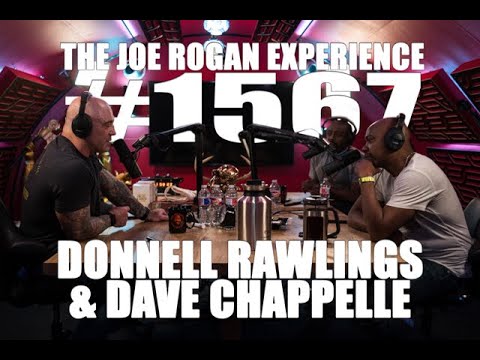
Joe Rogan Experience #1567 - Donnell Rawlings & Dave Chappelle
Narrator, Joe Rogan (host), Donnell Rawlings (guest), Dave Chappelle (guest), Dave Chappelle (guest), Narrator, Narrator
In this episode of The Joe Rogan Experience, featuring Narrator and Joe Rogan, Joe Rogan Experience #1567 - Donnell Rawlings & Dave Chappelle explores chappelle and Rawlings riff on COVID, politics, comedy, and change Joe Rogan hosts Donnell Rawlings and later Dave Chappelle for a sprawling, free‑form conversation that moves from Donnell’s recent thumb gunshot and emotional support dog to life under COVID, lockdowns, and how comics are adapting. They debate masks, bubbles, testing, vaccines, and how governments handled the pandemic, while also touching on health, discipline, and personal responsibility. The trio dives into politics and media—Trump, Biden, Kamala Harris, election fraud claims, and the performative nature of TV news versus podcasting. Woven through are stories about hunting, cooking elk, stand‑up on the road, Yellow Springs shows, podcast culture, race, language, and how the pandemic is forcing people to rethink careers, community, and where to live.
Chappelle and Rawlings riff on COVID, politics, comedy, and change
Joe Rogan hosts Donnell Rawlings and later Dave Chappelle for a sprawling, free‑form conversation that moves from Donnell’s recent thumb gunshot and emotional support dog to life under COVID, lockdowns, and how comics are adapting. They debate masks, bubbles, testing, vaccines, and how governments handled the pandemic, while also touching on health, discipline, and personal responsibility. The trio dives into politics and media—Trump, Biden, Kamala Harris, election fraud claims, and the performative nature of TV news versus podcasting. Woven through are stories about hunting, cooking elk, stand‑up on the road, Yellow Springs shows, podcast culture, race, language, and how the pandemic is forcing people to rethink careers, community, and where to live.
Key Takeaways
You can create your own ‘bubble’ of safety instead of waiting for permission.
Rogan and Rawlings describe how UFC, Chappelle’s Yellow Springs shows, and Rogan’s studio use testing and controlled groups to keep working safely, arguing that individuals and small groups can proactively build similar systems when they have access to tests.
Get the full analysis with uListen AI
Health and resilience are as important as restrictions in managing COVID risk.
They criticize public messaging for focusing on lockdowns and masks while neglecting diet, exercise, and metabolic health—emphasizing that taking care of your body radically changes how you handle illness.
Get the full analysis with uListen AI
The pandemic is forcing creatives to pivot or get left behind.
With live comedy largely shut down, Rawlings explains he lost about 95% of his income and had to ‘pivot’ by launching products and online sales, while Rogan and Chappelle moved into outdoor shows, podcasting, and alternative venues.
Get the full analysis with uListen AI
Trust in institutions is fragile, especially around elections and vaccines.
They note that both media and politicians have blurred lines between news, opinion, and performance, making it hard for people to trust election results or new vaccines without transparent evidence and honest communication.
Get the full analysis with uListen AI
Podcasting thrives by collaboration, not competition.
Rogan contrasts radio’s territorial culture with podcasting’s ‘feast, not famine’ mindset, where hosts cross-promote, share guests, and see each other’s success as expanding the whole ecosystem rather than stealing audience.
Get the full analysis with uListen AI
Living outside traditional entertainment hubs can improve perspective and quality of life.
Chappelle’s Yellow Springs experience and Rogan’s move to Austin illustrate how smaller communities, nature, and distance from Hollywood’s status games can deepen creativity, community, and happiness.
Get the full analysis with uListen AI
Self-discipline is built, not innate—and it often starts with discomfort.
Referencing David Goggins and Rogan’s own habits, they highlight that disciplined people still struggle and procrastinate; the difference is forcing themselves into hard actions (training, cooking, creating) instead of waiting to feel like it.
Get the full analysis with uListen AI
Notable Quotes
“We had the recipes, just not the ingredients.”
— Donnell Rawlings
“I always think there’s enough for everybody. I’m a feast thinker, not a famine thinker.”
— Joe Rogan
“You’re at the mercy of someone you don’t necessarily trust. That’s the rub.”
— Dave Chappelle
“Why not find the answers you need in life through yourself?”
— Donnell Rawlings (paraphrasing David Goggins)
“I just do what I like. I never thought, ‘If I do this, it’s gonna be huge.’”
— Joe Rogan
Questions Answered in This Episode
How much personal responsibility for health should individuals take versus what public health authorities prescribe during a pandemic?
Joe Rogan hosts Donnell Rawlings and later Dave Chappelle for a sprawling, free‑form conversation that moves from Donnell’s recent thumb gunshot and emotional support dog to life under COVID, lockdowns, and how comics are adapting. ...
Get the full analysis with uListen AI
Can small-scale ‘bubble’ models used by comedians and sports realistically scale to regular workplaces, or is that only viable for people with money and flexibility?
Get the full analysis with uListen AI
What structural changes would rebuild public trust in elections and vaccines beyond just telling people to ‘trust the science’?
Get the full analysis with uListen AI
Has the podcast model of open collaboration permanently changed how entertainers should think about competition and career strategy?
Get the full analysis with uListen AI
How might moving out of major cities like LA and New York reshape comedy, culture, and the broader media landscape over the next decade?
Get the full analysis with uListen AI
Transcript Preview
(drumming music plays) Joe Rogan podcast, check it out.
The Joe Rogan Experience. Train by day, Joe Rogan podcast by night. All day. (rock music plays) Donnell, what's going on, bro?
Good to see you, my friend.
<< Take me to the river, I wanna go. I'll go. Take me to your river, I wanna go >> I don't even know who sings that.
You don't know who sings that song?
No. Uh-
Leon Bridges. Leon Bridges? Yeah, he's like a folk country singer, black dude. I think he's, uh, Louisiana's, uh, where he's from. But about five years ago, he had a very popular song that was like a song that really charted well. It was called The River. That was that?
That was that song. And then he-
There he is.
And then what he does is he-
Are you aware, Jamie? You know that dude?
I've seen him before. Yeah, I don't know that I know the song, though.
But this song is like... He's had other songs, but for some reason, this song resonated with a lot of people-
Mm-hmm.
... in the country, man. It was like him reminiscing what, um, going to a place that made him feel good in the river.
I hope when we go over to Spotify we can play it. I don't think-
<< I go. >> I could... << Take me to your river, I wanna go. I'll go >>
(laughs)
That's pretty much it. That's the one part everybody knows.
It's acceptable now for people wear like neck scarfs.
Are you being insulting?
Neckerchiefs. No, not at all.
It's... What are you saying though?
It's normal. If you'd worn that on any other time, I'd be like, "What is on your neck?"
And I would explain it to be a gator.
Right.
A gator.
I know what it is. I know what a gator is, I hunt.
Yeah, this is what it is. It's my gator.
Yeah, you wear 'em when you're sneaking up on animals.
Or people, or people.
But you don't wear 'em in that color. Well, that color's not... You can't sneak up on anybody. Or people.
Gay pride, gay pride. (laughs)
Well, it's... There's a lot of colors-
This could be-
... in that. Yeah, I guess that's a rainbow.
Yeah, this is-
Not a traditional rainbow.
This is a liberal, liberal gator.
Liberal gator?
Yep. It's accepted by anything. Gay people, black people, Hispanic people, Tr- I'm sorry.
No worries.
My baby mother asking me about weed. Jesus fucking Christ.
(laughs)
I thought you don't like me? I thought you don't like me? Why you keep blowing me up about weed? You said you don't like me.
She likes your weed.
Install uListen to search the full transcript and get AI-powered insights
Get Full TranscriptGet more from every podcast
AI summaries, searchable transcripts, and fact-checking. Free forever.
Add to Chrome