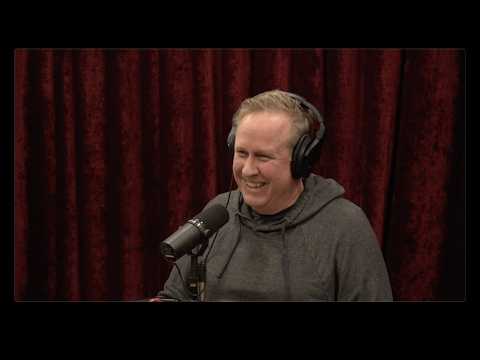
Joe Rogan Experience #2452 - Roger Avary
Joe Rogan (host), Roger Avary (guest), Joe Rogan (host), Joe Rogan (host), Joe Rogan (host)
In this episode of The Joe Rogan Experience, featuring Joe Rogan and Roger Avary, Joe Rogan Experience #2452 - Roger Avary explores film craft, streaming shifts, and spiraling conspiracies with Roger Avary Avary and Rogan begin with a cinephile deep dive into Orson Welles and classic long takes, using Citizen Kane and Touch of Evil to illustrate how technical constraints once drove inventive filmmaking.
Film craft, streaming shifts, and spiraling conspiracies with Roger Avary
Avary and Rogan begin with a cinephile deep dive into Orson Welles and classic long takes, using Citizen Kane and Touch of Evil to illustrate how technical constraints once drove inventive filmmaking.
They contrast shooting on film versus digital, arguing that cost, discipline, and limited monitoring shaped performances and directing, while today’s “video village,” streaming specs, and analytics push content toward formula and sameness.
The conversation broadens into contemporary film/TV criticism—Netflix-style structural mandates, DEI-as-corporate-messaging, and frustrations with modern Star Trek—while recommending alternatives like The Orville, Galaxy Quest, The Chosen, and The Pendragon Cycle.
In a sharp tonal pivot, Avary and Rogan discuss Epstein, coded language, elite blackmail, 9/11/Building 7 suspicions, and “predictive programming,” presenting a worldview in which institutions systematically deceive and desensitize the public.
They end by touching on AI and media’s future, with Avary describing how attaching “AI” unlocked funding for multiple new projects, framing the technology as a cost-collapsing VFX revolution for independent filmmaking.
Key Takeaways
Technical limits can fuel creative breakthroughs.
Avary frames Welles’ era as a time when heavy cameras, lighting needs, and expensive film stock forced meticulous planning and bold engineering, yielding enduring innovations like complex tracking shots and ambitious staging.
Get the full analysis with uListen AI
Film and digital are different “paints,” not better/worse.
Avary argues digital capture changes depth, highlight behavior, and set dynamics; trying to make digital “look like film” often leads to compensations (e. ...
Get the full analysis with uListen AI
On-set monitoring can dilute directorial authority and performance energy.
The “video village” environment encourages consensus notes and constant visibility, whereas older film workflows required commitment, rehearsal, and trusting the “moment,” which Avary believes helped actors and directors capture something more singular.
Get the full analysis with uListen AI
Streaming platforms shape story structure as much as distribution.
They claim analytics, attention scarcity, and platform guidelines create pacing mandates and predictable beats, making modern content feel optimized for retention rather than immersion or risk-taking.
Get the full analysis with uListen AI
Representation works best when integrated into strong storytelling.
Avary and Rogan cite classic Star Trek and Alien as examples where diverse casting/themes existed without feeling didactic, arguing that contemporary versions sometimes foreground messaging over character complexity and canon coherence.
Get the full analysis with uListen AI
Media fragmentation creates space for unexpected hits outside Hollywood’s center.
Avary praises projects like The Chosen (crowdfunded, widely accessible) and the Daily Wire’s Arthurian show as evidence that alternative funding/distribution can produce culturally significant work when legacy studios lose audience trust.
Get the full analysis with uListen AI
AI is becoming a financing keyword and a cost-collapse tool for production.
Avary claims attaching “AI” unlocked investor interest and enabled multiple films, presenting AI largely as a new VFX pipeline that makes formerly expensive imagery achievable for independent budgets.
Get the full analysis with uListen AI
Notable Quotes
“They are both paint, but one is watercolor and one is oil paint.”
— Roger Avary
“Movies are my church.”
— Roger Avary (quoting Quentin Tarantino’s sentiment)
“Mundus vult decipi, ergo decipiatur.”
— Roger Avary
“That fucking Alex Kurtzman… just shits all over everything.”
— Roger Avary
“Tower seven just drops… free-fall speed into its base. That’s weird.”
— Joe Rogan
Questions Answered in This Episode
On the Citizen Kane window-to-interior shot, what specific lighting/exposure tricks were standard in 1941 that modern viewers underestimate?
Avary and Rogan begin with a cinephile deep dive into Orson Welles and classic long takes, using Citizen Kane and Touch of Evil to illustrate how technical constraints once drove inventive filmmaking.
Get the full analysis with uListen AI
If digital is “flatter by nature” because of sensor behavior, what are the most effective non-gimmicky ways to restore perceived depth without leaning on lens flare?
They contrast shooting on film versus digital, arguing that cost, discipline, and limited monitoring shaped performances and directing, while today’s “video village,” streaming specs, and analytics push content toward formula and sameness.
Get the full analysis with uListen AI
What exactly do you mean by Netflix’s “white paper” shaping story—what requirements are technical specs versus narrative/pacing directives?
The conversation broadens into contemporary film/TV criticism—Netflix-style structural mandates, DEI-as-corporate-messaging, and frustrations with modern Star Trek—while recommending alternatives like The Orville, Galaxy Quest, The Chosen, and The Pendragon Cycle.
Get the full analysis with uListen AI
You argue streaming was “by design to eliminate residuals”; what concrete industry decisions or deal-structures best support that claim?
In a sharp tonal pivot, Avary and Rogan discuss Epstein, coded language, elite blackmail, 9/11/Building 7 suspicions, and “predictive programming,” presenting a worldview in which institutions systematically deceive and desensitize the public.
Get the full analysis with uListen AI
Which modern Star Trek writing or showrunning choices (specific episodes/arcs) most clearly demonstrate the shift from integrated themes to “corporate propaganda”?
They end by touching on AI and media’s future, with Avary describing how attaching “AI” unlocked funding for multiple new projects, framing the technology as a cost-collapsing VFX revolution for independent filmmaking.
Get the full analysis with uListen AI
Transcript Preview
Joe Rogan Podcast, check it out.
The Joe Rogan Experience.
Train by day, Joe Rogan Podcast by night. All day. [upbeat rock music] Come on, Roger.
Put the headphones on?
Yeah, fuck it. Fuck it.
Fuck it. Go for it.
Fuck it, we'll do it live.
Yeah, do it live!
That's a classic.
Oh, yeah.
That's a classic look behind the scenes. [laughs]
[laughs] Do it live! Fuck it.
Fucking cra- crazy people telling you the news. [laughs]
Yeah. That, that's good, and the, the William Shatner one where, uh, you know, the, um, studio guy, you know, he says, uh, Shatner's doing some ADR for, uh, the cartoon, the Star Trek cartoon, and he says, uh, you know, he's uses the word sabotage.
[laughs]
And he gets corrected by the, by the studio guy. He's like, "Uh, Bill, it's pronounced sabotage." "Please, don't correct me. It disgusts me. It sickens me."
[laughs]
"And you say sabotage; I say sabotage."
[laughs]
So I l- absolutely love William Shatner, especially-
My favorite ones are the Orw- uh, excuse me. Uh, fuck. Why can't I remember his name? Um-
Orson Welles
... Rosebud. Orson Welles. Jesus Christ.
Orson Welles.
What happened?
Now you start saying it.
I know. What happened?
[laughs]
My brain just said, "Nope. No access." When Orson Welles was doing the Gallo Wine commercials.
Oh, yeah.
Remember those days?
Yeah, yeah.
Like, Orson Welles is-
Would chill the wine [inhales] before it's time.
I know. And he was like-
Everything was like a, a, a exhaustive y- sucking of air to come in to speak
... but then he was making fun of how shitty the wine was in between takes, like he was angry. [laughs]
Yeah. [laughs] There is a CD that you can get, I can't remember what it's called, but I have them at home, and it's, like, all these radio things like that where just when celebrities, you know, lose it on, uh, while doing voiceover and ADR. It's hilarious.
Orson Welles is a crazy story, right? Because when he made that movie, when he made Citizen Kane, which was about William Randolph Hearst-
Yeah
... William Randolph Hearst essentially shut down one of the most talented guys alive at the time, shut down his career.
Yeah, because the movie was kind of an insult about... You know, the whole thing about Rosebud is that's the name of his girlfriend's clitoris.
Oh, really?
That, that was his nickname for her clitoris, and so Orson Welles was doing a kind of very, uh, uh, like, uh, uh, v- like, uh, he was jabbing at him in a very low-level way. Like-
Really?
Yeah, Rosebud.
How did he know that that was the nickname of his girlfriend's clitoris?
People in Hollywood know these things. [laughs]
Oh, boy. [laughs]
Word gets around. Word gets around.
I would keep that one just to her.
Yeah. [laughs]
Who told?
Yeah. [laughs]
That's crazy. But, I mean, if you go back to, like, War of Worlds and then Citizen Kane, I mean, this guy was a dynamo, and then they shut him down.
Install uListen to search the full transcript and get AI-powered insights
Get Full TranscriptGet more from every podcast
AI summaries, searchable transcripts, and fact-checking. Free forever.
Add to Chrome