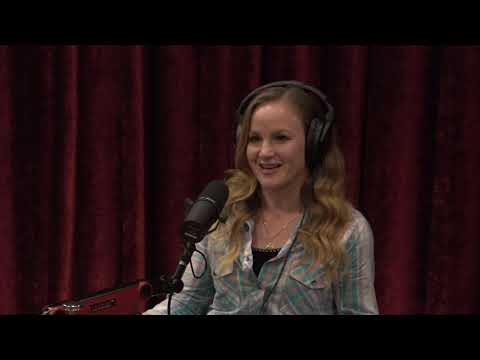
JRE MMA Show #115 with Valentina Schevchenko
Valentina Shevchenko (guest), Joe Rogan (host)
In this episode of The Joe Rogan Experience, featuring Valentina Shevchenko and Joe Rogan, JRE MMA Show #115 with Valentina Schevchenko explores valentina Shevchenko Explains How World Travel Forged a Perfect Fighter Valentina Shevchenko discusses her lifelong martial arts journey from Kyrgyzstan to becoming a dominant UFC champion, emphasizing the importance of a universal, well‑rounded fighting style. She explains how travel, language learning, shooting sports, and dance all feed into her mentality, balance, and performance as a fighter. Central to her success is her decades‑long partnership with coach Pavel and a training philosophy that rejects most ‘modern’ conditioning in favor of hard, long, skill‑focused sessions. She also shares her views on weight cutting, coaching, gun culture, kids and martial arts, and a possible future super‑fight with Amanda Nunes.
Valentina Shevchenko Explains How World Travel Forged a Perfect Fighter
Valentina Shevchenko discusses her lifelong martial arts journey from Kyrgyzstan to becoming a dominant UFC champion, emphasizing the importance of a universal, well‑rounded fighting style. She explains how travel, language learning, shooting sports, and dance all feed into her mentality, balance, and performance as a fighter. Central to her success is her decades‑long partnership with coach Pavel and a training philosophy that rejects most ‘modern’ conditioning in favor of hard, long, skill‑focused sessions. She also shares her views on weight cutting, coaching, gun culture, kids and martial arts, and a possible future super‑fight with Amanda Nunes.
Key Takeaways
Develop yourself as a universal fighter, not a specialist.
Shevchenko’s coach always pushed her into many rule sets (Taekwondo, Muay Thai, MMA, Sanda, etc. ...
Get the full analysis with uListen AI
A great coach who understands you is more important than a perfect gym.
Valentina follows Pavel wherever he goes because he’s been with her since age five and tailors technique to each athlete’s body and style instead of forcing one rigid system on everyone; she sees this as the main reason talent either flourishes or gets wasted.
Get the full analysis with uListen AI
Travel and learning outside the gym elevate performance inside the gym.
Living in Russia, Peru, and Thailand, speaking four languages, and deeply engaging with local cultures have expanded her perspective and resilience; she believes non‑fight experiences cross‑pollinate skills, sharpen self‑knowledge, and ultimately improve her fighting.
Get the full analysis with uListen AI
Train hard with purpose, not by copying trendy strength and conditioning.
She largely avoids weights, machines, running, and heart‑rate gadgets, instead doing one long, intense, skill‑heavy session a day with live partners and full‑power sparring (with protection). ...
Get the full analysis with uListen AI
Protect yourself in sparring so you can arrive fresh on fight night.
She criticizes hard, bare‑bones sparring without gear, noting that repeated damage in camp leaves fighters ‘like a balloon’ on fight night; her solution is full‑power but highly protected sparring (big gloves, headgear, pads) and careful energy management.
Get the full analysis with uListen AI
Balance intense ambition with humility and constant education.
Despite being a dominant champion, she deliberately stays grounded—treating the gym like a temple, refusing to underestimate opponents, and continuously learning (languages, shooting, dance). ...
Get the full analysis with uListen AI
Introduce kids to martial arts and responsible gun culture to reduce harm, not increase it.
She argues that teaching children martial arts channels their energy, builds confidence, and reduces bullying, while early gun safety education fosters respect and responsibility. ...
Get the full analysis with uListen AI
Notable Quotes
“To become a professional in something might take five years, so why not spend more years to learn something else and add more knowledge into yourself?”
— Valentina Shevchenko
“My coach always wanted to create universal fighters who don’t have any problems in any position.”
— Valentina Shevchenko
“In training you have to be the most simple person you can be, because it’s a real fight. If you think too much about yourself, it will break you.”
— Valentina Shevchenko
“I don’t like to choose my opponents. All my life it was: ‘Valentina, will you fight her?’ Yes.”
— Valentina Shevchenko
“For me, the gym is like my temple. If I respect that place, it will keep me safer from injuries.”
— Valentina Shevchenko
Questions Answered in This Episode
How would Valentina’s career and style have differed if she’d grown up with today’s UFC infrastructure and visibility instead of having to ‘go around the world’ first?
Valentina Shevchenko discusses her lifelong martial arts journey from Kyrgyzstan to becoming a dominant UFC champion, emphasizing the importance of a universal, well‑rounded fighting style. ...
Get the full analysis with uListen AI
Could her low‑tech, intuition‑based training approach (no running, no gadgets, minimal weights) be successfully applied to other high‑level fighters, or is it uniquely suited to her?
Get the full analysis with uListen AI
What risks and rewards would a third fight with Amanda Nunes at 135 pounds present, given Valentina’s refusal to add significant muscle mass?
Get the full analysis with uListen AI
If schools widely adopted both martial arts and gun‑safety education, how might that transform youth violence, bullying, and attitudes toward self‑defense?
Get the full analysis with uListen AI
Where is the line between healthy humility and potentially limiting your own ambition in a sport that rewards self‑promotion and big personalities?
Get the full analysis with uListen AI
Transcript Preview
(drumbeats) Joe Rogan podcast, check it out.
The Joe Rogan Experience. Train by day, Joe Rogan podcast by night. All day. (rock music plays) Okay, here we go. Valentina, pleasure to have you in here. Very excited.
Yes. Finally I'm here, right? (laughs)
(laughs) Finally, yeah. I mean, we've been talking about it for a while and, uh, I've been a fan of yours for quite a long time. You're a very unusual person, very unusual.
(laughs)
I mean, it's, it's unusual to be a martial arts champion, but you are ... You're an unusual martial arts champion. I mean, you're very ... You're very diverse. You have so many skills and talents. It's very strange. Like, how does one ... First of all, how many languages do you speak?
Um, three what I speak, and I'm learning fourths. I learning Thai now.
You're learning Thai?
Mm-hmm.
'Cause you were speaking Thai after one of your fights.
The last one, yeah.
Yeah. So it sounds like you know it. Like you say you're learning it, but you, you got a lot to say.
Uh, yeah, it's kind of like I can say a lot, but, uh, when I mean I'm learning, I want to, um ... So once I will speak it, like, fluently-
Mm-hmm.
... and I will understand, like, native people so good, then I consider it, yes, I speak language. Before that, it's kind of still learning and I think, um, I started to learning, like, couple years ago, but, um, I think it's very important to have practice with native people.
Yes.
Go to Thailand and, like, forget about speaking English, just speak Thai, and this is how, like, um, you just adopt everything. So this is what I ... I want to put this language, Thai language, on the next level. Then I will say, okay, four. Now four. (laughs)
So, like, you immerse yourself?
Um, maybe. Yeah. Kind of. Uh, because, for me, um, I try to do everything, like, as best way I can. Not the perfection way, right, but the best what I can.
Now, your first language is Russian?
Yes.
And when did you learn other ... When did you start learning other languages?
Um, so, English, it was ... I started to learn it in the school, just some basics, because it's like a school program. We learn alphabet, some just very easy words, and nothing enough for, like, speaking, uh, level. But when I started to compete and go and travel for the competition, that was, like, my push for, uh, bringing, uh, my l- um, like, uh, language level to the next level. And, uh, when we moved to, um, South America, then I started to learn, uh, Spanish. But learning Spanish, it was, uh, kind of like the hard way. I came there with no one word in Spanish. No one word, and it's straight, like, to there. "If you want to learn Spanish, you have to speak Spanish right now." And, uh, I say from the moment what I started to speak to the moment when I, uh, was kind of, like, given my first interview, it was four months. After four months, I was giving my first interview in Spanish. It was not the perfect Spanish, but I still could communicate. (laughs)
Install uListen to search the full transcript and get AI-powered insights
Get Full TranscriptGet more from every podcast
AI summaries, searchable transcripts, and fact-checking. Free forever.
Add to Chrome