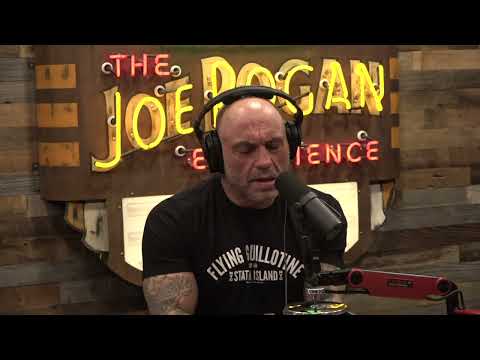
Joe Rogan Experience #2008 - Stephen C Meyer
Joe Rogan (host), Stephen C. Meyer (guest), Narrator
In this episode of The Joe Rogan Experience, featuring Joe Rogan and Stephen C. Meyer, Joe Rogan Experience #2008 - Stephen C Meyer explores joe Rogan and Stephen Meyer Debate God, DNA, and the Cosmos Stephen C. Meyer explains how existential questions and philosophical inquiry led him from teenage angst to theism, and eventually to championing intelligent design based on DNA, cosmic origins, and biological complexity.
Joe Rogan and Stephen Meyer Debate God, DNA, and the Cosmos
Stephen C. Meyer explains how existential questions and philosophical inquiry led him from teenage angst to theism, and eventually to championing intelligent design based on DNA, cosmic origins, and biological complexity.
He argues that the universe had a definite beginning, is finely tuned for life, and that the digital code in DNA and cellular regulatory networks exhibit hallmarks of mind rather than undirected material processes.
Rogan presses him on evolution, free will vs. determinism, suffering and evil, the reliability of religious texts, and the role of psychedelics and UFOs in spiritual interpretation.
Throughout, Meyer maintains that classical theism best explains the converging scientific and philosophical evidence, while Rogan repeatedly challenges whether personal experiences and selective historical data justify strong religious claims.
Key Takeaways
Meyer sees information in DNA as the strongest positive indicator of design.
He argues that long, functionally specific sequences of nucleotides (A, C, G, T) act like digital code or software, and in all known cases where we trace such information back to its cause, it comes from a mind, not undirected chemistry.
Get the full analysis with uListen AI
He contends that standard neo-Darwinism explains small changes, not major innovations.
Citing evolutionary biologists like Gerd Müller and Eric Davidson, Meyer claims mutation and natural selection can optimize existing traits (e. ...
Get the full analysis with uListen AI
Developmental gene regulatory networks are presented as a key obstacle to macroevolution.
These tightly integrated genetic “circuits” orchestrate embryo development; Meyer emphasizes that experiments suggest significant changes to core components collapse development, implying you can’t gradually rewire one body plan into another without destroying viability.
Get the full analysis with uListen AI
He views modern cosmology as powerful support for a transcendent creator.
From Hubble’s expanding universe to cosmic background radiation and the Borde–Guth–Vilenkin theorem, Meyer argues the evidence points to a definite beginning of space, time, matter and energy, making an eternal material universe a poor explanatory starting point.
Get the full analysis with uListen AI
Fine-tuning and multiverse theories, in his view, still point back to mind.
Meyer notes that life-permitting physical constants lie in extremely narrow ranges; multiverse models require universe-generating mechanisms that themselves must be finely tuned, so the ultimate fine-tuning remains unexplained without invoking intelligence.
Get the full analysis with uListen AI
He treats intelligent design as a historical-scientific inference, not mere theology.
Using the method of inference to the best explanation, Meyer says ID is about inferring the best cause (including non-material causes) from publicly accessible data, similar to how archaeologists infer scribes from inscriptions or SETI researchers would infer aliens from coded signals.
Get the full analysis with uListen AI
Rogan repeatedly challenges subjective religious experiences as evidence.
Meyer shares inner experiences he interprets as God’s guidance but explicitly downplays them as public evidence; Rogan counters with examples of cult manipulation and psychedelic states to suggest powerful inner experiences can be misattributed or engineered.
Get the full analysis with uListen AI
Notable Quotes
“Time was always the hero of the plot. But the more we learn about information and biological systems, the less plausible it is that random mutations and natural selection can build fundamentally new forms.”
— Stephen C. Meyer
“In the computer world, if you want to give your computer a new function, you have to provide new code. Biology is no different.”
— Stephen C. Meyer
“Science wants you to believe that it’s all about measurement and reason – if you allow them one miracle. That one miracle is the Big Bang.”
— Joe Rogan (paraphrasing Terence McKenna)
“When we find fine-tuning – an ensemble of improbable parameters working together for a functional outcome – our uniform experience is that it comes from a mind.”
— Stephen C. Meyer
“Anybody who hasn’t had that [psychedelic] experience and wants to have a reductionist take of what it means to be a human being, I think you’ve had a limited amount of experiences.”
— Joe Rogan
Questions Answered in This Episode
If DNA-level information and cellular circuitry are best explained by intelligence, what concrete predictions does intelligent design make that could distinguish it from purely natural evolutionary models?
Stephen C. ...
Get the full analysis with uListen AI
How should we weigh personal mystical or ‘God’ experiences—whether through prayer, trauma, or psychedelics—against historical and scientific evidence when forming a worldview?
He argues that the universe had a definite beginning, is finely tuned for life, and that the digital code in DNA and cellular regulatory networks exhibit hallmarks of mind rather than undirected material processes.
Get the full analysis with uListen AI
Does the existence of profound moral evil and psychological determinism (e.g., trauma, brain chemistry) fundamentally weaken the free-will-based defense of a benevolent creator?
Rogan presses him on evolution, free will vs. ...
Get the full analysis with uListen AI
If future evidence confirms advanced extraterrestrial civilizations or panspermia, how would that reshape Meyer's theistic interpretation of design and traditional Biblical narratives?
Throughout, Meyer maintains that classical theism best explains the converging scientific and philosophical evidence, while Rogan repeatedly challenges whether personal experiences and selective historical data justify strong religious claims.
Get the full analysis with uListen AI
To what extent might entrenched professional identity and institutional power in both scientific and religious communities be biasing how evidence for or against design is interpreted and communicated?
Get the full analysis with uListen AI
Transcript Preview
(drumming music plays) Joe Rogan podcast, check it out.
The Joe Rogan Experience.
Train by day, Joe Rogan podcast by night. All day. (heavier music plays) First of all, thank you for being here. Appreciate it.
It is great to be here, Joe. Thanks for having me.
I've, I've really enjoyed, uh, watching some of your videos online and, and listening to these arguments. This, this idea of intelligent design. My question to you, like, right off the bat was, is this an idea that you... Did you have a pre- did you have a notion in your mind already that you were trying to prove? Or was this something that you sort of started to believe upon the preponderance of evidence?
It was more the latter, but I had a, by the time I first encountered it, a philosophical framework that made me open to it. Um, I had a long, protracted, uh, religious conversion from late high school all the way through college. It took... It was the last thing from a Damascus Road experience. And, uh-
How did it happen?
It was a, a process of philosophical deliberation. It was not really based on science initially. I started having weird existential questions when I was 14 years old, after I'd broken my leg in a skiing accident.
Hmm.
And st- uh, questions like, "Well, what's it gonna matter in 100 years?" Uh, I, I was... There's this great quote from Bertrand Russell where he says, you know, that, "All the, the noonday genius of human achievement is destined for extinction in the vast heat death of the solar system."
Whoa.
I had never encountered Bertrand Russell as a 14-year-old, but I later-
(laughs)
... encountered that quote, and I thought, "That was what was bothering me." You know?
That dude was a scorcher.
Yeah, yeah. Well, I, you know, I read... In the hospital, after I had this accident, I was reading a, a book about the history of baseball. And I was totally into baseball at the time. I couldn't think of a, a, a better, uh, a higher form of human achievement than to play for the New York Yankees.
Mm-hmm.
And yet, all the stories of the great baseball guys e- ended the same. You know, they, they were recruited b- by, uh, scouts who saw their talent. They came up to the big leagues. They, uh, uh, uh, amassed records. They won a certain number of World Series. And then, you know, if they were really great, uh, they go to the Hall of Fame and retire at 38, and then what? And then I got to thinking, "Well, but then what for any of us?" You know? And, and so, I was, I was... This, this question of, of, uh, of meaning kind of haunted me. What, what, what could I possibly do that would have any lasting or enduring meaning? And, um, uh, I ended up taking... I d- I did a physics major and a geology major, um, in college, but I took as many philosophy classes as I could along the way, and I encountered these existentialist writers who were asking these same types of questions and realized, "Oh." Uh, as a 14-year-old, I thought I must be insane to be having these questions, and I worried that I was insane. I was a real... I mean, it was a, it was a real funk I was in for six or eight months. Uh, and then later I realized, no, these were philosophical questions. And for me, uh, the religious conversion I had started to address and answer those questions. So, I was, I was... By the time I got out of college, I was a convinced theist for philosophical reasons. But it, but I had... At that point, I was completely comfortable with the evolutionary explanation of everything. And then at a conference in my, uh, that I attended, um, while I was working as a geophysicist, um, it was a conference about the origin of the universe, the origin of life, and the origin and nature of human consciousness. And it was divided on each panel between theists and philosophical materialists, who were debating these, these big questions at the intersection of science and philosophy. And I was kind of stunned to learn or to, to perceive, at least, that the theists seemed to have the intellec- intellectual initiative in each of these big discussions. That materialism was a philosophy that was a spent force. It was not explaining where life first came from or the universe came from, let alone consciousness. And so I began, in a sense, on a kind of intellectual journey to see where these new evidences, the evidence for the beginning of the universe, of the fine-tuning of the universe, or the, the thing that really intrigued me was the discovery that at the foundation of life and even the very simplest cells, we have this amazingly complex code. The DNA we all learned about in high school, the... We think that... You know, we all learned about the double helix structure of the DNA molecule, but that's not the most important thing about it. It's that within that double helix, there is literally a code, uh, uh, digital information that is directing the construction of the important proteins and protein machines that every cells, every cell needs to stay alive. Bill Gates has said it's like a software program, but much more complex than any we've ever created. And I was doing, at the time, um, for the, uh, work as a geophysicist for an oil company, I was doing, uh, uh, seismic digital signal processing, which was an early form of information technology. And I got fascinated with the idea that, that there was this, first of all, an impasse in evolutionary explanations of the origin of life. Nobody how we got, k- knew how we got from the chemistry in the prebiotic soup to the code in an actual living cell. Uh, but it was fascinating that the, the impasse was created by the mystery surrounding the origin of information. Where did that come from? And so, uh, a year later, I was off to, to, uh, grad school in England. I ended up doing a PhD in origin of life biology within a, uh, history and philosophy of science d- um, department in, in Cambridge. And, um, so that's kind of my, a sketch of my journey and how I got interested in this. I saw in one of your previous interviews, you said that you were very interested in origin stories.
Install uListen to search the full transcript and get AI-powered insights
Get Full TranscriptGet more from every podcast
AI summaries, searchable transcripts, and fact-checking. Free forever.
Add to Chrome